Dixon Matthew T, Loader Robert J, Stevens Gregory C, Rowles Nick P
Plymouth Hospitals NHS Trust.
J Appl Clin Med Phys. 2016 May 8;17(3):380-391. doi: 10.1120/jacmp.v17i3.5724.
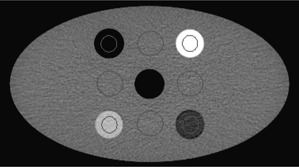
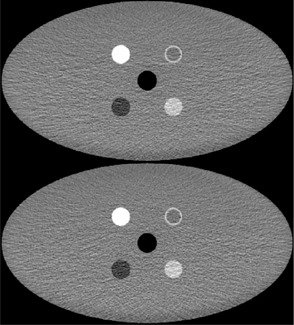
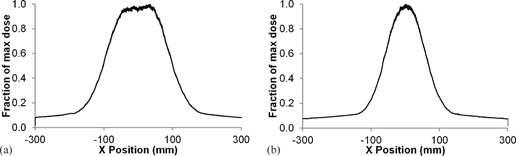
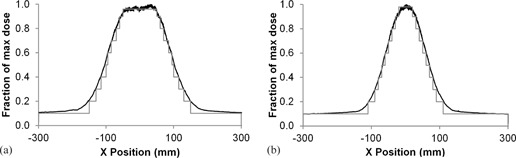
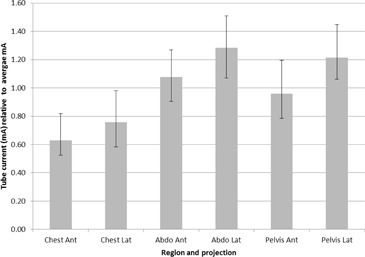
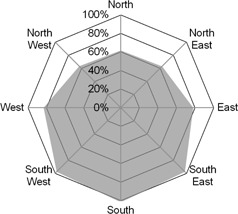
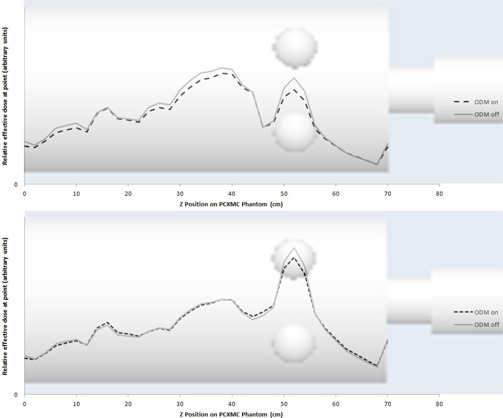
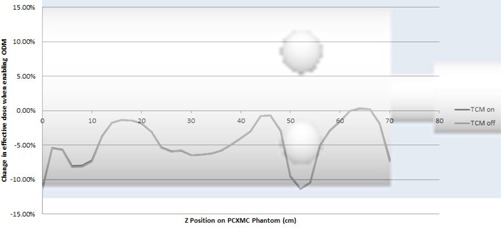
Organ Dose Modulation or ODM (GE Healthcare, Milwaukee, WI) was evaluated to characterize changes in CTDIvol, image noise, effective dose, and organ dose saving to patients. Three separate investigations were completed: a tube current modulation phantom was scanned with and without ODM, a CTDIvol phantom was scanned with ODM, and Monte Carlo simulations were performed. ODM was found to reduce the CTDIvol by approximately 20% whilst increasing the noise by approximately 14%. This was reflected in the dose distribution, where the anterior peripheral dose was reduced by approximately 40% whilst the identical poste-rior dose remained largely unaffected. Enabling ODM for the entire scan would reduce the effective dose by approximately 24%; however, this saving reduces to 5% if the images are matched for CTDIvol. These savings mostly originated from reductions in dose to the stomach, breasts, colon, bladder, and liver. ODM has the effect of a global reduction in CTDIvol with an associated increase in image noise. The benefit of ODM was found to be reduced when the dose-saving contribution from the reduced CTDIvol was removed. Given that there is a higher contribution to effective dose throughout the body from the anterior projections, consideration should be given to applying ODM throughout.
对器官剂量调制(ODM,通用电气医疗集团,威斯康星州密尔沃基)进行了评估,以表征容积CT剂量指数(CTDIvol)、图像噪声、有效剂量的变化以及对患者器官剂量的节省情况。完成了三项独立研究:对管电流调制体模在有和没有ODM的情况下进行扫描,对CTDIvol体模在有ODM的情况下进行扫描,并进行了蒙特卡洛模拟。结果发现,ODM可使CTDIvol降低约20%,同时使噪声增加约14%。这在剂量分布中得到体现,其中前周边剂量降低了约40%,而后部相同剂量基本未受影响。在整个扫描过程中启用ODM可使有效剂量降低约24%;然而,如果根据CTDIvol匹配图像,这种节省会降至5%。这些节省主要源于胃、乳房、结肠、膀胱和肝脏的剂量减少。ODM具有全局降低CTDIvol并伴随图像噪声增加的效果。当去除CTDIvol降低带来的剂量节省贡献时,发现ODM的益处会降低。鉴于前部投影对全身有效剂量的贡献更高,应考虑在整个过程中应用ODM。