
一种基于沃利斯闪避和高斯距离权重增强的无人机图像高效去缝方法。
An Efficient Seam Elimination Method for UAV Images Based on Wallis Dodging and Gaussian Distance Weight Enhancement.
作者信息
Tian Jinyan, Li Xiaojuan, Duan Fuzhou, Wang Junqian, Ou Yang
机构信息
Beijing Key Laboratory for Geographic Information Systems and Environment and Resources, Capital Normal University, Beijing 100048, China.
Department of Geography and Environmental Management, University of Waterloo, Waterloo, ON N2L 2R7, Canada.
出版信息
Sensors (Basel). 2016 May 10;16(5):662. doi: 10.3390/s16050662.
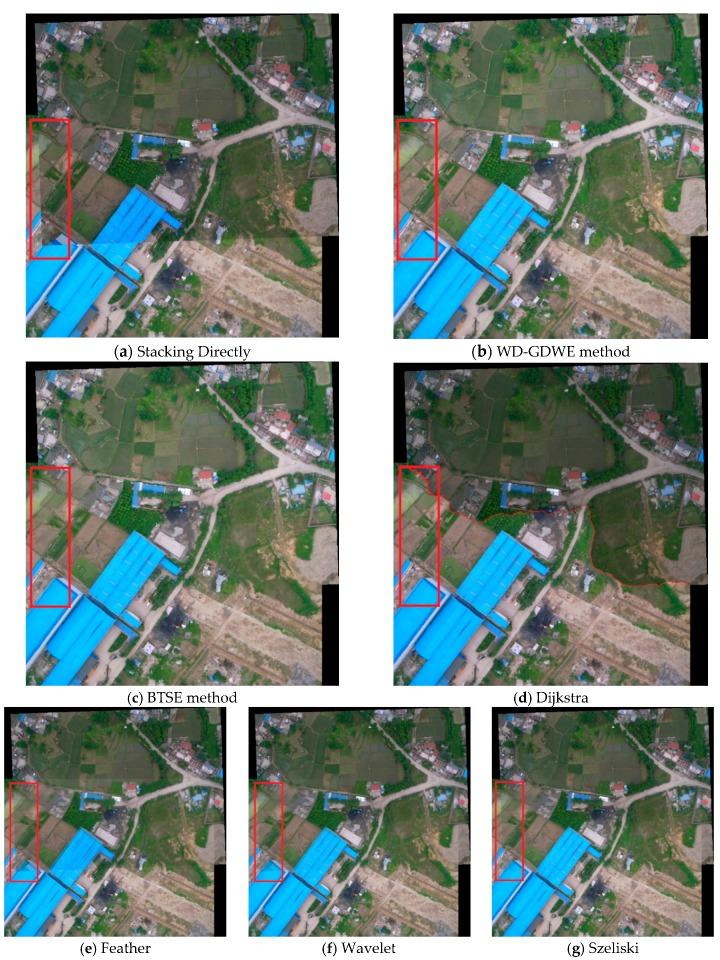
The rapid development of Unmanned Aerial Vehicle (UAV) remote sensing conforms to the increasing demand for the low-altitude very high resolution (VHR) image data. However, high processing speed of massive UAV data has become an indispensable prerequisite for its applications in various industry sectors. In this paper, we developed an effective and efficient seam elimination approach for UAV images based on Wallis dodging and Gaussian distance weight enhancement (WD-GDWE). The method encompasses two major steps: first, Wallis dodging was introduced to adjust the difference of brightness between the two matched images, and the parameters in the algorithm were derived in this study. Second, a Gaussian distance weight distribution method was proposed to fuse the two matched images in the overlap region based on the theory of the First Law of Geography, which can share the partial dislocation in the seam to the whole overlap region with an effect of smooth transition. This method was validated at a study site located in Hanwang (Sichuan, China) which was a seriously damaged area in the 12 May 2008 enchuan Earthquake. Then, a performance comparison between WD-GDWE and the other five classical seam elimination algorithms in the aspect of efficiency and effectiveness was conducted. Results showed that WD-GDWE is not only efficient, but also has a satisfactory effectiveness. This method is promising in advancing the applications in UAV industry especially in emergency situations.
无人机遥感技术的快速发展顺应了对低空超高分辨率(VHR)图像数据日益增长的需求。然而,海量无人机数据的高处理速度已成为其在各行业领域应用不可或缺的前提条件。在本文中,我们基于沃利斯闪避和高斯距离权重增强(WD - GDWE)开发了一种有效且高效的无人机图像拼接消除方法。该方法包括两个主要步骤:首先,引入沃利斯闪避来调整两幅匹配图像之间的亮度差异,并在本研究中推导了算法中的参数。其次,基于地理第一定律提出了一种高斯距离权重分布方法,用于在重叠区域融合两幅匹配图像,该方法可将拼接处的部分错位分摊到整个重叠区域,实现平滑过渡效果。此方法在位于中国四川汉旺的一个研究区域得到验证,该区域是2008年5月12日汶川地震中的严重受损地区。然后,在效率和效果方面对WD - GDWE与其他五种经典的拼接消除算法进行了性能比较。结果表明,WD - GDWE不仅效率高,而且效果令人满意。该方法在推动无人机行业应用尤其是在紧急情况下具有广阔前景。



 Zotero 插件