Meseure Didier, Vacher Sophie, Lallemand François, Alsibai Kinan Drak, Hatem Rana, Chemlali Walid, Nicolas Andre, De Koning Leanne, Pasmant Eric, Callens Celine, Lidereau Rosette, Morillon Antonin, Bieche Ivan
Department of Genetics, Unit of Pharmacogenetics, Institut Curie, 26 rue d'Ulm, Paris Cedex F-75248, France.
Department of Pathology, Platform of Investigative Pathology, Institut Curie, 26 rue d'Ulm, Paris Cedex F-75248, France.
Br J Cancer. 2016 Jun 14;114(12):1395-404. doi: 10.1038/bjc.2016.123. Epub 2016 May 12.
Epigenetic deregulation is considered as a new hallmark of cancer. The long non-coding RNA MALAT1 has been implicated in several cancers; however, its role in breast cancer is still little known.
We used RT-PCR, in situ hybridisation, and RPPA methods to quantify (i) the full-length (FL) and an alternatively spliced variant (Δsv) of MALAT1, and (ii) a panel of transcripts and proteins involved in MALAT1 pathways, in a large series of breast tumours from patients with known clinical/pathological status and long-term outcome.
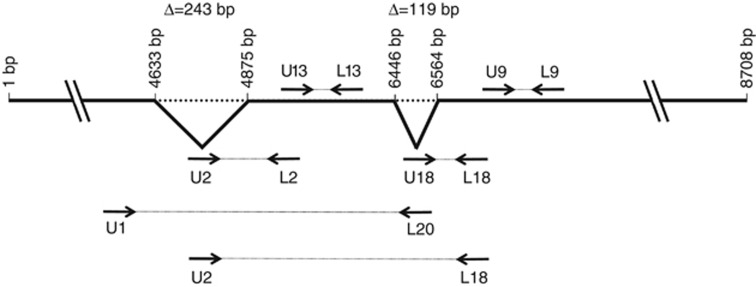
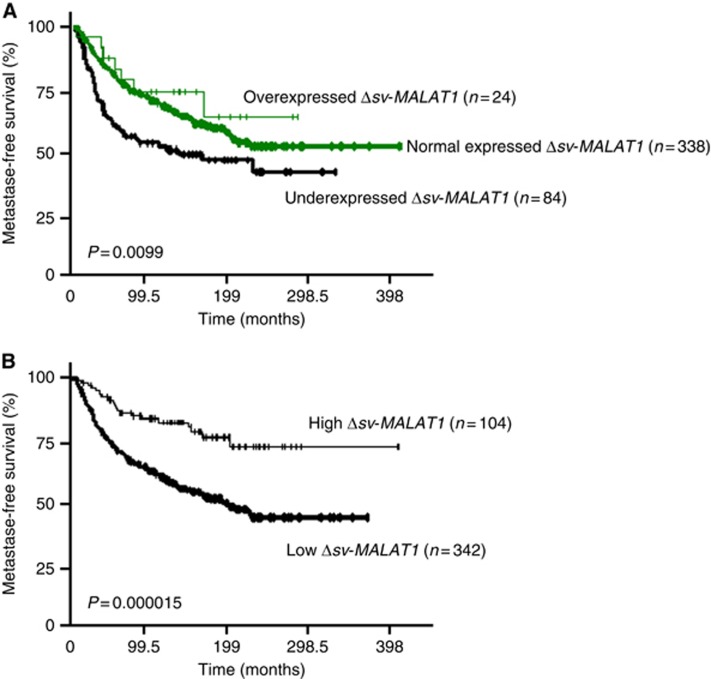
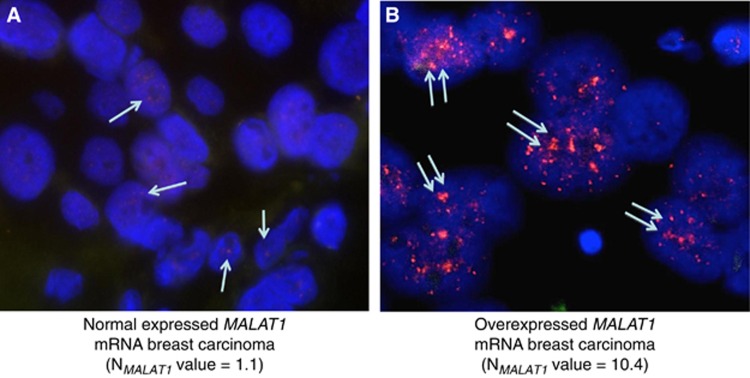
MALAT1 was overexpressed in 14% (63/446) of the breast tumours. MALAT1-overexpressed tumour epithelial cells showed marked diffuse nuclear signals and numerous huge nuclear speckles. Screening of the dbEST database led to the identification of Δsv-MALAT1, a major alternatively spliced MALAT1 transcript, with a very different expression pattern compared with FL-MALAT1. This alternative Δsv-MALAT1 transcript was mainly underexpressed (18.8%) in our breast tumour series. Multivariate analysis showed that alternative Δsv-MALAT1 transcript is an independent prognostic factor. Δsv-MALAT1 expression was associated with alterations of the pre-mRNAs alternative splicing machinery, and of the Drosha-DGCR8 complex required for non-coding RNA biogenesis. Alternative Δsv-MALAT1 transcript expression was associated to YAP protein status and with an activation of the PI3K-AKT pathway.
Our results reveal a complex expression pattern of various MALAT1 transcript variants in breast tumours, and suggest that this pattern of expressions should be taken into account to evaluate MALAT1 as predictive biomarker and therapeutic target.
表观遗传失调被认为是癌症的一个新特征。长链非编码RNA MALAT1与多种癌症有关;然而,其在乳腺癌中的作用仍鲜为人知。
我们使用逆转录聚合酶链反应(RT-PCR)、原位杂交和反向蛋白质阵列分析(RPPA)方法,对来自已知临床/病理状态和长期预后的患者的大量乳腺肿瘤样本进行分析,以定量(i)MALAT1的全长(FL)和一个可变剪接变体(Δsv),以及(ii)参与MALAT1通路的一组转录本和蛋白质。
14%(63/446)的乳腺肿瘤中MALAT1过表达。MALAT1过表达的肿瘤上皮细胞显示出明显的弥漫性核信号和大量巨大的核斑点。对dbEST数据库的筛选导致鉴定出Δsv-MALAT1,这是一种主要的可变剪接MALAT1转录本,其表达模式与FL-MALAT1非常不同。这种替代性的Δsv-MALAT1转录本在我们的乳腺肿瘤系列中主要表达不足(18.8%)。多变量分析表明,替代性的Δsv-MALAT1转录本是一个独立的预后因素。Δsv-MALAT1的表达与前体mRNA可变剪接机制以及非编码RNA生物合成所需的Drosha-DGCR8复合物的改变有关。替代性的Δsv-MALAT1转录本表达与YAP蛋白状态以及PI3K-AKT通路的激活有关。
我们的结果揭示了乳腺肿瘤中各种MALAT1转录本变体的复杂表达模式,并表明在评估MALAT1作为预测生物标志物和治疗靶点时应考虑这种表达模式。