
中国北京婴儿贫血危险因素的卡方自动交互检测决策树分析
Chi-squared Automatic Interaction Detection Decision Tree Analysis of Risk Factors for Infant Anemia in Beijing, China.
作者信息
Ye Fang, Chen Zhi-Hua, Chen Jie, Liu Fang, Zhang Yong, Fan Qin-Ying, Wang Lin
机构信息
Department of Preventive Health Care, China-Japan Friendship Hospital, Beijing 100029, China.
Department of Biochemistry and Molecular Biology, China-Japan Institute of Clinical Medical Science, Beijing 100029, China.
出版信息
Chin Med J (Engl). 2016 May 20;129(10):1193-9. doi: 10.4103/0366-6999.181955.
BACKGROUND
In the past decades, studies on infant anemia have mainly focused on rural areas of China. With the increasing heterogeneity of population in recent years, available information on infant anemia is inconclusive in large cities of China, especially with comparison between native residents and floating population. This population-based cross-sectional study was implemented to determine the anemic status of infants as well as the risk factors in a representative downtown area of Beijing.
METHODS
As useful methods to build a predictive model, Chi-squared automatic interaction detection (CHAID) decision tree analysis and logistic regression analysis were introduced to explore risk factors of infant anemia. A total of 1091 infants aged 6-12 months together with their parents/caregivers living at Heping Avenue Subdistrict of Beijing were surveyed from January 1, 2013 to December 31, 2014.
RESULTS
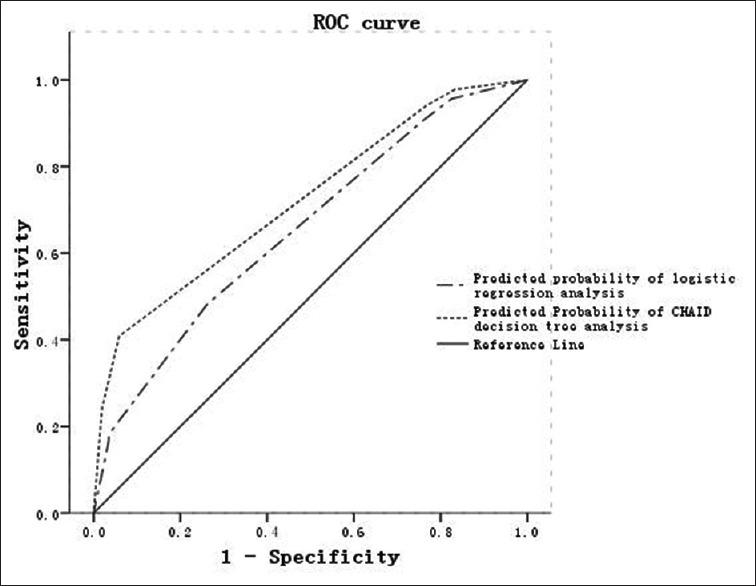
The prevalence of anemia was 12.60% with a range of 3.47%-40.00% in different subgroup characteristics. The CHAID decision tree model has demonstrated multilevel interaction among risk factors through stepwise pathways to detect anemia. Besides the three predictors identified by logistic regression model including maternal anemia during pregnancy, exclusive breastfeeding in the first 6 months, and floating population, CHAID decision tree analysis also identified the fourth risk factor, the maternal educational level, with higher overall classification accuracy and larger area below the receiver operating characteristic curve.
CONCLUSIONS
The infant anemic status in metropolis is complex and should be carefully considered by the basic health care practitioners. CHAID decision tree analysis has demonstrated a better performance in hierarchical analysis of population with great heterogeneity. Risk factors identified by this study might be meaningful in the early detection and prompt treatment of infant anemia in large cities.
背景
在过去几十年中,关于婴儿贫血的研究主要集中在中国农村地区。近年来,随着人口异质性的增加,中国大城市中有关婴儿贫血的现有信息尚无定论,尤其是本地居民与流动人口之间的比较。本基于人群的横断面研究旨在确定北京一个具有代表性的市中心地区婴儿的贫血状况及其危险因素。
方法
作为构建预测模型的有效方法,引入卡方自动交互检测(CHAID)决策树分析和逻辑回归分析来探索婴儿贫血的危险因素。2013年1月1日至2014年12月31日,对居住在北京和平大街街道的1091名6至12个月大的婴儿及其父母/照顾者进行了调查。
结果
贫血患病率为12.60%,不同亚组特征的患病率范围为3.47%-40.00%。CHAID决策树模型通过逐步检测贫血的途径展示了危险因素之间的多级相互作用。除了逻辑回归模型确定的三个预测因素,即孕期母亲贫血、前6个月纯母乳喂养和流动人口外,CHAID决策树分析还确定了第四个危险因素,即母亲的教育水平,其总体分类准确率更高,受试者工作特征曲线下面积更大。
结论
大城市中婴儿的贫血状况较为复杂,基层医疗保健从业者应予以认真考虑。CHAID决策树分析在对异质性较大的人群进行分层分析方面表现出更好的性能。本研究确定的危险因素可能对大城市婴儿贫血的早期发现和及时治疗具有重要意义。

 Zotero 插件