Li Qinrui, Liang Furong, Liang Weilan, Zhang Jing, Niu Manman, Han Ying
Department of Pediatrics, Peking University First Hospital, Beijing, China.
Department of Child Health Care, Peking University First Hospital, Beijing, China.
Front Pediatr. 2017 Nov 16;5:243. doi: 10.3389/fped.2017.00243. eCollection 2017.
An increasing number of parents in China ask grandparents or babysitters to care for their children. Modern parents are often the only child in their family because of China's One-Child Policy and thus may lack interaction with siblings. Accordingly, the present study aimed to explore whether different caregivers affect the physical and development of infants in China.
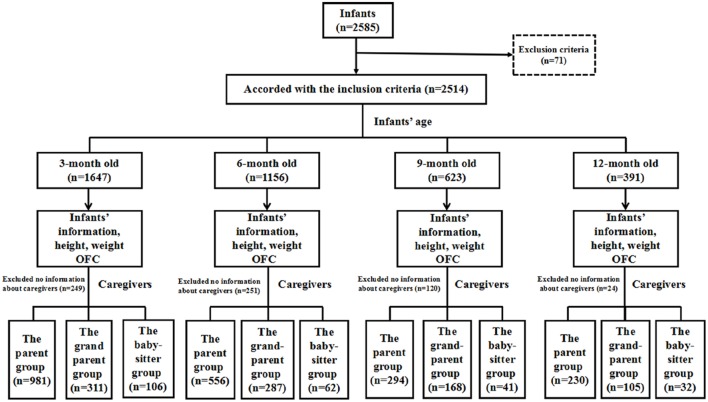
In total, 2,514 infants were enrolled in our study. We assessed their weight-for-age, supine length-for-age, weight-for-length, occipital-frontal circumference, and Denver Developmental Screening Test (DDST) results and recorded their general parental information and their primary caregivers.
The weights and lengths of 12-month-old infants under the care of babysitters were significantly lower than those of infants under the care of parents or grandparents ( < 0.05). Additionally, 12-month-old infants under the care of babysitters had the lowest DDST pass rate (75%) among the three groups (χ = 11.819, = 0.012), especially for the fine motor-adaptive and language domains. Compared to 12-month-old infants under the care of parents and babysitters, infants under the care of grandparents were more likely to be overweight or obese ( < 0.001).
The study showed that caregivers had a dominant role in the physical and cognitive development of the infants. Specifically, compared with infants raised by grandparents and parents, 12-month-old infants under the care of babysitters had partially suppressed lengths and weights and lagged cognitively. The 12-month-old infants under the care of grandparents were more overweight than those cared for by parents and babysitters.
在中国,越来越多的父母让祖父母或保姆照顾孩子。由于中国的独生子女政策,现代父母往往是家中的独子,因此可能缺乏与兄弟姐妹的互动。因此,本研究旨在探讨不同的照顾者是否会影响中国婴儿的身体和发育。
本研究共纳入2514名婴儿。我们评估了他们的年龄别体重、年龄别身长、身长别体重、枕额周长以及丹佛发育筛查测试(DDST)结果,并记录了他们的一般父母信息和主要照顾者。
保姆照顾下的12个月大婴儿的体重和身长明显低于父母或祖父母照顾下的婴儿(<0.05)。此外,保姆照顾下的12个月大婴儿在三组中的DDST通过率最低(75%)(χ=11.819,=0.012),尤其是在精细运动-适应性和语言领域。与父母和保姆照顾下的12个月大婴儿相比,祖父母照顾下的婴儿更有可能超重或肥胖(<0.001)。
研究表明,照顾者在婴儿的身体和认知发育中起主导作用。具体而言,与由祖父母和父母抚养的婴儿相比,保姆照顾下的12个月大婴儿的身长和体重部分受到抑制,认知能力滞后。祖父母照顾下的12个月大婴儿比父母和保姆照顾的婴儿更超重。