Choi Yoon Jin, Kim Nayoung, Kim Jinjoo, Lee Dong Ho, Park Ji Hyun, Jung Hyun Chae
From the Department of Internal Medicine and Seoul National University Bundang Hospital, Seongnam, Gyeonggi-do (YJC, NK, DHL); and Department of Internal Medicine and Liver Research Institute, Seoul National University College of Medicine, Seoul (NK, JK, DHL, JHP, HCJ), South Korea.
Medicine (Baltimore). 2016 May;95(19):e3410. doi: 10.1097/MD.0000000000003410.
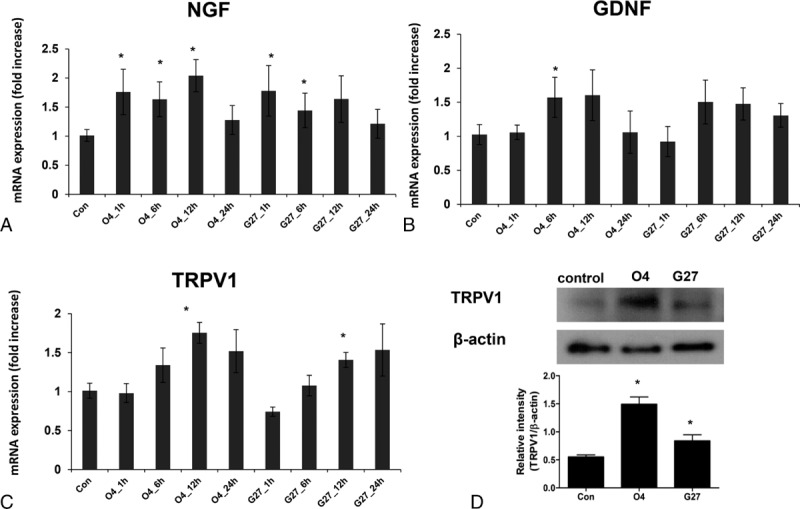
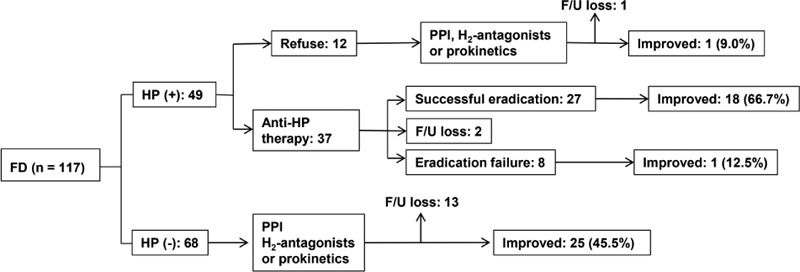
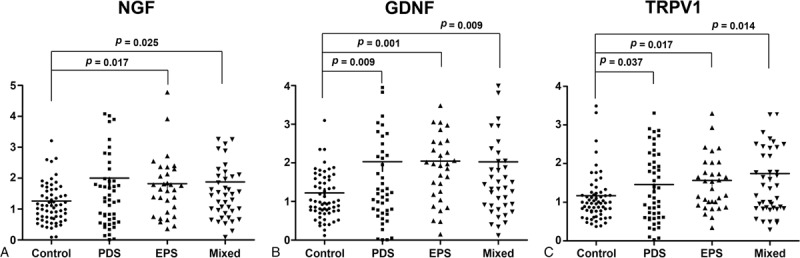
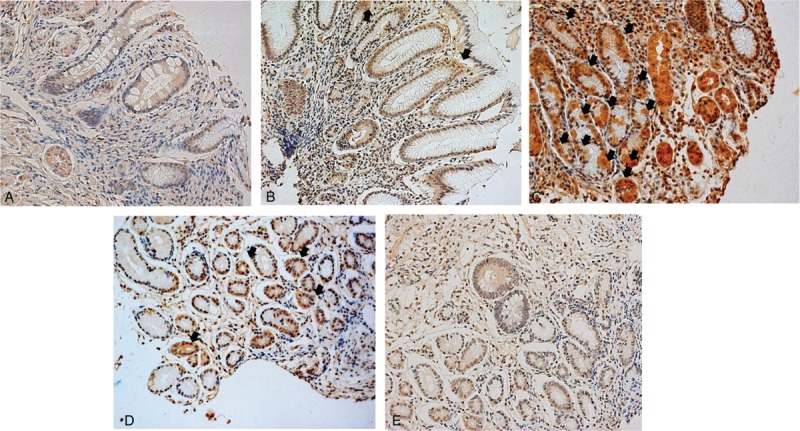
The etiological basis of functional dyspepsia (FD) is incompletely understood. The aim of this study was to evaluate the involvement of nociceptor-related genes and Helicobacter pylori (HP) in the pathogenesis of FD. The expression of nociceptor-related genes was measured in gastric cell lines that were co-cultured with HP. FD patients (n = 117) and controls (n = 55) were enrolled from a tertiary hospital gastroenterology clinic. Expression of the genes nerve growth factor (NGF), glial cell line-derived neurotrophic factor (GDNF), and transient receptor potential cation channel subfamily V member 1 (TRPV1) in the gastric mucosa were detected by reverse transcription polymerase chain reaction (RT-PCR), and immunohistochemical staining of TRPV1 was analyzed. These measurements were repeated after 1 year. TRPV1, GDNF, and NGF expression was elevated in gastric cell lines co-cultured with HP. TRPV1 immunostaining was stronger in HP-positive than HP-negative subjects. The FD group showed higher expression levels of TRPV1, GDNF, and NGF and increased TRPV1 immunostaining compared with those of the control group (all P < 0.05). Among 61 subjects who were followed up at 1 year, controls with successful HP eradication and patients whose symptoms had improved both showed significant reductions in the expression of TRPV1 and NGF (all P < 0.05) compared with controls without HP eradication and patients whose symptoms had not improved, respectively. The expression of NGF, GDNF, and TRPV1 may be associated with the pathogenesis of FD. Since HP infection may induce the increased expression of these genes, anti-HP therapy could be beneficial for HP-positive patients with FD.
功能性消化不良(FD)的病因基础尚未完全明确。本研究旨在评估伤害感受器相关基因和幽门螺杆菌(HP)在FD发病机制中的作用。在与HP共培养的胃细胞系中检测伤害感受器相关基因的表达。从一家三级医院的胃肠病诊所招募了FD患者(n = 117)和对照组(n = 55)。通过逆转录聚合酶链反应(RT-PCR)检测胃黏膜中神经生长因子(NGF)、胶质细胞源性神经营养因子(GDNF)和瞬时受体电位阳离子通道亚家族V成员1(TRPV1)基因的表达,并分析TRPV1的免疫组化染色情况。1年后重复这些测量。与HP共培养的胃细胞系中TRPV1、GDNF和NGF的表达升高。HP阳性受试者的TRPV1免疫染色比HP阴性受试者更强。与对照组相比,FD组的TRPV1、GDNF和NGF表达水平更高,TRPV1免疫染色增加(所有P < 0.05)。在1年随访的61名受试者中,成功根除HP的对照组和症状改善的患者与未根除HP的对照组和症状未改善的患者相比,TRPV1和NGF的表达均显著降低(所有P < 0.05)。NGF、GDNF和TRPV1的表达可能与FD的发病机制有关。由于HP感染可能诱导这些基因的表达增加,抗HP治疗可能对HP阳性的FD患者有益。