Yi Bo, Huang Gan, Zhou Zhiguang
Institute of Metabolism and Endocrinology, 2nd Xiangya Hospital, Central South University, Key Laboratory of Diabetes Immunology, Ministry of Education, National Clinical Research Center for Metabolic Diseases, Changsha, Hunan, China.
J Diabetes Investig. 2016 Jul;7(4):459-65. doi: 10.1111/jdi.12441. Epub 2016 Jan 9.
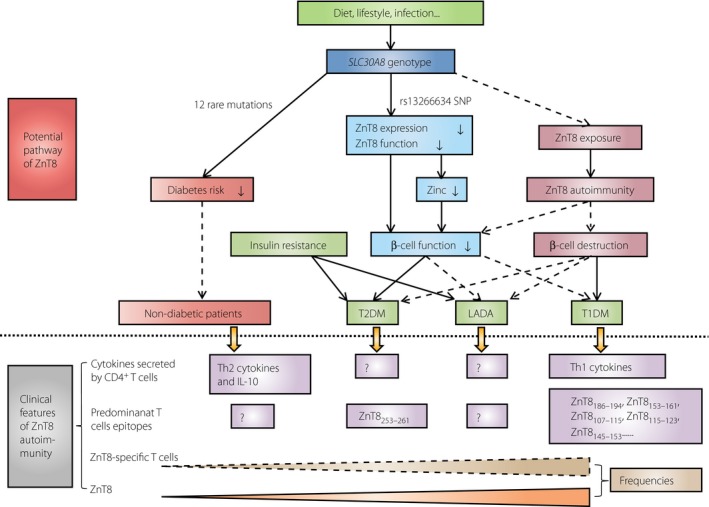
Diabetes can be simply classified into type 1 diabetes mellitus and type 2 diabetes mellitus. Zinc transporter 8 (ZnT8), a novel islet autoantigen, is specifically expressed in insulin-containing secretory granules of β-cells. Genetic studies show that the genotypes of SLC30A8 can determine either protective or diabetogenic response depending on environmental and lifestyle factors. The ZnT8 protein expression, as well as zinc content in β-cells, was decreased in diabetic mice. Thus, ZnT8 might participate in insulin biosynthesis and release, and subsequently involved deteriorated β-cell function through direct or indirect mechanisms in type 1 diabetes mellitus and type 2 diabetes mellitus. From a clinical feature standpoint, the prevalence of ZnT8A is gradiently increased in type 2 diabetes mellitus, latent autoimmune diabetes in adults and type 1 diabetes mellitus. The frequency and epitopes of ZnT8-specific T cells and cytokine release by ZnT8-specific T cells are also different in diabetic patients and healthy controls. Additionally, the response to ZnT8 administration is also different in type 1 diabetes mellitus and type 2 diabetes mellitus. In the present review, we summarize the literature about clinical aspects of ZnT8 in the pathogenesis of diabetes, and suggest that ZnT8 might play a different role between type 1 diabetes mellitus and type 2 diabetes mellitus.
糖尿病可简单分为1型糖尿病和2型糖尿病。锌转运体8(ZnT8)是一种新的胰岛自身抗原,在β细胞含胰岛素的分泌颗粒中特异性表达。遗传学研究表明,根据环境和生活方式因素,溶质载体家族30成员8(SLC30A8)的基因型可决定产生保护性或致糖尿病的反应。糖尿病小鼠的ZnT8蛋白表达以及β细胞中的锌含量均降低。因此,ZnT8可能参与胰岛素的生物合成和释放,并随后通过直接或间接机制参与1型糖尿病和2型糖尿病中β细胞功能的恶化。从临床特征的角度来看,ZnT8自身抗体(ZnT8A)在2型糖尿病、成人隐匿性自身免疫糖尿病和1型糖尿病中的患病率呈逐渐上升趋势。糖尿病患者和健康对照者中,ZnT8特异性T细胞的频率和表位以及ZnT8特异性T细胞释放的细胞因子也有所不同。此外,1型糖尿病和2型糖尿病对ZnT8给药的反应也不同。在本综述中,我们总结了有关ZnT8在糖尿病发病机制中临床方面的文献,并提出ZnT8在1型糖尿病和2型糖尿病中可能发挥不同作用。