Halvorsen Ann Rita, Bjaanæs Maria, LeBlanc Marissa, Holm Are M, Bolstad Nils, Rubio Luis, Peñalver Juan Carlos, Cervera José, Mojarrieta Julia Cruz, López-Guerrero Jose Antonio, Brustugun Odd Terje, Helland Åslaug
Department of Cancer Genetics, Institute for Cancer Research, OUS Radiumhospitalet, Oslo, Norway.
Department of Oncology, OUS Radiumhospitalet, Oslo, Norway.
Oncotarget. 2016 Jun 14;7(24):37250-37259. doi: 10.18632/oncotarget.9363.
Circulating microRNAs are promising biomarkers for diagnosis, predication and prognostication of diseases. Lung cancer is the cancer disease accountable for most cancer deaths, largely due to being diagnosed at late stages. Therefore, diagnosing lung cancer patients at an early stage is crucial for improving the outcome. The purpose of this study was to identify circulating microRNAs for detection of early stage lung cancer, capable of discriminating lung cancer patients from those with chronic obstructive pulmonary disease (COPD) and healthy volunteers.
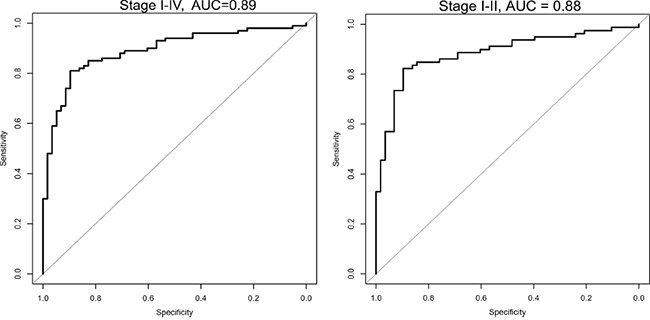
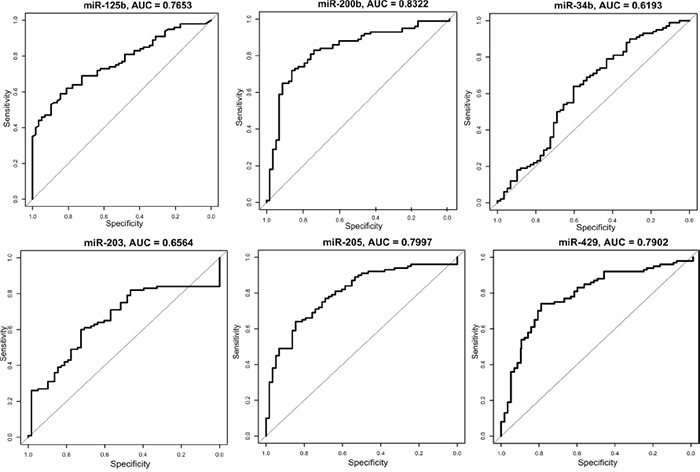
We identified 7 microRNAs separating lung cancer patients from controls. By using RT-qPCR, we validated 6 microRNAs (miR-429, miR-205, miR-200b, miR-203, miR-125b and miR-34b) with a significantly higher abundance in serum from NSCLC patients. Furthermore, the 6 miRNAs were validated in a different dataset, revealing an area under the receiver operating characteristic curve of 0.89 for stage I-IV and 0.88 for stage I/II.
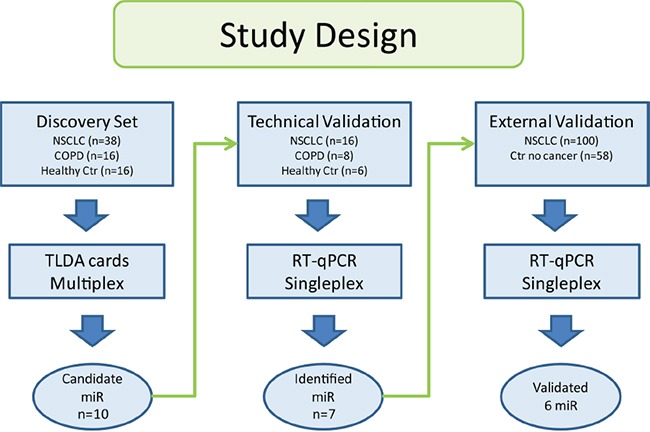
We profiled the expression of 754 unique microRNAs by TaqMan Low Density Arrays, and analyzed serum from 38 patients with NSCLC, 16 patients suffering from COPD and 16 healthy volunteers from Norway, to explore their potential as diagnostic biomarkers. For validation, we analyzed serum collected from high-risk individuals enrolled in the Valencia branch of the International Early Lung Cancer Action Program screening trial (n=107) in addition to 51 lung cancer patients.
Considering the accessibility and stability of circulating miRNAs, these 6 microRNAs are promising biomarkers as a supplement in future screening studies.
循环微RNA是用于疾病诊断、预测和预后评估的有前景的生物标志物。肺癌是导致大多数癌症死亡的癌症疾病,主要原因是其在晚期才被诊断出来。因此,早期诊断肺癌患者对于改善治疗结果至关重要。本研究的目的是鉴定用于检测早期肺癌的循环微RNA,其能够区分肺癌患者与慢性阻塞性肺疾病(COPD)患者及健康志愿者。
我们鉴定出7种可区分肺癌患者与对照组的微RNA。通过逆转录定量聚合酶链反应(RT-qPCR),我们验证了6种微RNA(miR-429、miR-205、miR-200b、miR-203、miR-125b和miR-34b),它们在非小细胞肺癌(NSCLC)患者血清中的丰度显著更高。此外,这6种微RNA在另一个数据集中得到验证,其在I-IV期的受试者工作特征曲线下面积为0.89,在I/II期为0.88。
我们使用TaqMan低密度阵列分析了754种独特微RNA的表达,并分析了来自挪威的38例NSCLC患者、16例COPD患者和16名健康志愿者的血清,以探索它们作为诊断生物标志物的潜力。为进行验证,我们除了分析51例肺癌患者的血清外,还分析了参加国际早期肺癌行动计划筛查试验巴伦西亚分支(n = 107)的高危个体所采集的血清。
考虑到循环微RNA的可获取性和稳定性,这6种微RNA作为未来筛查研究的补充,是很有前景的生物标志物。