Fang Na, Jiang Menglin, Fan Yu
From the Institute of Molecular Biology & Translational Medicine, the Affiliated People's Hospital, Jiangsu University, Zhenjiang, Jiangsu, PR China.
Medicine (Baltimore). 2016 May;95(20):e3576. doi: 10.1097/MD.0000000000003576.
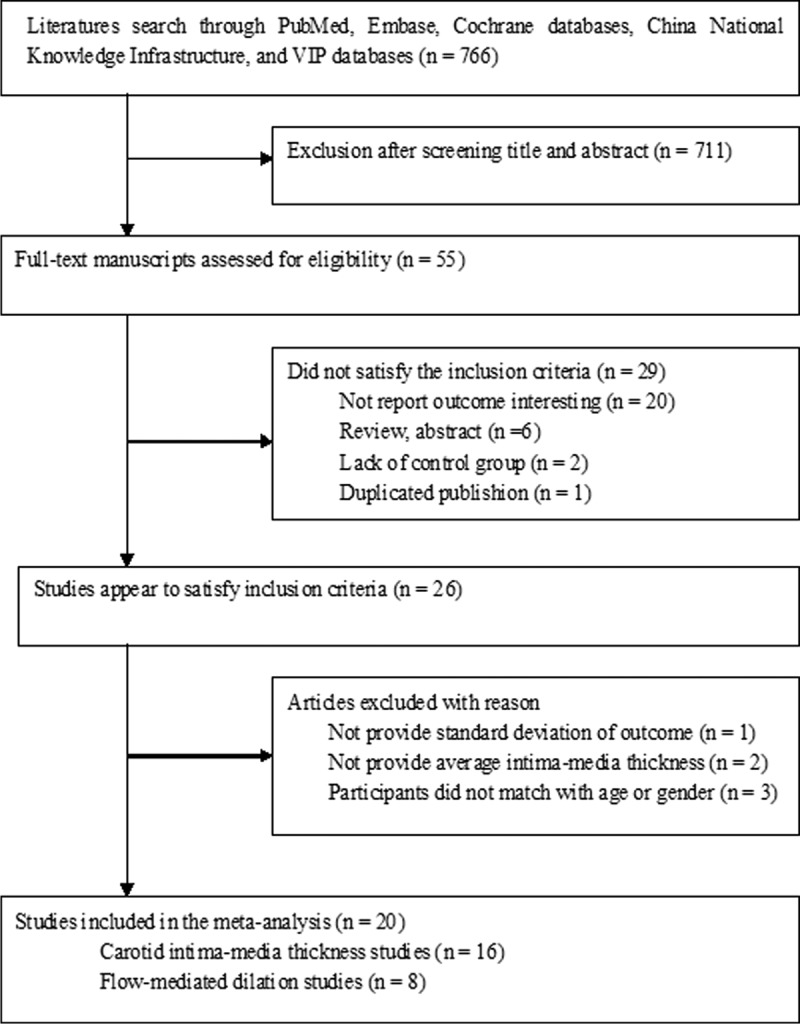
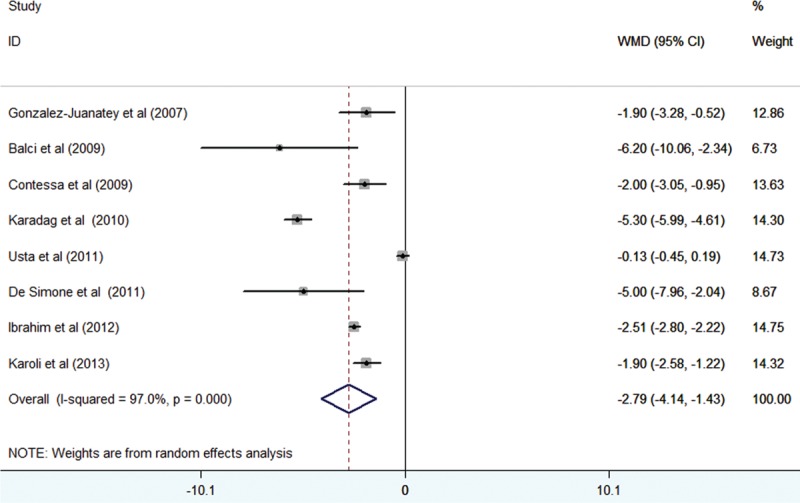
The association between psoriasis and carotid intima-media thickness (CIMT) or impaired flow-mediated dilation (FMD) remains controversial. We aimed to evaluate the extent of subclinical atherosclerosis as measured by CIMT and FMD in patients with psoriasis by conducting a meta-analysis.A systematic literature search was performed using PubMed, Embase, Cochrane databases, China National Knowledge Infrastructure, and VIP databases up to February 2015. Observational studies investigating CIMT or FMD in patients with psoriasis and controls were eligible. Psoriatic patients and controls were at least age- and sex-matched. Random-effects analysis was used to estimate the weighted mean difference (WMD) and 95% confidence interval (CI) between psoriatic patients and controls.A total of 20 studies were identified and analyzed. Meta-analysis showed that psoriatic patients had a significantly thicker CIMT (WMD 0.11 mm; 95% CI 0.08-0.15) and lower FMD (WMD -2.79%; -4.14% to -1.43%) than those in controls. Subgroup analysis indicated that psoriatic arthritis appeared to have less impaired FMD (WMD -2.45%) and thinner CIMT (WMD 0.10 mm). Psoriatic patients with mean age >45 years had much thicker CIMT (WMD 0.13 mm). The impaired FMD (WMD -3.99%) seemed more pronounced in psoriatic patients with mean age <45 years.This meta-analysis suggests that patients with psoriasis are associated with excessive risk of subclinical atherosclerosis. Screening and monitoring CIMT and brachial artery FMD may be recommended to identify a subgroup of psoriatic patients at higher risk for cardiovascular events.
银屑病与颈动脉内膜中层厚度(CIMT)或血流介导的血管舒张功能(FMD)受损之间的关联仍存在争议。我们旨在通过进行一项荟萃分析,评估银屑病患者中通过CIMT和FMD测量的亚临床动脉粥样硬化程度。
使用PubMed、Embase、Cochrane数据库、中国知网和维普数据库进行了系统的文献检索,检索截至2015年2月。纳入调查银屑病患者和对照者的CIMT或FMD的观察性研究。银屑病患者和对照者至少在年龄和性别上匹配。采用随机效应分析估计银屑病患者与对照者之间的加权平均差(WMD)和95%置信区间(CI)。
共识别并分析了20项研究。荟萃分析表明,与对照者相比,银屑病患者的CIMT显著更厚(WMD 0.11mm;95%CI 0.08 - 0.15),FMD更低(WMD -2.79%;-4.14%至-1.43%)。亚组分析表明,银屑病关节炎患者的FMD受损程度似乎较小(WMD -2.45%),CIMT较薄(WMD 0.10mm)。平均年龄>45岁的银屑病患者的CIMT厚得多(WMD 0.13mm)。平均年龄<45岁的银屑病患者中FMD受损(WMD -3.99%)似乎更明显。
这项荟萃分析表明,银屑病患者存在亚临床动脉粥样硬化风险过高的情况。可能建议筛查和监测CIMT和肱动脉FMD,以识别心血管事件风险较高的银屑病患者亚组。