Nourski Kirill V, Steinschneider Mitchell, Rhone Ariane E
Human Brain Research Laboratory, Department of Neurosurgery, The University of Iowa, Iowa City IA, USA.
Departments of Neurology and Neuroscience, Albert Einstein College of Medicine, Bronx NY, USA.
Front Hum Neurosci. 2016 May 4;10:202. doi: 10.3389/fnhum.2016.00202. eCollection 2016.
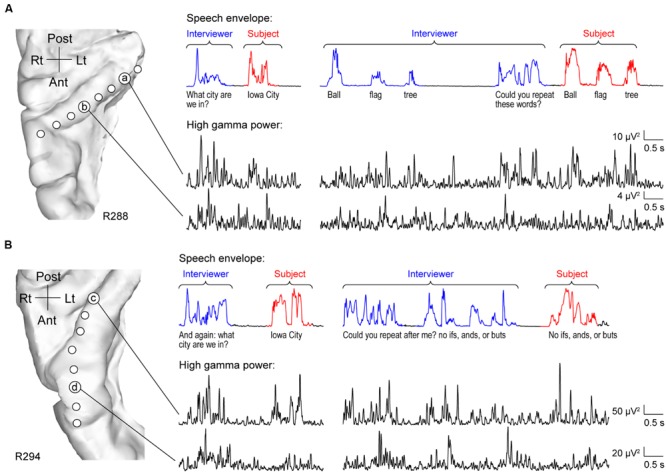
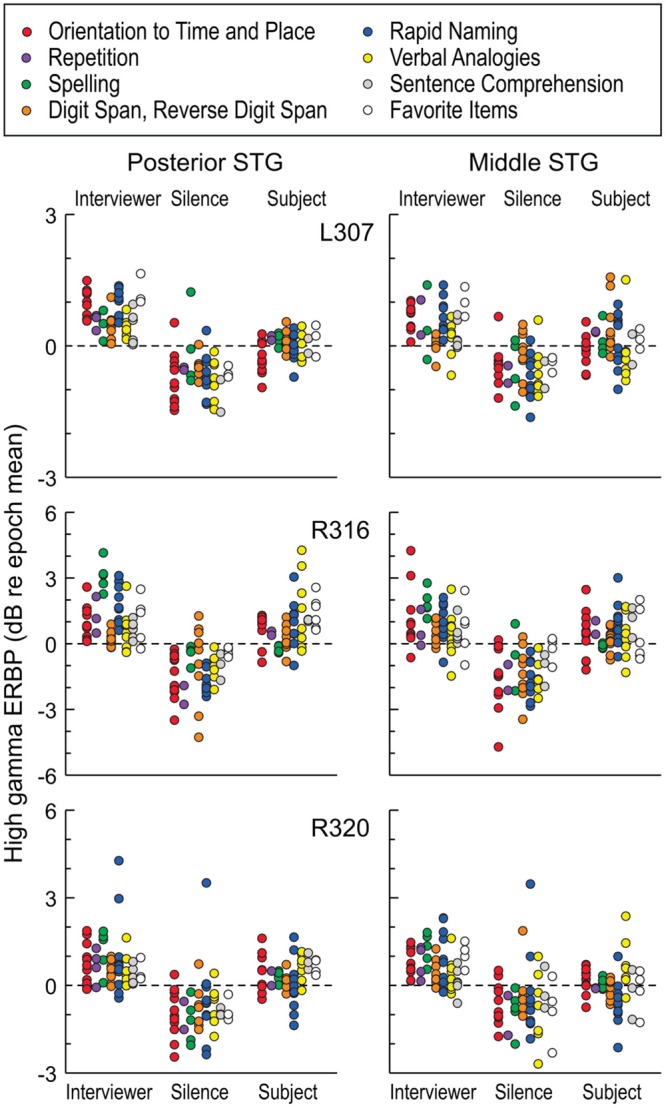
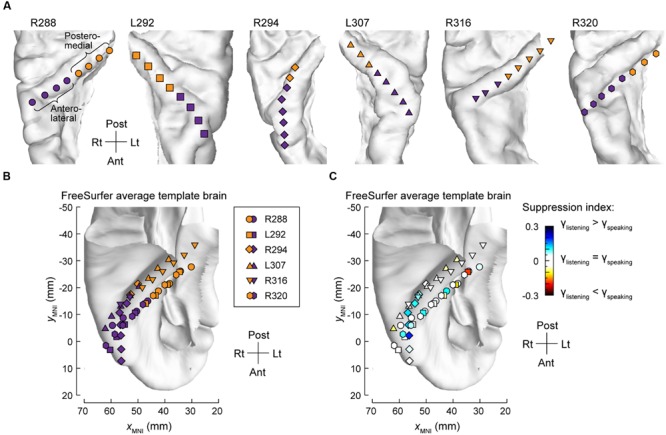
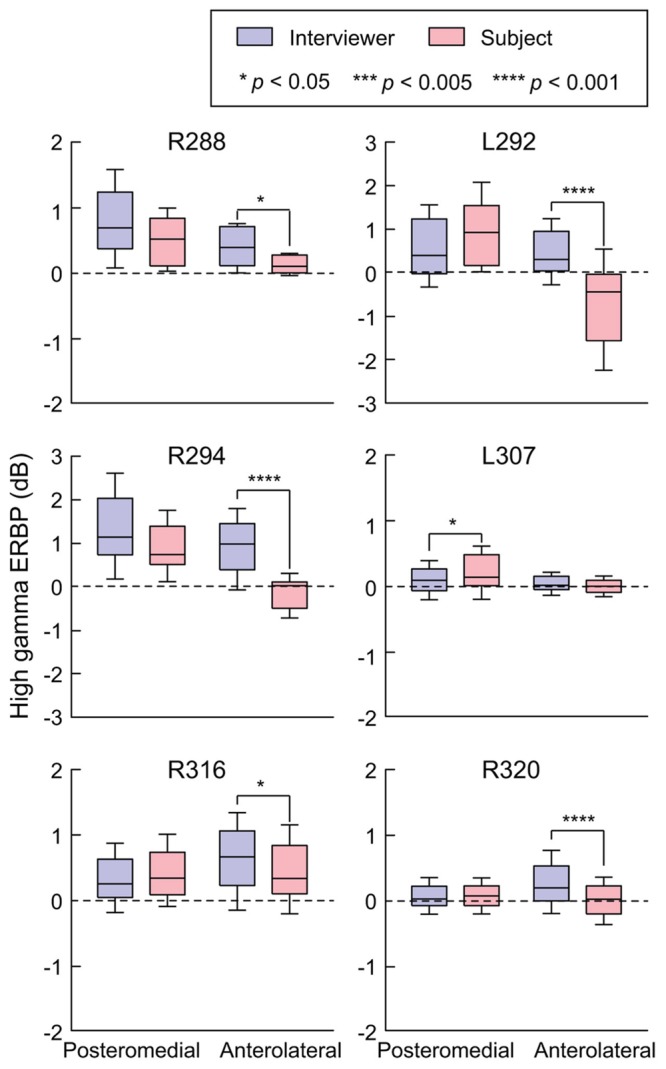
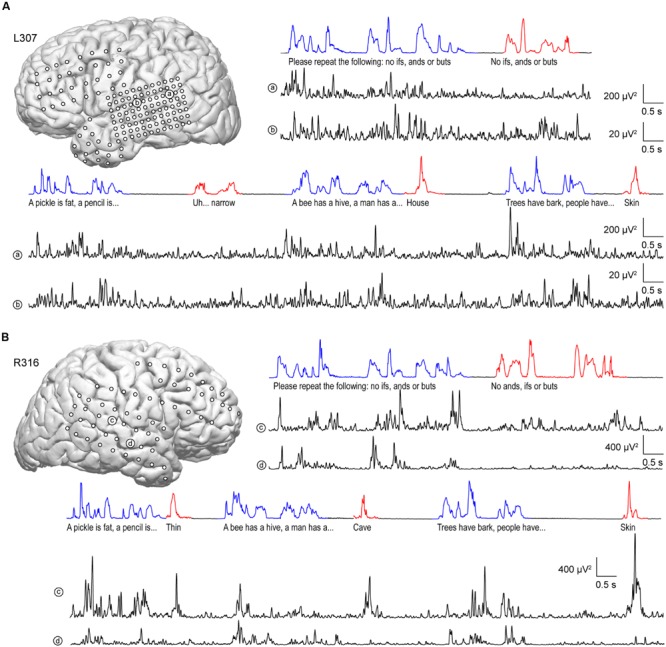
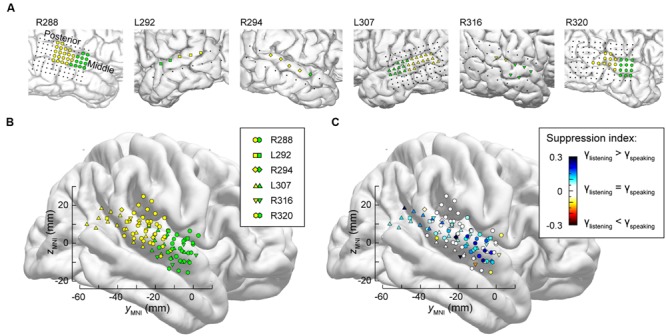
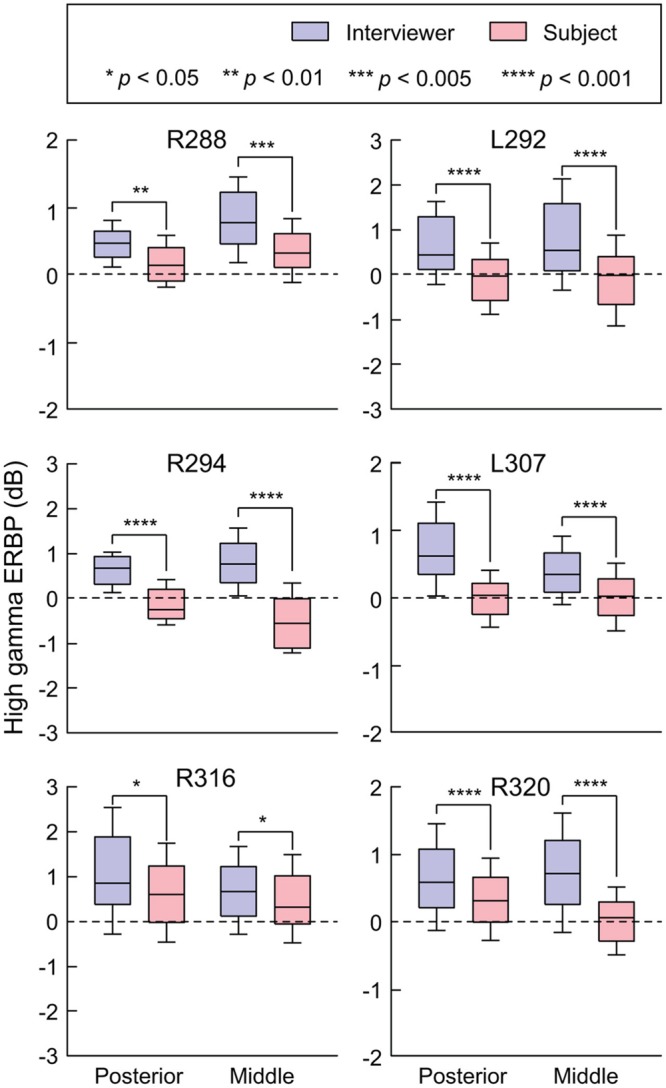
Current models of cortical speech and language processing include multiple regions within the temporal lobe of both hemispheres. Human communication, by necessity, involves complex interactions between regions subserving speech and language processing with those involved in more general cognitive functions. To assess these interactions, we utilized an ecologically salient conversation-based approach. This approach mandates that we first clarify activity patterns at the earliest stages of cortical speech processing. Therefore, we examined high gamma (70-150 Hz) responses within the electrocorticogram (ECoG) recorded simultaneously from Heschl's gyrus (HG) and lateral surface of the superior temporal gyrus (STG). Subjects were neurosurgical patients undergoing evaluation for treatment of medically intractable epilepsy. They performed an expanded version of the Mini-mental state examination (MMSE), which included additional spelling, naming, and memory-based tasks. ECoG was recorded from HG and the STG using multicontact depth and subdural electrode arrays, respectively. Differences in high gamma activity during listening to the interviewer and the subject's self-generated verbal responses were quantified for each recording site and across sites within HG and STG. The expanded MMSE produced widespread activation in auditory cortex of both hemispheres. No significant difference was found between activity during listening to the interviewer's questions and the subject's answers in posteromedial HG (auditory core cortex). A different pattern was observed throughout anterolateral HG and posterior and middle portions of lateral STG (non-core auditory cortical areas), where activity was significantly greater during listening compared to speaking. No systematic task-specific differences in the degree of suppression during speaking relative to listening were found in posterior and middle STG. Individual sites could, however, exhibit task-related variability in the degree of suppression during speaking compared to listening. The current study demonstrates that ECoG recordings can be acquired in time-efficient dialog-based paradigms, permitting examination of language and cognition in an ecologically salient manner. The results obtained from auditory cortex serve as a foundation for future studies addressing patterns of activity beyond auditory cortex that subserve human communication.
当前的皮质言语和语言处理模型包括两个半球颞叶内的多个区域。人类交流必然涉及到负责言语和语言处理的区域与参与更一般认知功能的区域之间的复杂相互作用。为了评估这些相互作用,我们采用了一种基于生态显著对话的方法。这种方法要求我们首先阐明皮质言语处理最早阶段的活动模式。因此,我们检查了从颞横回(HG)和颞上回(STG)外侧表面同时记录的皮质脑电图(ECoG)中的高频伽马(70 - 150赫兹)反应。受试者是因药物难治性癫痫接受治疗评估的神经外科患者。他们进行了扩展版的简易精神状态检查(MMSE),其中包括额外的拼写、命名和基于记忆的任务。分别使用多触点深度电极阵列和硬膜下电极阵列从HG和STG记录ECoG。针对每个记录位点以及HG和STG内的各个位点,对听采访者讲话和受试者自发言语反应期间的高频伽马活动差异进行了量化。扩展版MMSE在两个半球的听觉皮层中产生了广泛激活。在颞横回后内侧(听觉核心皮层),听采访者问题和受试者回答期间的活动没有显著差异。在整个颞横回前外侧以及颞上回外侧的后部和中部(非核心听觉皮层区域)观察到了不同的模式,与说话时相比,听时的活动明显更强。在颞上回后部和中部,未发现说话相对于听时抑制程度的系统性任务特异性差异。然而,与听时相比,个别位点在说话时的抑制程度可能表现出与任务相关的变异性。当前研究表明,可以在基于高效对话的范式中获取ECoG记录,从而能够以生态显著的方式检查语言和认知。从听觉皮层获得的结果为未来研究人类交流背后的听觉皮层以外的活动模式奠定了基础。