Department of Anesthesiology, University of Wisconsin, Madison, Wisconsin, United States of America.
Department of Neuroscience, University of Wisconsin, Madison, Wisconsin, United States of America.
PLoS Biol. 2023 Aug 31;21(8):e3002239. doi: 10.1371/journal.pbio.3002239. eCollection 2023 Aug.
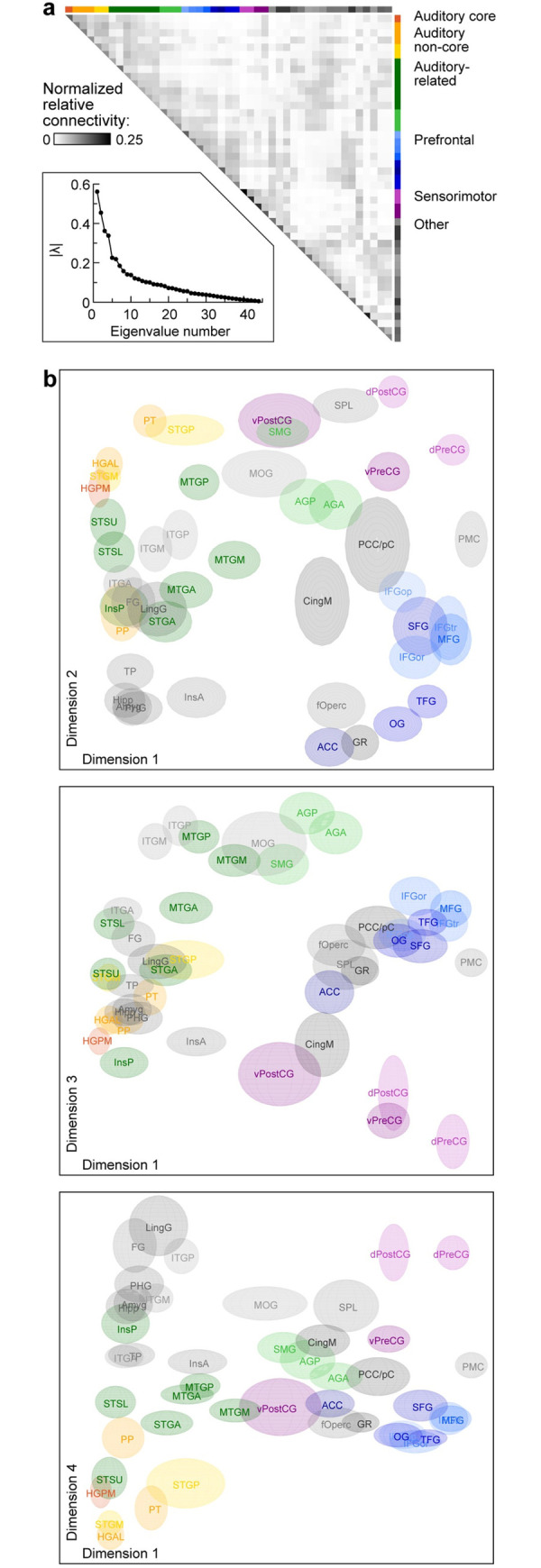
Understanding central auditory processing critically depends on defining underlying auditory cortical networks and their relationship to the rest of the brain. We addressed these questions using resting state functional connectivity derived from human intracranial electroencephalography. Mapping recording sites into a low-dimensional space where proximity represents functional similarity revealed a hierarchical organization. At a fine scale, a group of auditory cortical regions excluded several higher-order auditory areas and segregated maximally from the prefrontal cortex. On mesoscale, the proximity of limbic structures to the auditory cortex suggested a limbic stream that parallels the classically described ventral and dorsal auditory processing streams. Identities of global hubs in anterior temporal and cingulate cortex depended on frequency band, consistent with diverse roles in semantic and cognitive processing. On a macroscale, observed hemispheric asymmetries were not specific for speech and language networks. This approach can be applied to multivariate brain data with respect to development, behavior, and disorders.
理解中枢听觉处理过程的关键在于定义潜在的听觉皮质网络及其与大脑其他部分的关系。我们使用源自人类颅内脑电图的静息状态功能连接来解决这些问题。将记录位点映射到一个低维空间中,其中接近度表示功能相似性,揭示了一个层次结构。在精细尺度上,一组听觉皮质区域排除了几个高级听觉区域,并与前额叶皮质最大程度地分离。在中尺度上,边缘结构与听觉皮层的接近程度表明存在一个边缘流,与经典描述的腹侧和背侧听觉处理流平行。前颞叶和扣带回皮质全局枢纽的身份取决于频带,这与语义和认知处理中的多种作用一致。在宏观尺度上,观察到的半球不对称性并非特定于言语和语言网络。这种方法可以应用于与发育、行为和障碍有关的多变量脑数据。