Yuan Huili, Cheung C Y Maurice, Hilbers Peter A J, van Riel Natal A W
Department of Biomedical Engineering, Eindhoven University of Technology Eindhoven, Netherlands.
Yale-NUS College Singapore, Singapore.
Front Plant Sci. 2016 Apr 26;7:537. doi: 10.3389/fpls.2016.00537. eCollection 2016.
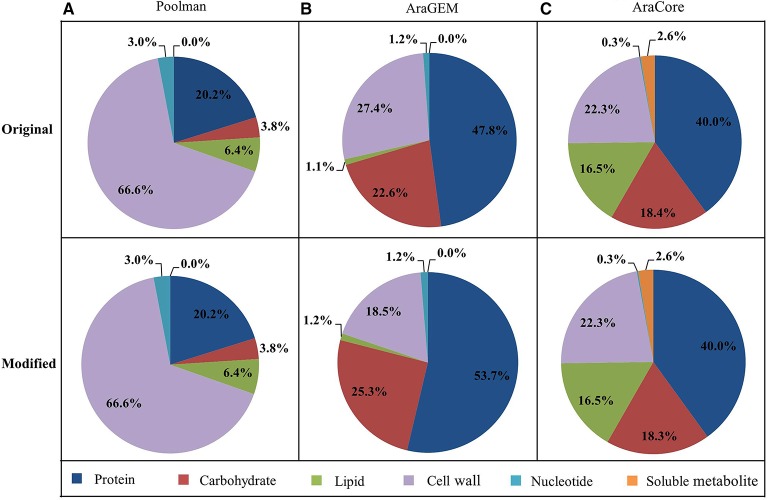
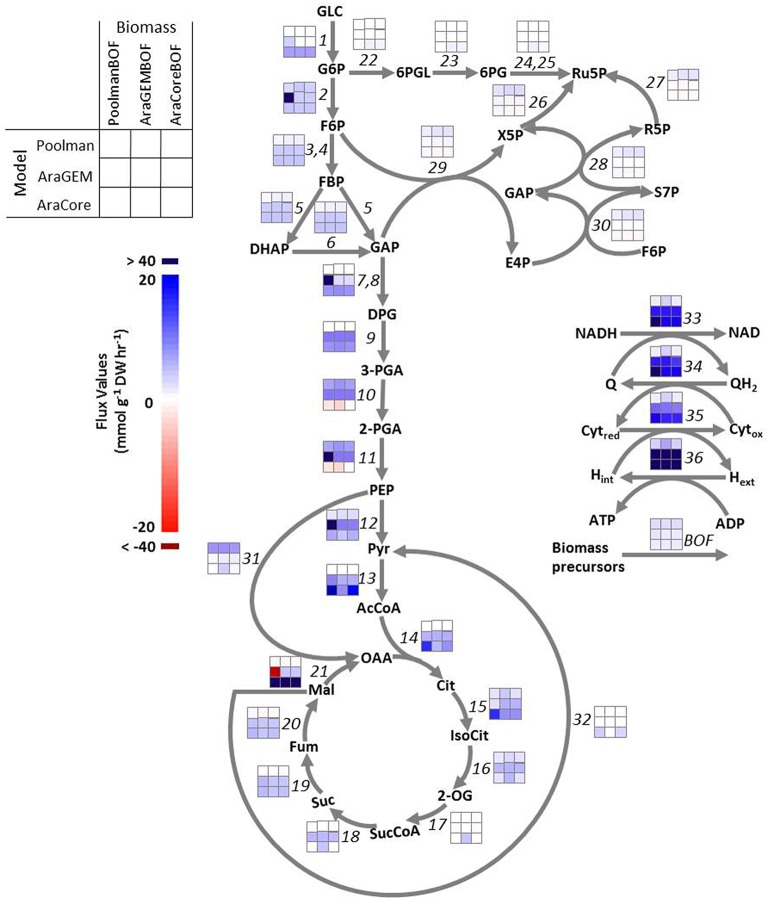
The biomass composition represented in constraint-based metabolic models is a key component for predicting cellular metabolism using flux balance analysis (FBA). Despite major advances in analytical technologies, it is often challenging to obtain a detailed composition of all major biomass components experimentally. Studies examining the influence of the biomass composition on the predictions of metabolic models have so far mostly been done on models of microorganisms. Little is known about the impact of varying biomass composition on flux prediction in FBA models of plants, whose metabolism is very versatile and complex because of the presence of multiple subcellular compartments. Also, the published metabolic models of plants differ in size and complexity. In this study, we examined the sensitivity of the predicted fluxes of plant metabolic models to biomass composition and model structure. These questions were addressed by evaluating the sensitivity of predictions of growth rates and central carbon metabolic fluxes to varying biomass compositions in three different genome-/large-scale metabolic models of Arabidopsis thaliana. Our results showed that fluxes through the central carbon metabolism were robust to changes in biomass composition. Nevertheless, comparisons between the predictions from three models using identical modeling constraints and objective function showed that model predictions were sensitive to the structure of the models, highlighting large discrepancies between the published models.
基于约束的代谢模型中所呈现的生物质组成是使用通量平衡分析(FBA)预测细胞代谢的关键组成部分。尽管分析技术取得了重大进展,但通过实验获得所有主要生物质成分的详细组成往往具有挑战性。迄今为止,研究生物质组成对代谢模型预测影响的研究大多是在微生物模型上进行的。对于生物质组成变化对植物FBA模型中通量预测的影响知之甚少,由于存在多个亚细胞区室,植物的代谢非常多样且复杂。此外,已发表的植物代谢模型在规模和复杂性上存在差异。在本研究中,我们研究了植物代谢模型预测通量对生物质组成和模型结构的敏感性。通过评估拟南芥三种不同的基因组/大规模代谢模型中生长速率和中心碳代谢通量预测对不同生物质组成的敏感性,解决了这些问题。我们的结果表明,通过中心碳代谢的通量对生物质组成的变化具有鲁棒性。然而,使用相同建模约束和目标函数的三个模型预测之间的比较表明,模型预测对模型结构敏感,突出了已发表模型之间的巨大差异。