Young Kymberly D, Preskorn Sheldon H, Victor Teresa, Misaki Masaya, Bodurka Jerzy, Drevets Wayne C
University of Pittsburgh School of Medicine, Pittsburgh, PA (Dr Young) Laureate Institute for Brain Research, Tulsa, OK (Drs Young, Preskorn, Victor, Misaki, Bodurka, and Drevets); Kansas University School of Medicine, Wichita, KS (Dr Preskorn); Biomedical Engineering Center, University of Oklahoma College of Engineering, Norman, OK (Dr Bodurka); Janssen Research and Development, LLC, of Johnson & Johnson, Inc., New Brunswick, NJ (Dr Drevets).
Int J Neuropsychopharmacol. 2016 Sep 21;19(9). doi: 10.1093/ijnp/pyw036. Print 2016 Sep.
Acutely elevated cortisol levels in healthy humans impair autobiographical memory recall and alter hemodynamic responses of the amygdala to emotionally valenced stimuli. It is hypothesized that the effects of the cortisol on cognition are influenced by the ratio of mineralocorticoid receptor to glucocorticoid receptor occupation. The current study examined the effects of acutely blocking mineralocorticoid receptors and glucocorticoid receptors separately on 2 processes known to be affected by altering levels of cortisol: the specificity of autobiographical memory recall, and the amygdala hemodynamic response to sad and happy faces.
We employed a within-subjects design in which 10 healthy male participants received placebo, the mineralocorticoid receptor antagonist spironolactone (600mg) alone, and the glucocorticoid receptor antagonist mifepristone (600mg) alone in a randomized, counter-balanced order separated by 1-week drug-free periods.
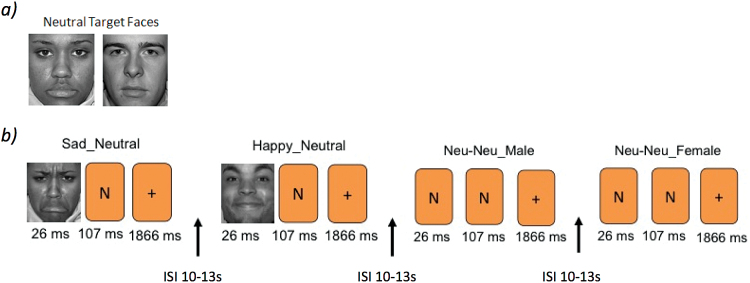
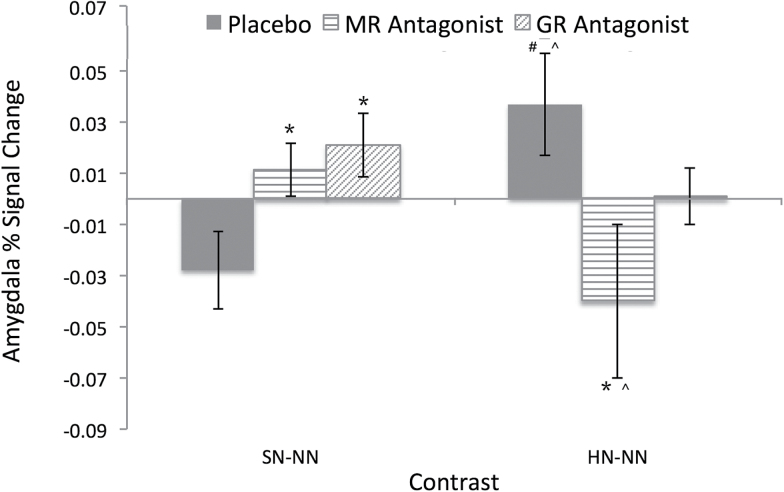
On autobiographical memory testing, mineralocorticoid receptor antagonism impaired, while glucocorticoid receptor antagonism improved, recall relative to placebo, as evinced by changes in the percent of specific memories recalled. During fMRI, the amygdala hemodynamic response to masked sad faces was greater under both mineralocorticoid receptor and glucocorticoid receptor antagonism relative to placebo, while the response to masked happy faces was attenuated only during mineralocorticoid receptor antagonism relative to placebo.
These data suggest both mineralocorticoid receptor and glucocorticoid receptor antagonism (and potentially any deviation from the normal physiological mineralocorticoid receptor/glucocorticoid receptor ratio achieved under the circadian pattern) enhances amygdala-based processing of sad stimuli and may shift the emotional processing bias away from the normative processing bias and towards the negative valence. In contrast, autobiographical memory was enhanced by conditions of reduced glucocorticoid receptor occupancy.
健康人体内皮质醇水平的急性升高会损害自传体记忆的回忆,并改变杏仁核对情绪效价刺激的血流动力学反应。据推测,皮质醇对认知的影响受盐皮质激素受体与糖皮质激素受体占有率的比例影响。本研究分别检测了急性阻断盐皮质激素受体和糖皮质激素受体对已知受皮质醇水平改变影响的两个过程的作用:自传体记忆回忆的特异性,以及杏仁核对悲伤和快乐面孔的血流动力学反应。
我们采用了一项被试内设计,10名健康男性参与者以随机、平衡的顺序接受安慰剂、单独的盐皮质激素受体拮抗剂螺内酯(600mg)和单独的糖皮质激素受体拮抗剂米非司酮(600mg),每次用药间隔1周的无药期。
在自传体记忆测试中,相对于安慰剂,盐皮质激素受体拮抗作用损害了回忆,而糖皮质激素受体拮抗作用改善了回忆,这可通过特定记忆回忆百分比的变化得以证明。在功能磁共振成像期间,相对于安慰剂,在盐皮质激素受体和糖皮质激素受体拮抗作用下,杏仁核对蒙面悲伤面孔的血流动力学反应均增强,而相对于安慰剂,仅在盐皮质激素受体拮抗作用期间,对蒙面快乐面孔的反应减弱。
这些数据表明,盐皮质激素受体和糖皮质激素受体拮抗作用(以及可能与昼夜节律模式下正常生理盐皮质激素受体/糖皮质激素受体比例的任何偏差)均增强了基于杏仁核的悲伤刺激处理,并可能将情绪处理偏向从正常处理偏向转向负性效价。相比之下,糖皮质激素受体占有率降低的情况会增强自传体记忆。