Koopman F A, Tang M W, Vermeij J, de Hair M J, Choi I Y, Vervoordeldonk M J, Gerlag D M, Karemaker J M, Tak P P
Amsterdam Rheumatology and Immunology Center, Department of Clinical Immunology & Rheumatology, Academic Medical Center, University of Amsterdam, Amsterdam, The Netherlands.
Amsterdam Rheumatology and Immunology Center, Department of Clinical Immunology & Rheumatology, Academic Medical Center, University of Amsterdam, Amsterdam, The Netherlands; Department of Rheumatology & Clinical Immunology, University Medical Center Utrecht, The Netherlands.
EBioMedicine. 2016 Apr;6:231-237. doi: 10.1016/j.ebiom.2016.02.029. Epub 2016 Feb 19.
Heart rate variability (HRV) is a validated method to establish autonomic nervous system (ANS) activity. Rheumatoid arthritis (RA) is accompanied by ANS imbalance. We hypothesized that ANS dysfunction may precede the development of RA, which would suggest that it plays a role in its etiopathogenesis.
First, we assessed HRV parameters in supine (resting) and upright (active) position in healthy subjects (HS, n=20), individuals at risk of developing arthritis (AR subjects, n=50) and RA patients (RA, n=20). Next, we measured resting heart rate (RHR), a parasympathetic HRV parameter, in an independent prospective cohort of AR subjects (n=45). We also evaluated expression levels of the parasympathetic nicotinic acetylcholine receptor type 7 (α7nAChR) on circulating monocytes.
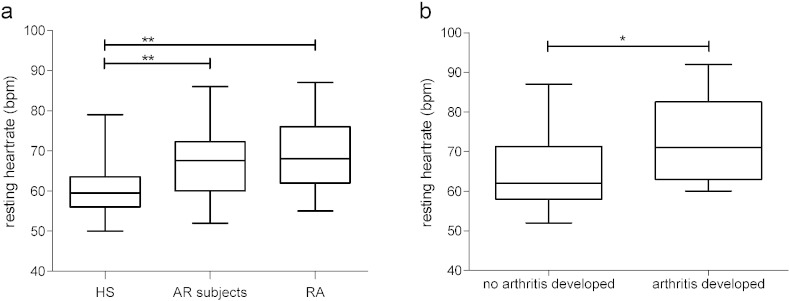
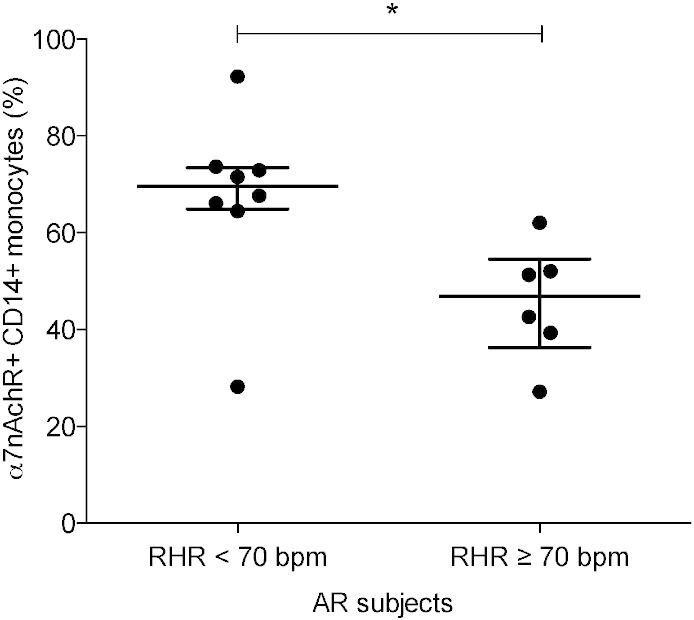
Both AR subjects (68 beats per minute (bpm), interquartile range (IQR) 68-73) and RA patients (68bpm, IQR 62-76) had a significantly higher RHR compared to HS (60bpm, IQR 56-63). RHR was significantly higher at baseline in individuals who subsequently developed arthritis. Expression levels of α7nAChR were lower in AR subjects with RHR ≥70bpm compared to those with RHR <70bpm, consistent with reduced activity of the parasympathetic cholinergic anti-inflammatory pathway.
These data support the notion that autonomic dysfunction precedes the development of RA.
心率变异性(HRV)是一种用于确定自主神经系统(ANS)活动的有效方法。类风湿性关节炎(RA)伴有ANS失衡。我们假设ANS功能障碍可能先于RA的发生,这表明它在RA的病因发病机制中起作用。
首先,我们评估了健康受试者(HS,n = 20)、有患关节炎风险的个体(AR受试者,n = 50)和RA患者(RA,n = 20)在仰卧(静息)和直立(活动)姿势下的HRV参数。接下来,我们在一个独立的AR受试者前瞻性队列(n = 45)中测量了静息心率(RHR),这是一个副交感神经HRV参数。我们还评估了循环单核细胞上副交感神经烟碱型乙酰胆碱受体7(α7nAChR)的表达水平。
与HS(60次/分钟(bpm),四分位间距(IQR)56 - 63)相比,AR受试者(68 bpm;IQR 68 - 73)和RA患者(68 bpm;IQR 62 - 76)的RHR显著更高。随后发生关节炎个体的基线RHR显著更高。与RHR < 70 bpm 的AR受试者相比,RHR≥70 bpm的AR受试者中α7nAChR表达水平较低,这与副交感胆碱能抗炎途径活性降低一致。
这些数据支持自主神经功能障碍先于RA发生这一观点。