University of Manchester, Manchester, UK.
University of Cambridge School of Clinical Medicine, Cambridge, UK.
Arthritis Rheumatol. 2016 Nov;68(11):2629-2636. doi: 10.1002/art.39760.
Genetic variation in FOXO3 (tagged by rs12212067) has been associated with a milder course of rheumatoid arthritis (RA) and shown to limit monocyte-driven inflammation through a transforming growth factor β1-dependent pathway. This genetic association, however, has not been consistently observed in other RA cohorts. We sought to clarify the contribution of FOXO3 to prognosis in RA by combining detailed analysis of nonradiographic disease severity measures with an in vivo model of arthritis.
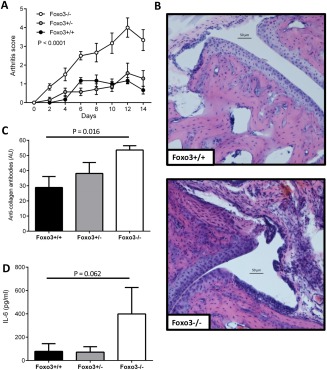
Collagen-induced arthritis, the most commonly used mouse model of RA, was used to assess how Foxo3 contributes to arthritis severity. Using clinical, serologic, and biochemical methods, the arthritis that developed in mice carrying a loss-of-function mutation in Foxo3 was compared with that which occurred in littermate controls. The association of rs12212067 with nonradiographic measures of RA severity, including the C-reactive protein level, the swollen joint count, the tender joint count, the Disease Activity Score in 28 joints, and the Health Assessment Questionnaire score, were modeled longitudinally in a large prospective cohort of patients with early RA.
Loss of Foxo3 function resulted in more severe arthritis in vivo (both clinically and histologically) and was associated with higher titers of anticollagen antibodies and interleukin-6 in the blood. Similarly, rs12212067 (a single-nucleotide polymorphism that increases FOXO3 transcription) was associated with reduced inflammation, both biochemically and clinically, and with lower RA activity scores.
Consistent with its known role in restraining inflammatory responses, FOXO3 limits the severity of in vivo arthritis and, through genetic variation that increases its transcription, is associated with reduced inflammation and disease activity in RA patients, effects that result in less radiographic damage.
FOXO3(由 rs12212067 标记)的遗传变异与类风湿关节炎(RA)的较轻病程相关,并通过转化生长因子β1 依赖性途径限制单核细胞驱动的炎症。然而,这种遗传关联在其他 RA 队列中并未得到一致观察。我们试图通过将非影像学疾病严重程度指标的详细分析与关节炎体内模型相结合,阐明 FOXO3 对 RA 预后的贡献。
胶原诱导性关节炎是最常用于 RA 的小鼠模型,用于评估 Foxo3 如何促进关节炎严重程度。使用临床、血清学和生化方法,比较了 Foxo3 功能丧失突变小鼠与同窝对照小鼠发生的关节炎。采用 rs12212067 与非影像学 RA 严重程度指标的关联,包括 C 反应蛋白水平、肿胀关节计数、压痛关节计数、28 个关节疾病活动评分和健康评估问卷评分,对早期 RA 患者的大型前瞻性队列进行了纵向建模。
Foxo3 功能丧失导致体内关节炎更严重(临床和组织学上),并与血液中抗胶原抗体和白细胞介素-6 的滴度升高相关。同样,rs12212067(增加 FOXO3 转录的单核苷酸多态性)与炎症的减少相关,包括生化和临床方面,并且 RA 活动评分也较低。
与已知其在抑制炎症反应中的作用一致,FOXO3 限制了体内关节炎的严重程度,并且通过增加其转录的遗传变异,与 RA 患者的炎症和疾病活动减少相关,从而导致较少的放射学损伤。