Kim Junghee, Park Jin-Hwa, Shin Sujin
The Catholic University of Korea 222, Banpodae-ro, Seocho-gu, Seoul, 06591, Republic of Korea.
Catholic University of Daegu, 33, Duryugongwon-ro 17gil, Nam-gu, Daegu, 42472, Republic of Korea.
BMC Med Educ. 2016 May 23;16:152. doi: 10.1186/s12909-016-0672-7.
Simulation-based nursing education is an increasingly popular pedagogical approach. It provides students with opportunities to practice their clinical and decision-making skills through various real-life situational experiences. However, simulation approaches fall along a continuum ranging from low-fidelity to high-fidelity simulation. The purpose of this study was to determine the effect size of simulation-based educational interventions in nursing and compare effect sizes according to the fidelity level of the simulators through a meta-analysis.
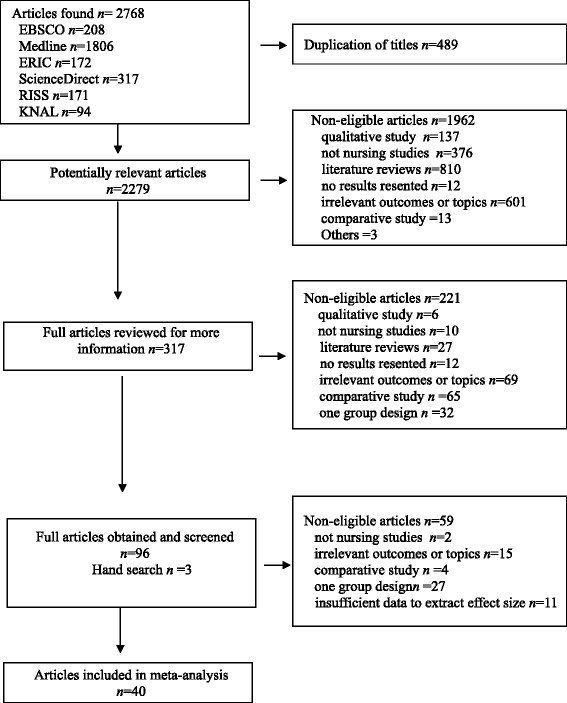
This study explores the quantitative evidence published in the electronic databases EBSCO, Medline, ScienceDirect, ERIC, RISS, and the National Assembly Library of Korea database. Using a search strategy including the search terms "nursing," "simulation," "human patient," and "simulator," we identified 2279 potentially relevant articles. Forty studies met the inclusion criteria and were retained in the analysis.
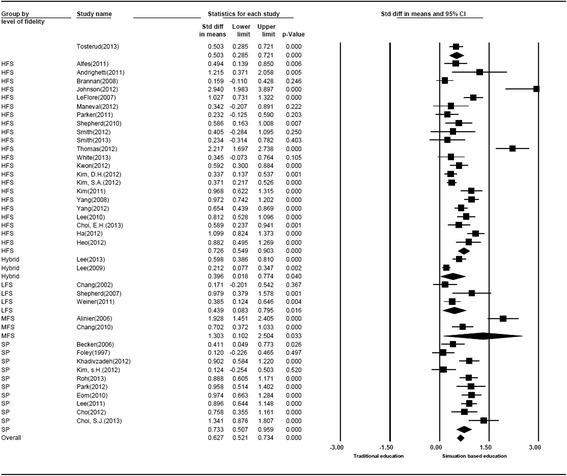
This meta-analysis showed that simulation-based nursing education was effective in various learning domains, with a pooled random-effects standardized mean difference of 0.70. Subgroup analysis revealed that effect sizes were larger for high-fidelity simulation (0.86), medium-fidelity simulation (1.03), and standardized patients (0.86) than they were for low-fidelity and hybrid simulations. In terms of cognitive outcomes, the effect size was the largest for high-fidelity simulation (0.50). Regarding affective outcome, high-fidelity simulation (0.80) and standardized patients (0.73) had the largest effect sizes.
These results suggest that simulation-based nursing educational interventions have strong educational effects, with particularly large effects in the psychomotor domain. Since the effect is not proportional to fidelity level, it is important to use a variety of educational interventions to meet all of the educational goals.
基于模拟的护理教育是一种越来越受欢迎的教学方法。它为学生提供了通过各种现实生活情境体验来实践其临床和决策技能的机会。然而,模拟方法涵盖了从低保真度到高保真度模拟的连续范围。本研究的目的是通过荟萃分析确定基于模拟的护理教育干预措施的效应量,并根据模拟器的保真度水平比较效应量。
本研究探索了在电子数据库EBSCO、Medline、ScienceDirect、ERIC、RISS以及韩国国会图书馆数据库中发表的定量证据。使用包括搜索词“护理”“模拟”“人体患者”和“模拟器”的搜索策略,我们识别出2279篇潜在相关文章。40项研究符合纳入标准并被保留用于分析。
这项荟萃分析表明,基于模拟的护理教育在各个学习领域均有效,合并随机效应标准化平均差为0.70。亚组分析显示,高保真模拟(0.86)、中保真模拟(1.03)和标准化患者(0.86)的效应量大于低保真度和混合模拟。在认知结果方面,高保真模拟的效应量最大(0.50)。关于情感结果,高保真模拟(0.80)和标准化患者(0.73)的效应量最大。
这些结果表明,基于模拟的护理教育干预措施具有强大的教育效果,在心理运动领域的效果尤为显著。由于效应与保真度水平不成正比,因此使用各种教育干预措施以实现所有教育目标很重要。