Garrido Melissa M, Dowd Bryan, Hebert Paul L, Maciejewski Matthew L
James J. Peters VA Medical Center, Bronx, New York, USA; Icahn School of Medicine at Mount Sinai, New York, New York, USA.
University of Minnesota School of Public Health, Minneapolis, Minnesota, USA.
J Pain Symptom Manage. 2016 Sep;52(3):446-52. doi: 10.1016/j.jpainsymman.2016.01.016. Epub 2016 May 21.
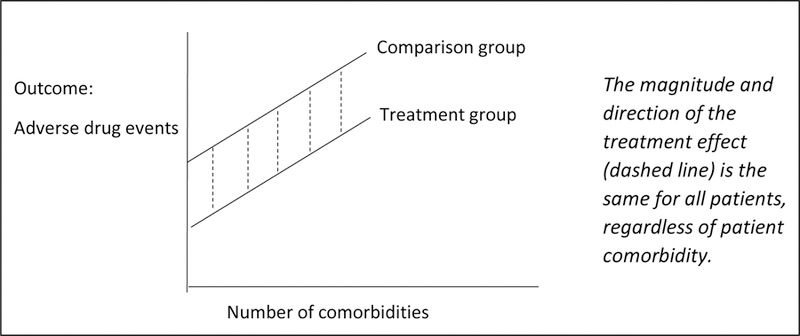
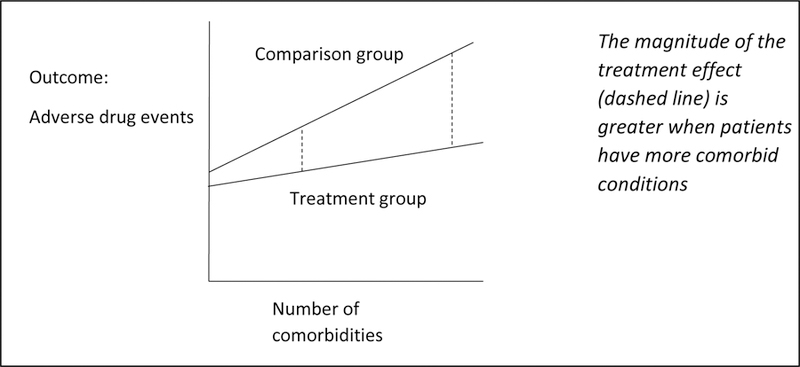
Within health services and medical research, there is a wide variety of terminology related to treatment effects. Understanding differences in types of treatment effects is especially important in pain and symptom management research where nonexperimental and quasiexperimental observational data analysis is common. We use the example of a palliative care consultation team leader considering implementation of a medication reconciliation program and a care-coordination intervention reported in the literature to illustrate population-level and conditional treatment effects and to highlight the sensitivity of values of treatment effects to sample selection and treatment assignment. Our goal is to facilitate appropriate reporting and interpretation of study results and to help investigators understand what information a decision maker needs when deciding whether to implement a treatment. Greater awareness of the reasons why treatment effects may differ across studies of the same patients in the same treatment settings can help policy makers and clinicians understand to whom a study's results may be generalized.
在卫生服务和医学研究领域,与治疗效果相关的术语种类繁多。在疼痛和症状管理研究中,理解不同类型治疗效果之间的差异尤为重要,因为非实验性和准实验性观察数据分析在这类研究中很常见。我们以一位姑息治疗咨询团队负责人为例,该负责人考虑实施一项文献中报道的药物重整计划和护理协调干预措施,以说明总体水平和条件性治疗效果,并强调治疗效果值对样本选择和治疗分配的敏感性。我们的目标是促进对研究结果进行恰当的报告和解读,并帮助研究人员了解决策者在决定是否实施某种治疗时需要哪些信息。对于在相同治疗环境下对同一患者进行的不同研究中治疗效果为何可能存在差异有更深入的认识,有助于政策制定者和临床医生理解一项研究的结果可能适用于哪些人群。