Hinzey Adam, Gaudier-Diaz Monica M, Lustberg Maryam B, DeVries A Courtney
Department of Neuroscience, The Ohio State University Wexner Medical Center, Columbus, OH, 43210, USA.
Department of Internal Medicine, The Ohio State University Wexner Medical Center, Columbus, OH, 43210, USA.
Breast Cancer Res. 2016 May 26;18(1):54. doi: 10.1186/s13058-016-0700-x.
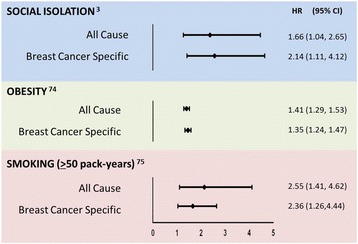
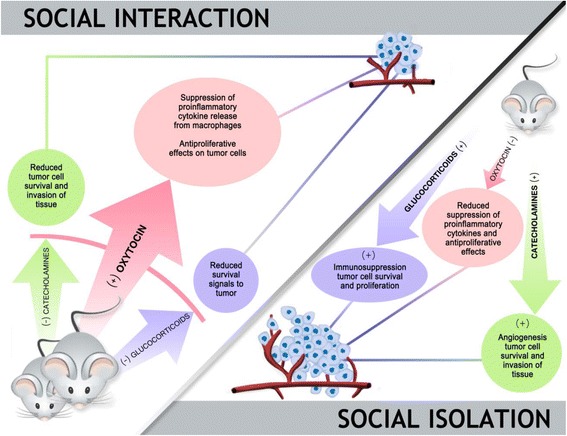
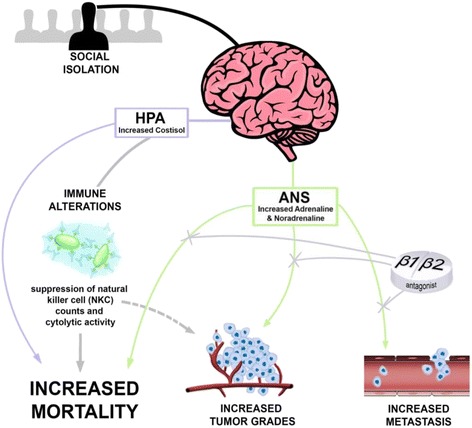
Social environment is a well-recognized determinant in health and wellbeing. Among breast cancer patients, inadequate social support is associated with a substantial increase in cancer-related mortality. A common explanation is that socially isolated individuals fare worse due to reduced instrumental support (i.e., assistance meeting the demands of treatment). However, the ability to replicate the detrimental effects of social isolation on mammary tumor growth in rodents strongly suggests an alternative explanation; i.e., socially isolated individuals have a physiological milieu that promotes tumor growth. This review summarizes the clinical and basic science literature supporting social influences on breast cancer, and provides a conceptual physiological framework for these effects. We propose that social environment contributes to the vast individual differences in prognosis among breast cancer survivors because social environment is capable of altering basic physiological processes, which in turn can modulate tumor growth. Appreciation of the role of social environment in breast cancer progression could promote the identification of patients at increased risk for poor outcomes. In addition, characterization of the underlying physiological mechanisms could lead to targeted disruption of detrimental pathways that promote tumor progression in socially isolated individuals, or exploitation of protective pathways activated through social engagement as novel therapeutic complements to contemporary treatments.
社会环境是健康和幸福的一个公认的决定因素。在乳腺癌患者中,社会支持不足与癌症相关死亡率的大幅上升有关。一个常见的解释是,社会孤立的个体由于工具性支持减少(即满足治疗需求的援助)而情况更糟。然而,在啮齿动物中复制社会孤立对乳腺肿瘤生长的有害影响的能力强烈表明了另一种解释;即,社会孤立的个体具有促进肿瘤生长的生理环境。本综述总结了支持社会对乳腺癌影响的临床和基础科学文献,并为这些影响提供了一个概念性的生理框架。我们认为,社会环境导致了乳腺癌幸存者预后的巨大个体差异,因为社会环境能够改变基本生理过程,进而调节肿瘤生长。认识到社会环境在乳腺癌进展中的作用可以促进识别预后不良风险增加的患者。此外,对潜在生理机制的表征可能导致有针对性地破坏在社会孤立个体中促进肿瘤进展的有害途径,或者利用通过社会参与激活的保护途径作为当代治疗的新型治疗补充。