
通过计算机模拟实现纳米颗粒高效递送的表面修饰设计策略
Design strategy of surface decoration for efficient delivery of nanoparticles by computer simulation.
作者信息
Ding Hong-Ming, Ma Yu-Qiang
机构信息
Center for Soft Condensed Matter Physics and Interdisciplinary Research, Soochow University, Suzhou 215006, China.
National Laboratory of Solid State Microstructures and Department of Physics, Collaborative Innovation Center of Advanced Microstructures, Nanjing University, Nanjing 210093, China.
出版信息
Sci Rep. 2016 May 26;6:26783. doi: 10.1038/srep26783.
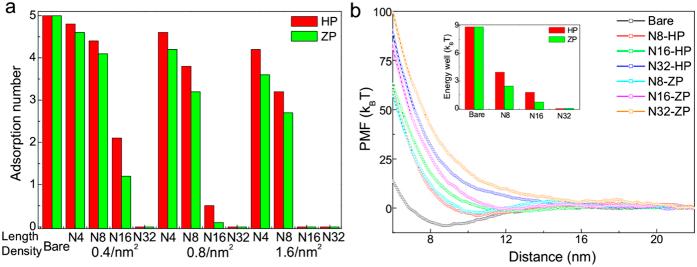
Understanding the role of surface decoration of nanoparticles in protein adsorption and cellular uptake is of great importance in biomedicine. Here, by using dissipative particle dynamics simulations, we take two typical coating polymers (i.e., hydrophilic and zwitterionic polymers) as an example, and systematically investigate their effect on cellular delivery of hydrophobic and charged nanoparticles (in the presence of serum protein). Our results show that though two types of polymers are charge-neutral and can both reduce the protein adsorption, there exist some differences between their ability of protein resistance, especially in the case of positively charged nanoparticles. Besides, it is found that the coating polymers may also greatly decrease the cellular uptake efficiency of nanoparticles. Nevertheless, and importantly, since the zwitterionic polymers may become positively charged under low pH environments, the nanoparticle can attach onto cell membrane more firmly than that coated with hydrophilic polymers, which can further enhance the active targeting of nanoparticles. Finally, we also provide the design maps for surface decoration to achieve efficient cellular delivery. These results can help better understand how to keep the balance between protein resistance and cell targeting, which may give some useful guidelines on optimal design of future nanomaterials in drug delivery.
了解纳米颗粒表面修饰在蛋白质吸附和细胞摄取中的作用在生物医学中具有重要意义。在此,我们以两种典型的包覆聚合物(即亲水性和两性离子聚合物)为例,通过耗散粒子动力学模拟,系统地研究了它们在(存在血清蛋白的情况下)对疏水性和带电纳米颗粒细胞递送的影响。我们的结果表明,尽管这两种类型的聚合物呈电中性且都能减少蛋白质吸附,但它们的抗蛋白质能力存在一些差异,尤其是在带正电纳米颗粒的情况下。此外,发现包覆聚合物也可能大大降低纳米颗粒的细胞摄取效率。然而,重要的是,由于两性离子聚合物在低pH环境下可能带正电,纳米颗粒比涂覆亲水性聚合物的纳米颗粒能更牢固地附着在细胞膜上,这可以进一步增强纳米颗粒的主动靶向性。最后,我们还提供了用于表面修饰以实现高效细胞递送的设计图。这些结果有助于更好地理解如何在抗蛋白质和细胞靶向之间保持平衡,这可能为未来药物递送纳米材料的优化设计提供一些有用的指导。




 Zotero 插件