Schachat Sandra R, Brown Richard L
Mississippi Entomological Museum, Mississippi State, MS, 39762, USA.
Department of Paleobiology, Smithsonian Institution, Washington, DC, 20013, USA.
BMC Evol Biol. 2016 May 26;16(1):116. doi: 10.1186/s12862-016-0687-z.
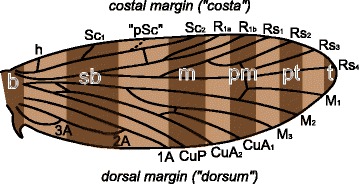
Despite the great importance of lepidopteran wing patterns in various biological disciplines, homologies between wing pattern elements in different moth and butterfly lineages are still not understood. Among other reasons, this may be due to an incomplete understanding of the relationship between color pattern and wing venation; many individual wing pattern elements have a known relationship with venation, but a framework to unite all wing pattern elements with venation is lacking. Though plesiomorphic wing veins are known to influence color patterning even when not expressed in the adult wing, most studies of wing pattern evolution have focused on derived taxa with a reduced suite of wing veins.
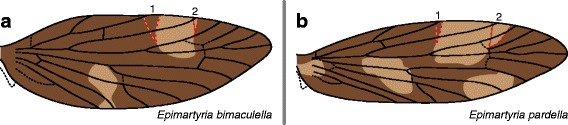
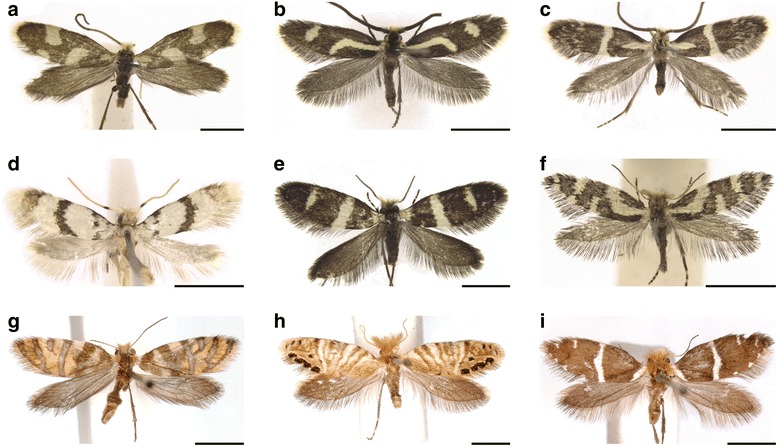
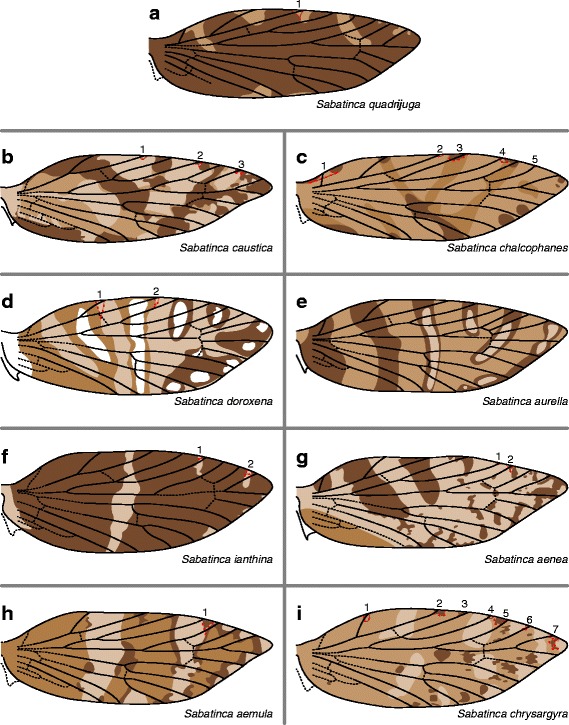
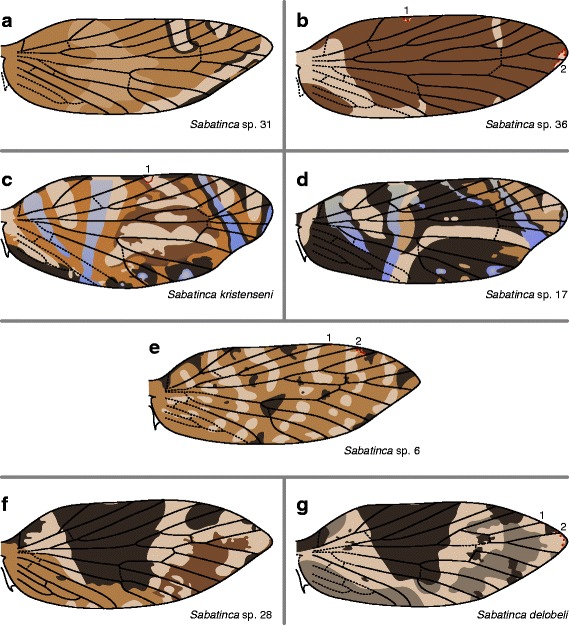
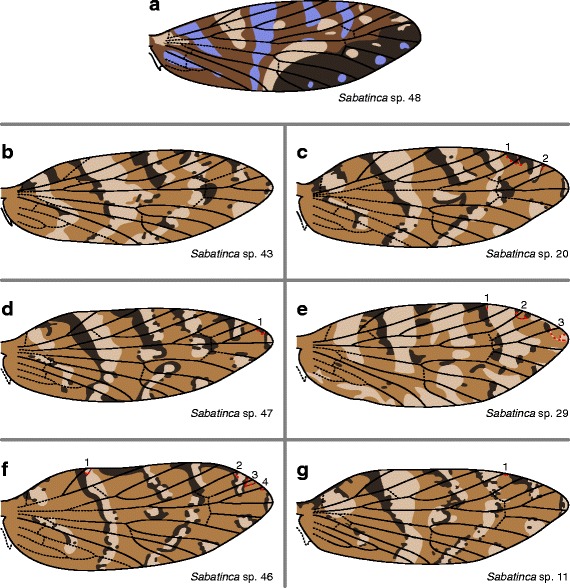
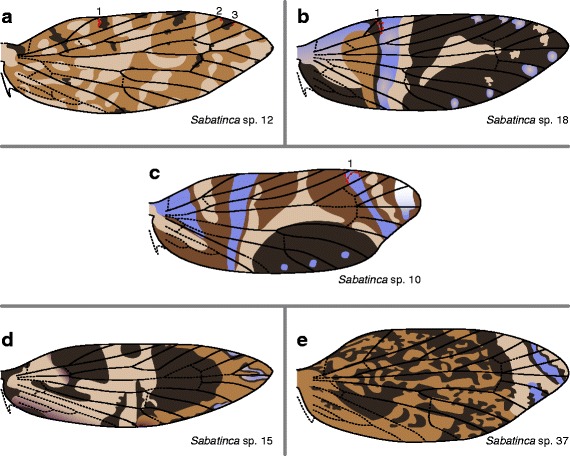
The present study aims to address this gap through an examination of Micropterigidae, a very early-diverged moth family in which all known plesiomorphic lepidopteran veins are expressed in the adult wing. The relationship between wing pattern and venation was examined in 66 species belonging to 9 genera. The relationship between venation and pattern element location, predicted based on moths in the family Tortricidae, holds for Sabatinca just as it does for Micropterix. However, the pattern elements that are lightly colored in Micropterix are dark in Sabatinca, and vice-versa. When plotted onto a hypothetical nymphalid wing in accordance with the relationship between pattern and venation discussed here, the wing pattern of Sabatinca doroxena very closely resembles the nymphalid groundplan.
The color difference in pattern elements between Micropterix and Sabatinca indicates that homologies exist among the contrast boundaries that divide wing pattern elements, and that color itself is not a reliable indicator of homology. The similarity between the wing pattern of Sabatinca doroxena and the nymphalid groundplan suggests that the nymphalid groundplan may have originated from a Sabatinca-like wing pattern subjected to changes in wing shape and reduced expression of venation.
尽管鳞翅目昆虫的翅斑在各种生物学学科中具有重要意义,但不同蛾类和蝶类谱系中翅斑元素之间的同源性仍未得到充分理解。造成这种情况的原因之一可能是对色斑与翅脉之间的关系理解不全面;许多单个的翅斑元素与翅脉之间的关系已为人所知,但缺乏一个将所有翅斑元素与翅脉联系起来的框架。虽然已知即使在成虫翅中未表达的原始翅脉也会影响色斑形成,但大多数关于翅斑进化的研究都集中在翅脉数量减少的衍生类群上。
本研究旨在通过对微翅蛾科进行研究来填补这一空白,微翅蛾科是一个分化非常早的蛾类家族,所有已知的原始鳞翅目翅脉在成虫翅中均有表达。对9个属的66个物种的翅斑与翅脉之间的关系进行了研究。基于卷蛾科蛾类预测的翅脉与斑纹元素位置之间的关系,对Sabatinca和Micropterix同样适用。然而,Micropterix中颜色较浅的斑纹元素在Sabatinca中是深色的,反之亦然。根据此处讨论的斑纹与翅脉之间的关系,将其绘制在一个假设的蛱蝶翅上时,多罗克纳Sabatinca的翅斑与蛱蝶的基本翅脉图案非常相似。
Micropterix和Sabatinca斑纹元素的颜色差异表明,划分翅斑元素的对比边界之间存在同源性,而且颜色本身并不是同源性的可靠指标。多罗克纳Sabatinca的翅斑与蛱蝶基本翅脉图案的相似性表明,蛱蝶的基本翅脉图案可能起源于类似Sabatinca的翅斑,并经历了翅形变化和翅脉表达减少。