Laboratory for Evolutionary Morphology, Center for Developmental Biology, RIKEN, Chuo-ku Kobe, Japan.
BMC Evol Biol. 2013 Jul 27;13:158. doi: 10.1186/1471-2148-13-158.
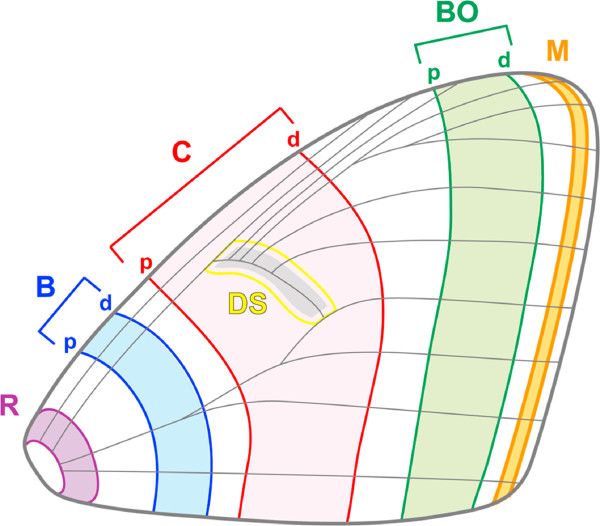
One of the most intriguing questions in evolutionary developmental biology is how an insect acquires a mimicry pattern within its body parts. A striking example of pattern mimicry is found in the pattern diversity of moth and butterfly wings, which is thought to evolve from preexisting elements illustrated by the nymphalid ground plan (NGP). Previous studies demonstrated that individuality of the NGP facilitates the decoupling of associated common elements, leading to divergence. In contrast, recent studies on the concept of modularity have argued the importance of a combination of coupling and decoupling of the constituent elements. Here, we examine the modularity of a mimicry wing pattern in a moth and explore an evolvable characteristic of the NGP.
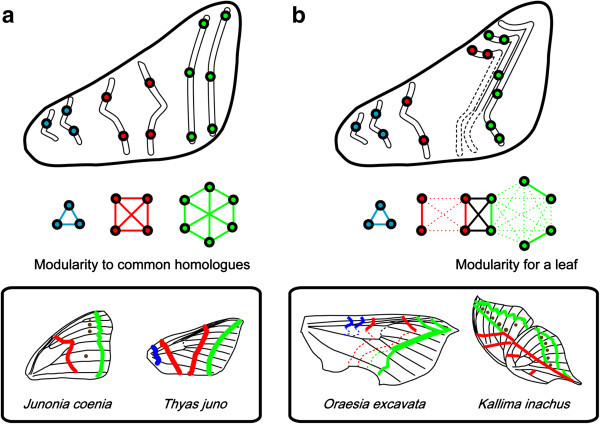
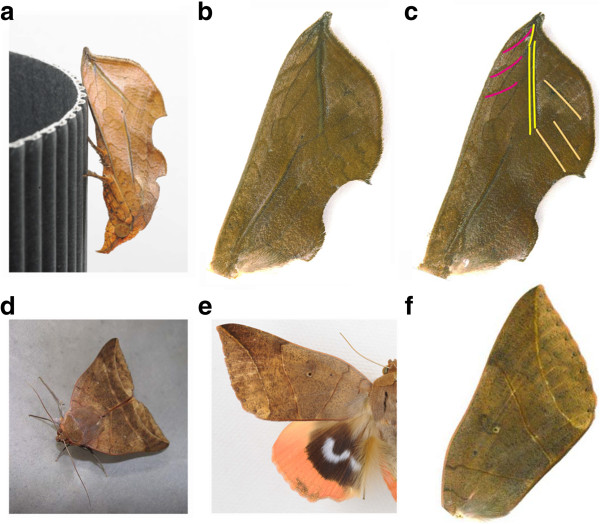
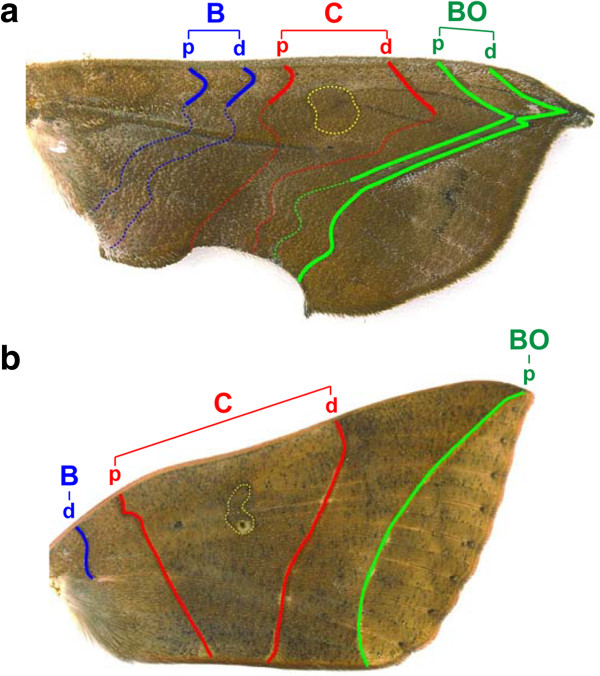
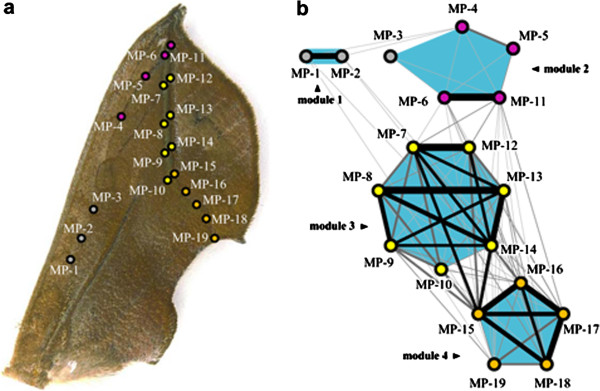
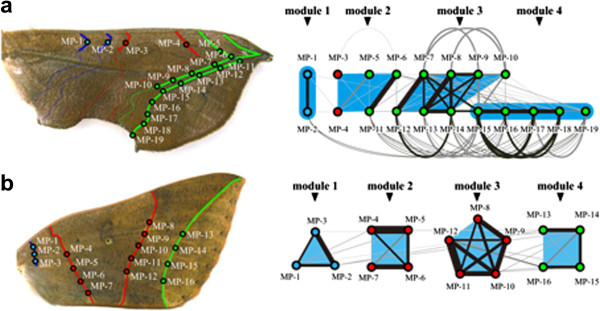
This study examined the wings of the noctuid moth Oraesia excavata, which closely resemble leaves with a leaf venation pattern. Based on a comparative morphological procedure, we found that this leaf pattern was formed by the NGP common elements. Using geometric morphometrics combined with network analysis, we found that each of the modules in the leaf pattern integrates the constituent components of the leaf venation pattern (i.e., the main and lateral veins). Moreover, the detected modules were established by coupling different common elements and decoupling even a single element into different modules. The modules of the O. excavata wing pattern were associated with leaf mimicry, not with the individuality of the NGP common elements. For comparison, we also investigated the modularity of a nonmimetic pattern in the noctuid moth Thyas juno. Quantitative analysis demonstrated that the modules of the T. juno wing pattern regularly corresponded to the individuality of the NGP common elements, unlike those in the O. excavata wing pattern.
This study provides the first evidence for modularity in a leaf mimicry pattern. The results suggest that the evolution of this pattern involves coupling and decoupling processes to originate these modules, free from the individuality of the NGP system. We propose that this evolution has been facilitated by a versatile characteristic of the NGP, allowing the association of freely modifiable subordinate common elements to make modules.
进化发育生物学中最引人关注的问题之一是昆虫如何在身体部位获得拟态模式。鳞翅目昆虫和蝴蝶翅膀的图案多样性就是一个引人注目的例子,其被认为是从 nymphalid 地图形(NGP)所展示的已有元素进化而来。先前的研究表明,NGP 的个体性促进了相关共有元素的解耦,从而导致了趋异。相比之下,最近关于模块性概念的研究则强调了组成元素的耦合和解耦的重要性。在这里,我们研究了一种蛾类的拟态翅膀图案的模块性,并探索了 NGP 的可进化特征。
本研究检查了夜蛾 Oraesia excavata 的翅膀,其与叶子的叶脉图案非常相似。基于比较形态学程序,我们发现这种叶子图案是由 NGP 的共有元素形成的。通过几何形态测量学与网络分析相结合,我们发现,叶子图案的每个模块都整合了叶脉图案的组成部分(即主脉和侧脉)。此外,检测到的模块是由不同的共有元素耦合和甚至将单个元素解耦为不同的模块而建立的。O. excavata 翅膀图案的模块与叶子拟态有关,而与 NGP 共有元素的个体性无关。作为比较,我们还研究了夜蛾 Thyas juno 的非拟态图案的模块性。定量分析表明,T. juno 翅膀图案的模块与 NGP 共有元素的个体性规则对应,与 O. excavata 翅膀图案的模块不同。
本研究首次提供了叶子拟态模式的模块性证据。结果表明,该模式的进化涉及耦合和解耦过程,以形成这些模块,而不受 NGP 系统的个体性限制。我们提出,这种进化是由 NGP 的多功能特征促进的,允许自由可修改的从属共有元素关联以形成模块。