Imhof Simon, Fragoso Cristina, Hemphill Andrew, von Schubert Conrad, Li Dong, Legant Wesley, Betzig Eric, Roditi Isabel
Institute of Cell Biology, University of Bern, Bern, Switzerland; Graduate School of Cellular and Biomedical Sciences, University of Bern, Bern, Switzerland.
Institute of Cell Biology, University of Bern, Bern, Switzerland.
F1000Res. 2016 Apr 14;5:682. doi: 10.12688/f1000research.8249.1. eCollection 2016.
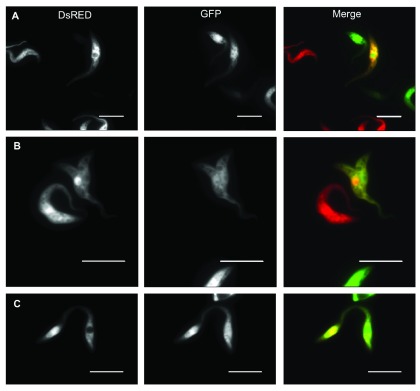
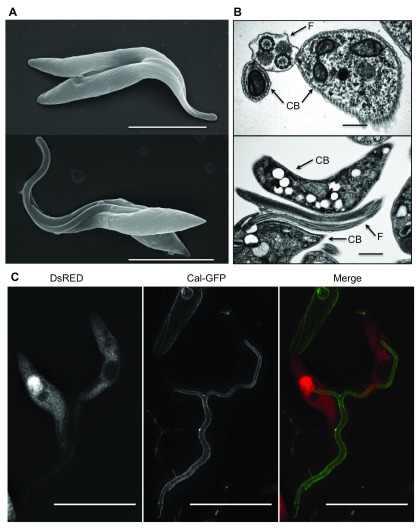
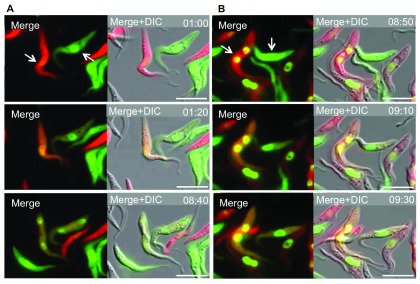
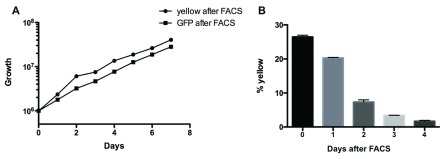
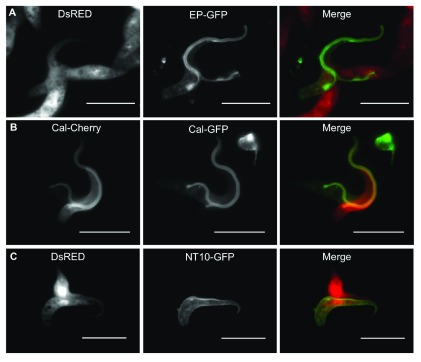
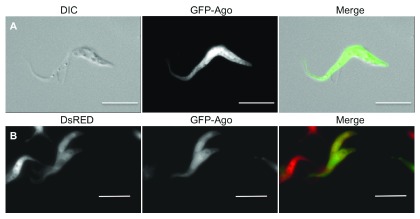
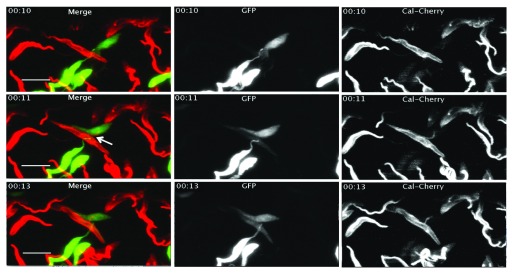
Diverse structures facilitate direct exchange of proteins between cells, including plasmadesmata in plants and tunnelling nanotubes in bacteria and higher eukaryotes. Here we describe a new mechanism of protein transfer, flagellar membrane fusion, in the unicellular parasite Trypanosoma brucei. When fluorescently tagged trypanosomes were co-cultured, a small proportion of double-positive cells were observed. The formation of double-positive cells was dependent on the presence of extracellular calcium and was enhanced by placing cells in medium supplemented with fresh bovine serum. Time-lapse microscopy revealed that double-positive cells arose by bidirectional protein exchange in the absence of nuclear transfer. Furthermore, super-resolution microscopy showed that this process occurred in ≤1 minute, the limit of temporal resolution in these experiments. Both cytoplasmic and membrane proteins could be transferred provided they gained access to the flagellum. Intriguingly, a component of the RNAi machinery (Argonaute) was able to move between cells, raising the possibility that small interfering RNAs are transported as cargo. Transmission electron microscopy showed that shared flagella contained two axonemes and two paraflagellar rods bounded by a single membrane. In some cases flagellar fusion was partial and interactions between cells were transient. In other cases fusion occurred along the entire length of the flagellum, was stable for several hours and might be irreversible. Fusion did not appear to be deleterious for cell function: paired cells were motile and could give rise to progeny while fused. The motile flagella of unicellular organisms are related to the sensory cilia of higher eukaryotes, raising the possibility that protein transfer between cells via cilia or flagella occurs more widely in nature.
多种结构促进细胞间蛋白质的直接交换,包括植物中的胞间连丝以及细菌和高等真核生物中的隧道纳米管。在此,我们描述了单细胞寄生虫布氏锥虫中一种新的蛋白质转移机制——鞭毛膜融合。当荧光标记的锥虫共培养时,观察到一小部分双阳性细胞。双阳性细胞的形成依赖于细胞外钙的存在,并且通过将细胞置于补充有新鲜牛血清的培养基中而增强。延时显微镜显示双阳性细胞是在没有核转移的情况下通过双向蛋白质交换产生的。此外,超分辨率显微镜显示这个过程在≤1分钟内发生,这是这些实验中的时间分辨率极限。只要细胞质和膜蛋白能够进入鞭毛,它们就可以被转移。有趣的是,RNA干扰机制的一个组分(AGO蛋白)能够在细胞间移动,这增加了小干扰RNA作为货物被运输的可能性。透射电子显微镜显示共享的鞭毛包含两个轴丝和两个副鞭毛杆,由单个膜包围。在某些情况下,鞭毛融合是部分的,细胞间的相互作用是短暂的。在其他情况下,融合沿着鞭毛的整个长度发生,稳定数小时并且可能是不可逆的。融合似乎对细胞功能无害:配对的细胞是可运动的,并且在融合时可以产生后代。单细胞生物的运动鞭毛与高等真核生物的感觉纤毛相关,这增加了细胞间通过纤毛或鞭毛进行蛋白质转移在自然界中更广泛发生的可能性。