Stubenhaus Bradford M, Dustin John P, Neverett Emily R, Beaudry Megan S, Nadeau Leanna E, Burk-McCoy Ethan, He Xinwen, Pearson Bret J, Pellettieri Jason
Department of Biology, Keene State College, Keene, United States.
The Hospital for Sick Children, Toronto, Canada.
Elife. 2016 May 31;5:e14175. doi: 10.7554/eLife.14175.
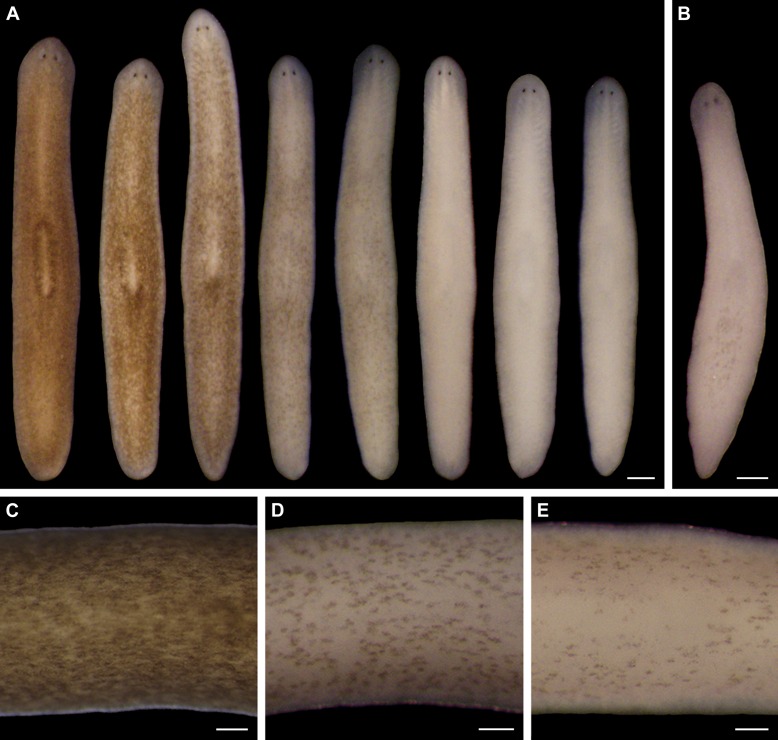
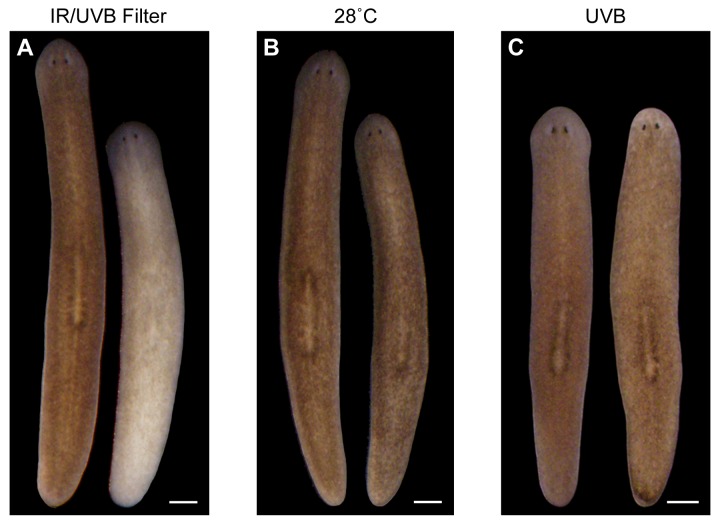
Porphyrias are disorders of heme metabolism frequently characterized by extreme photosensitivity. This symptom results from accumulation of porphyrins, tetrapyrrole intermediates in heme biosynthesis that generate reactive oxygen species when exposed to light, in the skin of affected individuals. Here we report that in addition to producing an ommochrome body pigment, the planarian flatworm Schmidtea mediterranea generates porphyrins in its subepithelial pigment cells under physiological conditions, and that this leads to pigment cell loss when animals are exposed to intense visible light. Remarkably, porphyrin biosynthesis and light-induced depigmentation are enhanced by starvation, recapitulating a common feature of some porphyrias - decreased nutrient intake precipitates an acute manifestation of the disease. Our results establish planarians as an experimentally tractable animal model for research into the pathophysiology of acute porphyrias, and potentially for the identification of novel pharmacological interventions capable of alleviating porphyrin-mediated photosensitivity or decoupling dieting and fasting from disease pathogenesis.
卟啉病是血红素代谢紊乱疾病,常表现为极度的光敏感性。这种症状是由于卟啉(血红素生物合成中的四吡咯中间体)在受影响个体的皮肤中积累所致,卟啉在光照下会产生活性氧。在此我们报告,涡虫纲扁形动物地中海涡虫(Schmidtea mediterranea)除了产生眼色素体色素外,在生理条件下其上皮下色素细胞中也会产生卟啉,并且当动物暴露于强光下时,这会导致色素细胞损失。值得注意的是,饥饿会增强卟啉生物合成和光诱导的色素脱失,重现了一些卟啉病的一个共同特征——营养摄入减少会促使疾病急性发作。我们的研究结果确立了涡虫作为一种易于实验操作的动物模型,可用于研究急性卟啉病的病理生理学,并且有可能用于鉴定能够减轻卟啉介导的光敏感性或使节食和禁食与疾病发病机制脱钩的新型药物干预措施。