Jiang Sen, Zhao Chao, Yang Xiaodi, Li Xiangyang, Pan Qing, Huang Haijin, Wen Xuyang, Shan Husheng, Li Qianwen, Du Yunxiang, Zhao Yaping
The 82nd Hospital of the People's Liberation Army, Huaian, Jiangsu 223001, P.R. China.
Department of Gastroenterology, Shanghai Sixth People's Hospital, School of Medicine, Shanghai Jiaotong University, Shanghai 200030, P.R. China.
Int J Mol Med. 2016 Jul;38(1):113-22. doi: 10.3892/ijmm.2016.2619. Epub 2016 May 31.
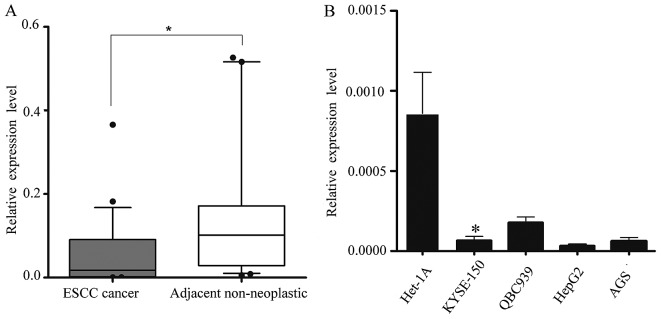
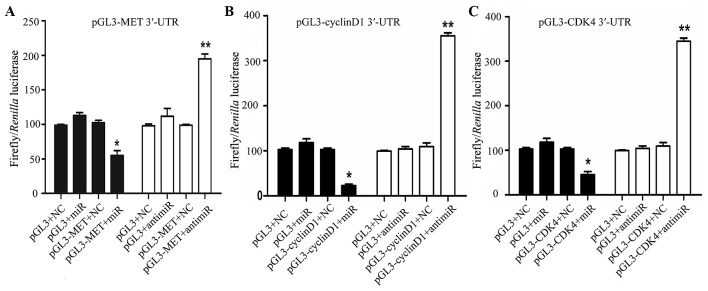
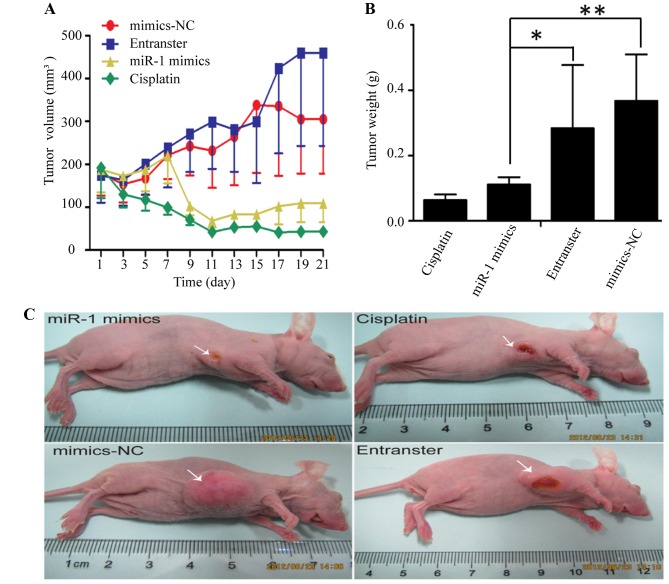
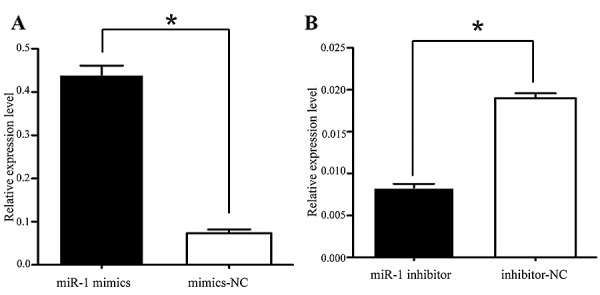
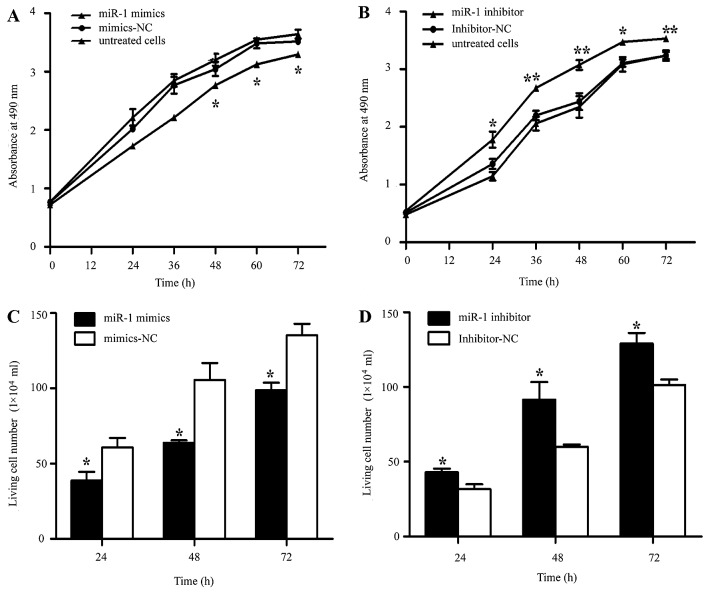
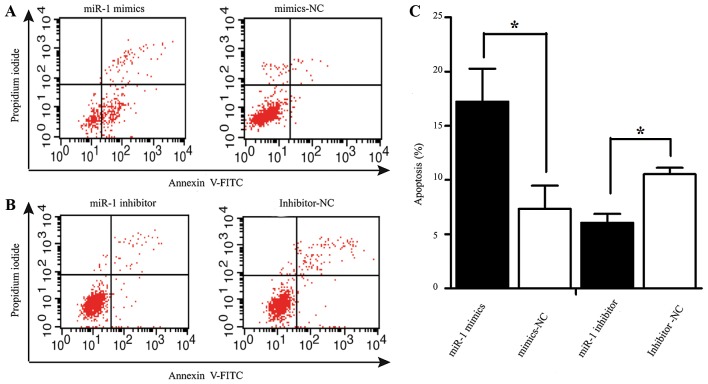
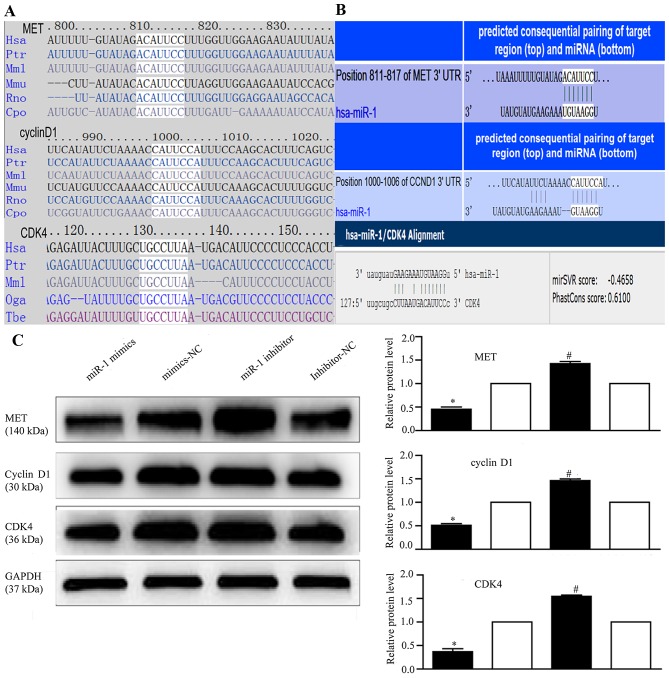
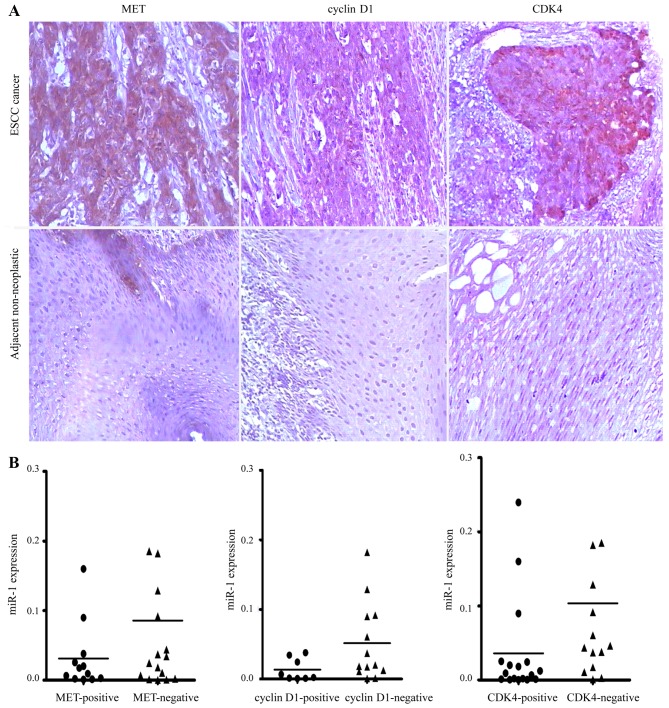
Several aberrant microRNAs (miRNAs or miRs) have been implicated in esophageal cancer (EC), which is widely prevalent in China. However, their role in EC tumorigenesis has not yet been fully elucidated. In the present study, we determined that miR‑1 was downregulated in esophageal squamous cell carcinoma (ESCC) tissues compared with adjacent non-neoplastic tissues using RT-qPCR, and confirmed this using an ESCC cell line. Using a nude mouse xenograft model, we confirmed that the re-expression of miR‑1 significantly inhibited ESCC tumor growth. A tetrazolium assay and a trypan blue exclusion assay revealed that miR‑1 suppressed ESCC cell proliferation and increased apoptosis, whereas the silencing of miR‑1 promoted cell proliferation and decreased apoptosis, suggesting that miR‑1 is a novel tumor suppressor. To elucidate the molecular mechanisms of action of miR‑1 in ESCC, we investigated putative targets using bioinformatics tools. MET, cyclin D1 and cyclin-dependent kinase 4 (CDK4), which are involved in the hepatocyte growth factor (HGF)/MET signaling pathway, were found to be targets of miR‑1. miR‑1 expression inversely correlated with MET, cyclin D1 and CDK4 expression in ESCC cells. miR‑1 directly targeted MET, cyclin D1 and CDK4, suppressing ESCC cell growth. The newly identified miR‑1/MET/cyclin D1/CDK4 axis provides new insight into the molecular mechanisms of ESCC pathogenesis and indicates a novel strategy for the diagnosis and treatment of ESCC.
几种异常的微小RNA(miRNA或miR)与食管癌(EC)有关,食管癌在中国广泛流行。然而,它们在EC肿瘤发生中的作用尚未完全阐明。在本研究中,我们使用RT-qPCR确定与相邻非肿瘤组织相比,miR-1在食管鳞状细胞癌(ESCC)组织中表达下调,并使用ESCC细胞系证实了这一点。使用裸鼠异种移植模型,我们证实miR-1的重新表达显著抑制了ESCC肿瘤生长。四唑盐测定法和台盼蓝排斥试验表明,miR-1抑制ESCC细胞增殖并增加凋亡,而miR-1的沉默促进细胞增殖并减少凋亡,表明miR-1是一种新型肿瘤抑制因子。为了阐明miR-1在ESCC中的分子作用机制,我们使用生物信息学工具研究了推定的靶标。发现参与肝细胞生长因子(HGF)/MET信号通路的MET、细胞周期蛋白D1和细胞周期蛋白依赖性激酶4(CDK4)是miR-1的靶标。miR-1表达与ESCC细胞中MET、细胞周期蛋白D1和CDK4表达呈负相关。miR-1直接靶向MET、细胞周期蛋白D1和CDK4,抑制ESCC细胞生长。新发现的miR-1/MET/细胞周期蛋白D1/CDK4轴为ESCC发病机制的分子机制提供了新的见解,并指出了ESCC诊断和治疗的新策略。