Baidjoe Amrish Y, Stevenson Jennifer, Knight Philip, Stone William, Stresman Gillian, Osoti Victor, Makori Euniah, Owaga Chrispin, Odongo Wycliffe, China Pauline, Shagari Shehu, Kariuki Simon, Drakeley Chris, Cox Jonathan, Bousema Teun
Department of Medical Microbiology, Radboud University Medical Centre, Geert Grooteplein 26-28, 6525, GA, Nijmegen, The Netherlands.
European Programme for Public Health Microbiology Training, European Centre of Disease Prevention and Control (ECDC), Stockholm, Sweden.
Malar J. 2016 Jun 4;15:307. doi: 10.1186/s12936-016-1362-y.
The East African highlands are fringe regions between stable and unstable malaria transmission. What factors contribute to the heterogeneity of malaria exposure on different spatial scales within larger foci has not been extensively studied. In a comprehensive, community-based cross-sectional survey an attempt was made to identify factors that drive the macro- and micro epidemiology of malaria in a fringe region using parasitological and serological outcomes.
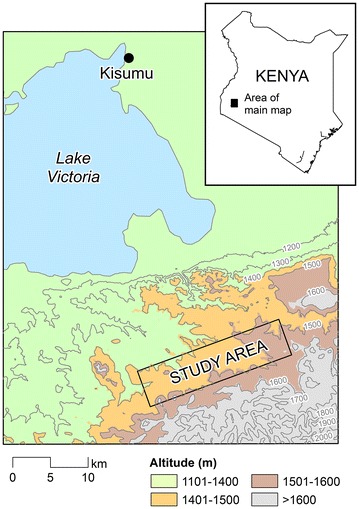
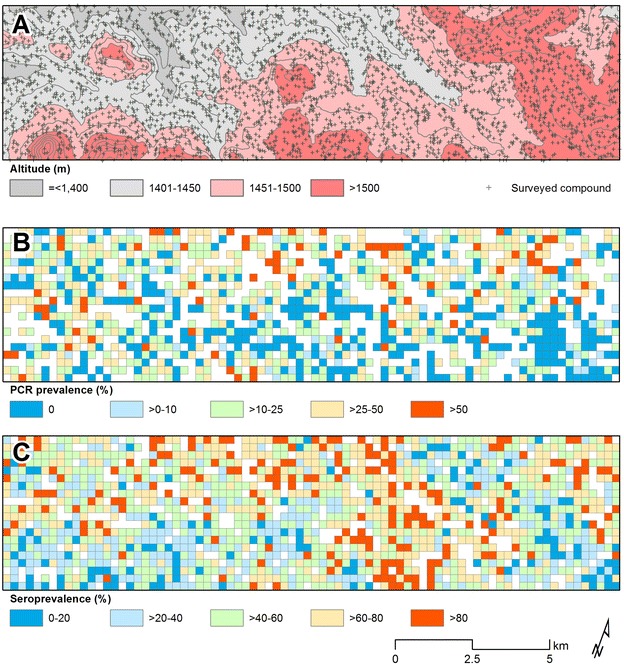
A large cross-sectional survey including 17,503 individuals was conducted across all age groups in a 100 km(2) area in the Western Kenyan highlands of Rachuonyo South district. Households were geo-located and prevalence of malaria parasites and malaria-specific antibodies were determined by PCR and ELISA. Household and individual risk-factors were recorded. Geographical characteristics of the study area were digitally derived using high-resolution satellite images.
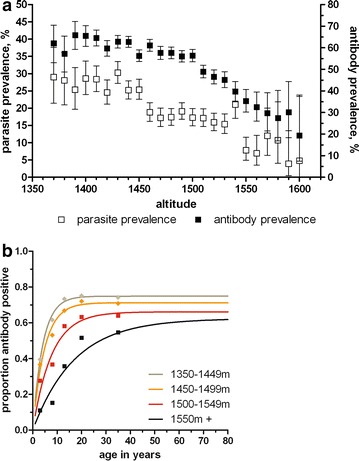
Malaria antibody prevalence strongly related to altitude (1350-1600 m, p < 0.001). A strong negative association with increasing altitude and PCR parasite prevalence was found. Parasite carriage was detected at all altitudes and in all age groups; 93.2 % (2481/2663) of malaria infections were apparently asymptomatic. Malaria parasite prevalence was associated with age, bed net use, house construction features, altitude and topographical wetness index. Antibody prevalence was associated with all these factors and distance to the nearest water body.
Altitude was a major driver of malaria transmission in this study area, even across narrow altitude bands. The large proportion of asymptomatic parasite carriers at all altitudes and the age-dependent acquisition of malaria antibodies indicate stable malaria transmission; the strong correlation between current parasite carriage and serological markers of malaria exposure indicate temporal stability of spatially heterogeneous transmission.
东非高地是疟疾稳定传播区与不稳定传播区之间的边缘地带。在较大疫区内,不同空间尺度上疟疾暴露的异质性受哪些因素影响,目前尚未得到广泛研究。在一项基于社区的综合性横断面调查中,我们试图利用寄生虫学和血清学结果,确定在一个边缘地区推动疟疾宏观和微观流行病学的因素。
在肯尼亚西部高地拉乔尼奥南区100平方公里的区域内,对所有年龄组进行了一项大规模横断面调查,共纳入17503人。对家庭进行地理位置定位,并通过聚合酶链反应(PCR)和酶联免疫吸附测定(ELISA)确定疟原虫和疟疾特异性抗体的流行情况。记录家庭和个人的危险因素。利用高分辨率卫星图像,通过数字方式得出研究区域的地理特征。
疟疾抗体流行率与海拔高度密切相关(1350 - 1600米,p < 0.001)。发现海拔升高与PCR疟原虫流行率呈强烈负相关。在所有海拔高度和所有年龄组均检测到寄生虫携带情况;93.2%(2481/2663)的疟疾感染显然无症状。疟原虫流行率与年龄、蚊帐使用情况、房屋建筑特征、海拔高度和地形湿度指数有关。抗体流行率与所有这些因素以及到最近水体的距离有关。
在本研究区域,海拔高度是疟疾传播的主要驱动因素,即使在狭窄的海拔范围内也是如此。所有海拔高度无症状寄生虫携带者的比例很高,以及疟疾抗体的年龄依赖性获得表明疟疾传播稳定;当前寄生虫携带情况与疟疾暴露血清学标志物之间的强相关性表明空间异质性传播的时间稳定性。