Gastner Michael T, Ódor Géza
Yale-NUS College, 16 College Avenue West, #01-220 Singapore 138527.
MTA-EK-MFA, Research Center for Energy, Hungarian Academy of Sciences, P. O. Box 49, H-1525 Budapest, Hungary.
Sci Rep. 2016 Jun 7;6:27249. doi: 10.1038/srep27249.
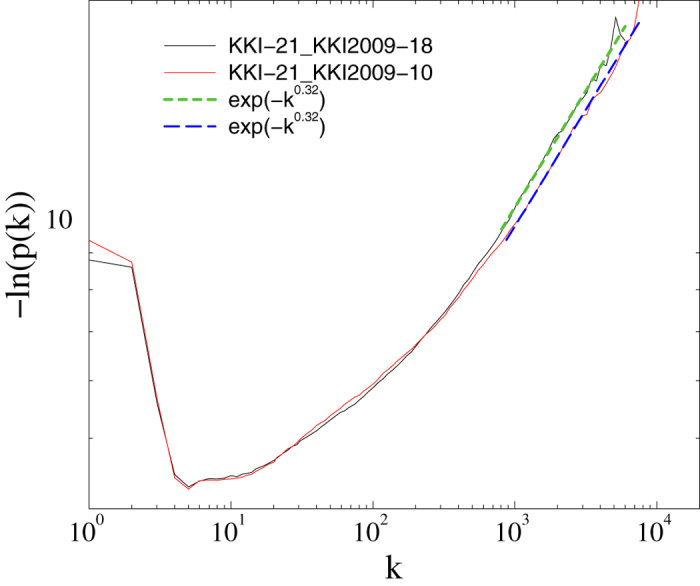
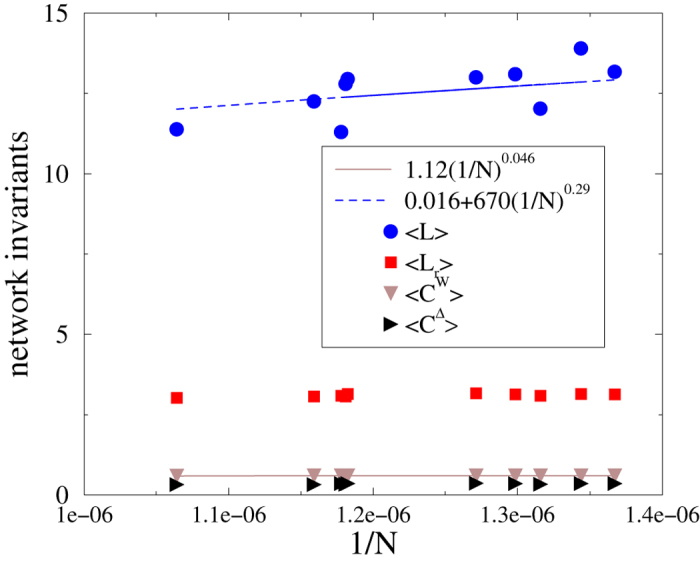
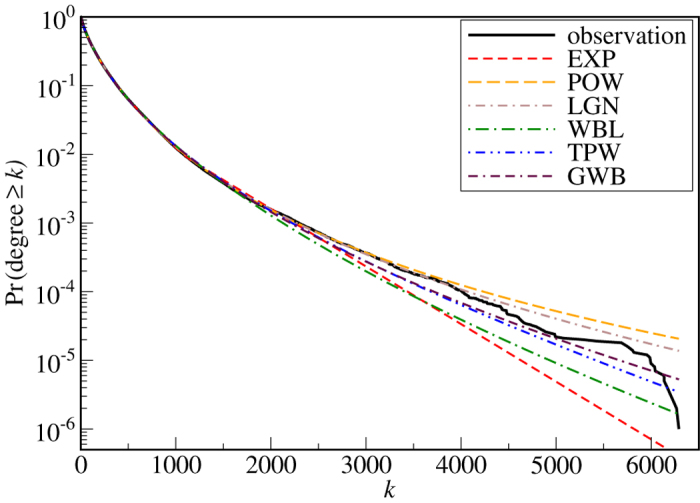
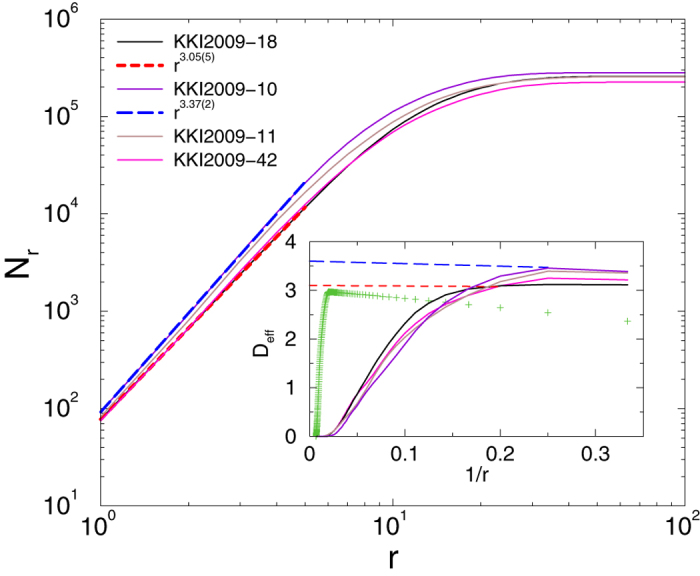
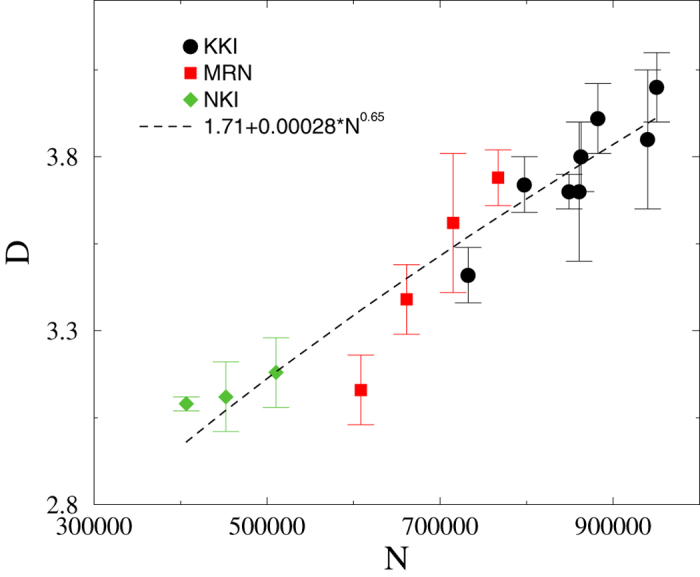
The structural human connectome (i.e. the network of fiber connections in the brain) can be analyzed at ever finer spatial resolution thanks to advances in neuroimaging. Here we analyze several large data sets for the human brain network made available by the Open Connectome Project. We apply statistical model selection to characterize the degree distributions of graphs containing up to nodes and edges. A three-parameter generalized Weibull (also known as a stretched exponential) distribution is a good fit to most of the observed degree distributions. For almost all networks, simple power laws cannot fit the data, but in some cases there is statistical support for power laws with an exponential cutoff. We also calculate the topological (graph) dimension D and the small-world coefficient σ of these networks. While σ suggests a small-world topology, we found that D < 4 showing that long-distance connections provide only a small correction to the topology of the embedding three-dimensional space.
得益于神经成像技术的进步,人类大脑结构连接组(即大脑中的纤维连接网络)能够以越来越精细的空间分辨率进行分析。在此,我们分析了开放连接组计划提供的几个关于人类大脑网络的大型数据集。我们应用统计模型选择来刻画包含多达节点和边的图的度分布。三参数广义威布尔分布(也称为拉伸指数分布)能很好地拟合大多数观测到的度分布。对于几乎所有网络,简单幂律都无法拟合数据,但在某些情况下,有统计证据支持具有指数截断的幂律。我们还计算了这些网络的拓扑(图)维度D和小世界系数σ。虽然σ表明具有小世界拓扑结构,但我们发现D < 4,这表明长距离连接对嵌入三维空间的拓扑结构仅提供了很小的修正。