Matsumoto Hirotaka, Kiryu Hisanori
Bioinformatics Research Unit, Advanced Center for Computing and Communication, RIKEN, 2-1 Hirosawa, Wako, Saitama, 351-0198, Japan.
Department of Computational Biology and Medical Sciences, Faculty of Frontier Sciences, The University of Tokyo, 5-1-5 Kashiwanoha, Kashiwa, Chiba, 277-8561, Japan.
BMC Bioinformatics. 2016 Jun 8;17(1):232. doi: 10.1186/s12859-016-1109-3.
Single-cell technologies make it possible to quantify the comprehensive states of individual cells, and have the power to shed light on cellular differentiation in particular. Although several methods have been developed to fully analyze the single-cell expression data, there is still room for improvement in the analysis of differentiation.
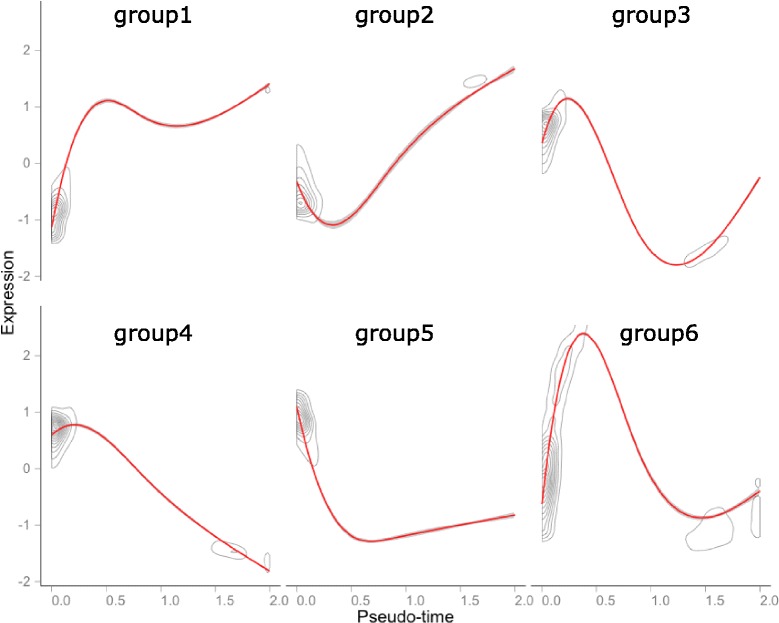
In this paper, we propose a novel method SCOUP to elucidate differentiation process. Unlike previous dimension reduction-based approaches, SCOUP describes the dynamics of gene expression throughout differentiation directly, including the degree of differentiation of a cell (in pseudo-time) and cell fate. SCOUP is superior to previous methods with respect to pseudo-time estimation, especially for single-cell RNA-seq. SCOUP also successfully estimates cell lineage more accurately than previous method, especially for cells at an early stage of bifurcation. In addition, SCOUP can be applied to various downstream analyses. As an example, we propose a novel correlation calculation method for elucidating regulatory relationships among genes. We apply this method to a single-cell RNA-seq data and detect a candidate of key regulator for differentiation and clusters in a correlation network which are not detected with conventional correlation analysis.
We develop a stochastic process-based method SCOUP to analyze single-cell expression data throughout differentiation. SCOUP can estimate pseudo-time and cell lineage more accurately than previous methods. We also propose a novel correlation calculation method based on SCOUP. SCOUP is a promising approach for further single-cell analysis and available at https://github.com/hmatsu1226/SCOUP.
单细胞技术使量化单个细胞的综合状态成为可能,尤其有助于揭示细胞分化过程。尽管已经开发了几种方法来全面分析单细胞表达数据,但在分化分析方面仍有改进空间。
在本文中,我们提出了一种新方法SCOUP来阐明分化过程。与以前基于降维的方法不同,SCOUP直接描述了整个分化过程中基因表达的动态,包括细胞的分化程度(在伪时间内)和细胞命运。在伪时间估计方面,SCOUP优于以前的方法,特别是对于单细胞RNA测序。与以前的方法相比,SCOUP还能更准确地估计细胞谱系,特别是对于处于分叉早期的细胞。此外,SCOUP可应用于各种下游分析。例如,我们提出了一种新的相关性计算方法来阐明基因之间的调控关系。我们将此方法应用于单细胞RNA测序数据,并在相关网络中检测到一个分化关键调节因子的候选者以及传统相关性分析未检测到的聚类。
我们开发了一种基于随机过程的方法SCOUP来分析整个分化过程中的单细胞表达数据。与以前的方法相比,SCOUP能够更准确地估计伪时间和细胞谱系。我们还基于SCOUP提出了一种新的相关性计算方法。SCOUP是一种有前途的进一步单细胞分析方法,可在https://github.com/hmatsu1226/SCOUP上获取。