Mergenthal Karola, Beyer Martin, Gerlach Ferdinand M, Guethlin Corina
Institute of General Practice, Goethe-University Frankfurt, Frankfurt/Main, Germany.
PLoS One. 2016 Jun 9;11(6):e0157248. doi: 10.1371/journal.pone.0157248. eCollection 2016.
Expected growth in the demand for health services has generated interest in the more effective deployment of health care assistants. Programs encouraging German general practitioners (GPs) to share responsibility for care with specially qualified health care assistants in the family practice (VERAHs) have existed for several years. But no studies have been conducted on the tasks German GPs are willing to rely on specially qualified personnel to perform, what they are prepared to delegate to all non-physician practice staff and what they prefer to do themselves.
As part of an evaluation study on the deployment of VERAHs in GP-centered health care, we used a questionnaire to ask about task delegation within the practice team. From a list of tasks that VERAHs are specifically trained to carry out, GPs were asked to indicate which they actually delegate. We also asked GPs why they had employed a VERAH in their practice and for their opinions on the benefits and limitations of assigning tasks to VERAHs. The aim of the study was to find out which tasks GPs delegate to their specially qualified personnel, which they permit all HCAs to carry out, and which tasks they do not delegate at all.
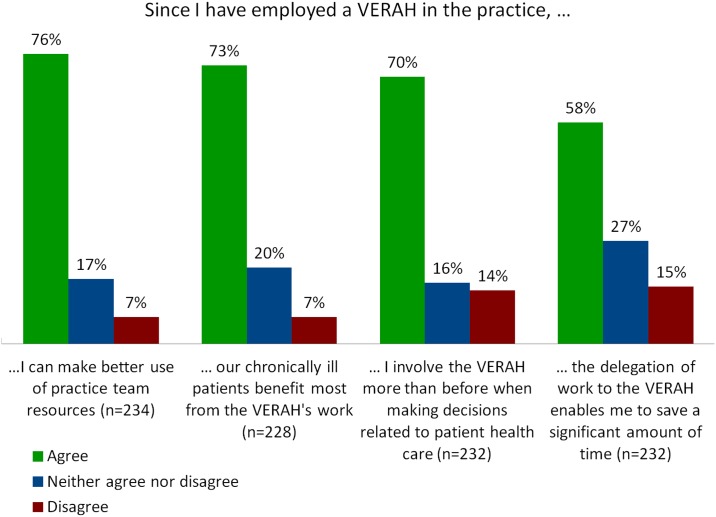
The survey was filled in and returned by 245 GPs (83%). Some tasks were exclusively delegated to VERAHs (e.g. home visits), while others were delegated to all HCAs (e.g. vaccinations). About half the GPs rated the assessment of mental health, as part of the comprehensive assessment of a patient's condition, as the sole responsibility of a GP. The possibility to delegate more complex tasks was the main reason given for employing a VERAH. Doctors said the delegation of home visits provided them with the greatest relief.
In Germany, where GPs are solely accountable for the health care provided in their practices, experience with the transfer of responsibility to other non-physician health care personnel is still very limited. When HCAs have undergone special training, GPs seem to be prepared to delegate tasks that demand a substantial degree of know-how, such as home visits and case management. This "new" role allocation within the practice may signal a shift in the provision of health care by family practice teams in Germany.
卫生服务需求的预期增长引发了人们对更有效地部署医疗保健助理的兴趣。鼓励德国全科医生(GP)与家庭医疗中具备特殊资质的医疗保健助理(VERAH)分担护理责任的项目已经开展了数年。但尚未有研究探讨德国全科医生愿意让具备特殊资质的人员执行哪些任务,他们准备委托给所有非医师执业人员哪些工作,以及他们自己更倾向于做哪些工作。
作为一项关于在以全科医生为中心的医疗保健中部署VERAH的评估研究的一部分,我们使用问卷调查了执业团队内部的任务委托情况。从一份VERAH接受过专门培训的任务清单中,我们询问全科医生实际委托了哪些任务。我们还询问全科医生在其诊所聘用VERAH的原因,以及他们对将任务分配给VERAH的益处和局限性的看法。该研究的目的是找出全科医生委托给其具备特殊资质人员的任务、允许所有医疗保健助理执行的任务以及他们根本不委托的任务。
2�5名全科医生(83%)填写并返回了调查问卷。一些任务专门委托给VERAH(如家访),而其他任务则委托给所有医疗保健助理(如疫苗接种)。约一半的全科医生将心理健康评估作为患者病情综合评估的一部分,视为全科医生的唯一职责。委托更复杂任务的可能性是聘用VERAH的主要原因。医生们表示,家访的委托给他们带来了最大的解脱。
在德国,全科医生对其诊所提供的医疗保健负全部责任,将责任转移给其他非医师医疗保健人员的经验仍然非常有限。当医疗保健助理接受过特殊培训时,全科医生似乎准备委托需要相当专业知识的任务,如家访和病例管理。诊所内这种“新”的角色分配可能标志着德国家庭医疗团队提供医疗保健方式的转变。