Lin Serena Y C, Toyoda Hidenori, Kumada Takashi, Liu Hsin-Fu
Department of Bioscience and Biotechnology, National Taiwan Ocean University, Keelung, Taiwan.
Department of Medical Research, Mackay Memorial Hospital, Taipei, Taiwan.
PLoS One. 2016 Jun 9;11(6):e0157103. doi: 10.1371/journal.pone.0157103. eCollection 2016.
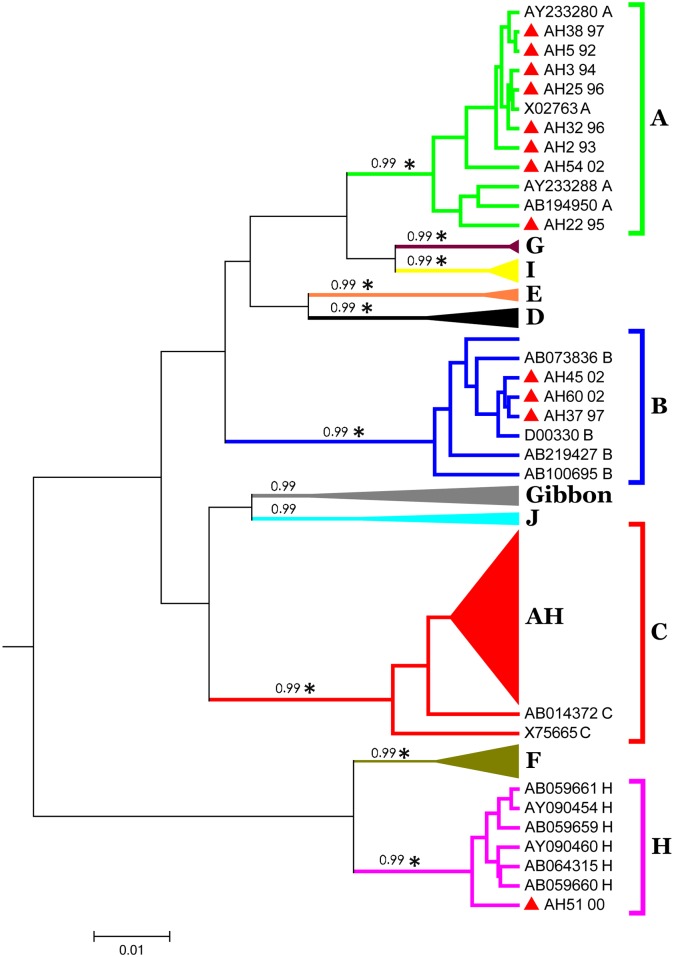
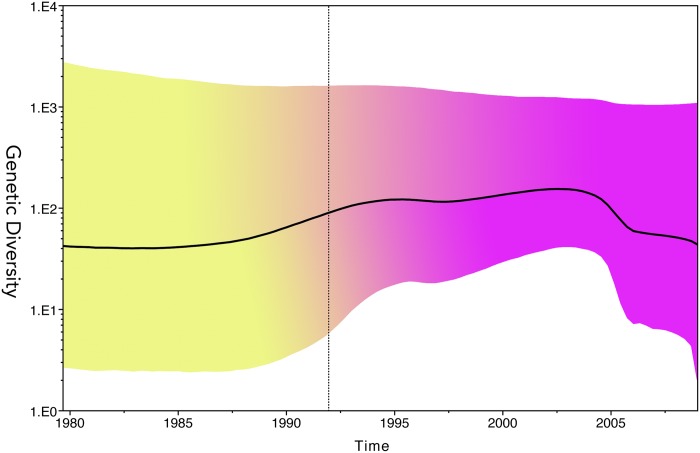
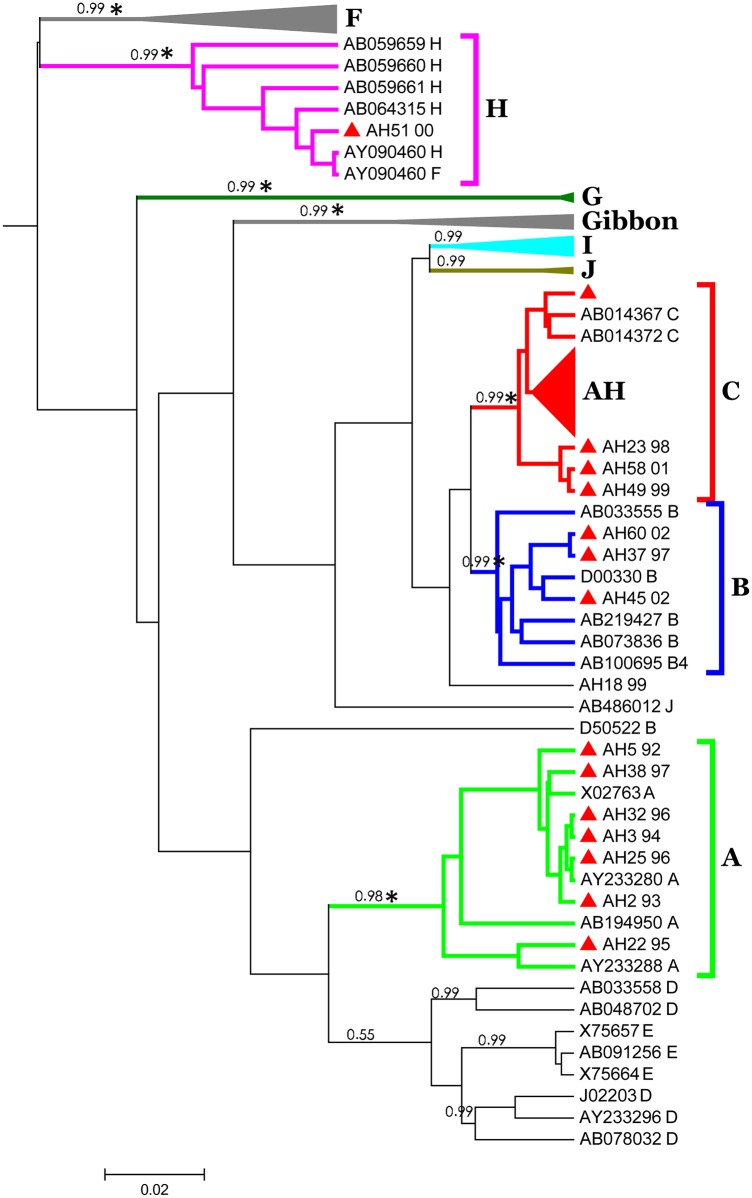
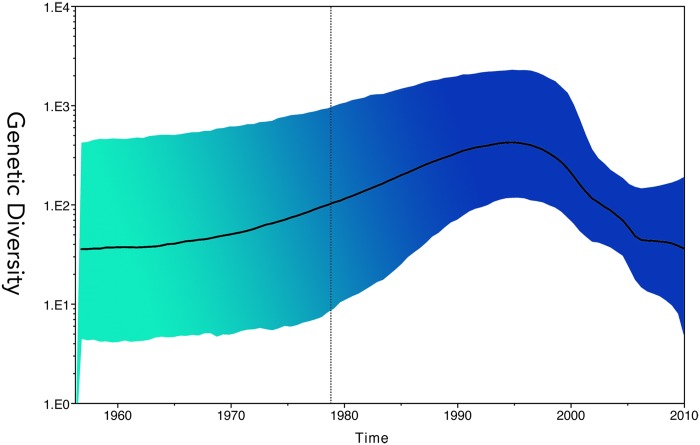
Hepatitis B virus (HBV) is prevalent worldwide and causes liver diseases, including acute and chronic hepatitis. Ten HBV genotypes (A-J) with distinct geographic distributions have been reported. Cases of acute HBV infection with genotype A have increased in Japan nationwide since the 1990s, mainly through sexual transmission. To investigate the molecular evolution and phylodynamics of HBV genotypes, we collected acute HBV isolates acquired in Japan from 1992-2002. Full genomes were obtained for comprehensive phylogenetic and phylodynamic analysis, with other Japanese HBV sequences from GenBank that were isolated during 1991-2010. HBV genotypes were classified using the maximum-likelihood and Bayesian methods. The GMRF Bayesian Skyride was used to estimate the evolution and population dynamics of HBV. Four HBV genotypes (A, B, C, and H) were identified, of which C was the major genotype. The phylodynamic results indicated an exponential growth between the 1960s and early 1990s; this was followed by a population bottleneck after 1995, possibly linked with successful implementation of a nationwide vaccination program. However, HBV/A increased from 1990 to 2003-2004, and then started to decrease. The prevalence of genotype A has increased over the past 10 years. Phylodynamic inference clearly demonstrates a steady population growth compatible with an ongoing subepidemic; this might be due to the loss of immunity to HBV in adolescents and people being born before the vaccination program. This is the first phylodynamic study of HBV infection in Japan and will facilitate understanding the molecular epidemiology and long-term evolutionary dynamics of this virus in Japan.
乙型肝炎病毒(HBV)在全球范围内广泛流行,可引发包括急性和慢性肝炎在内的肝脏疾病。目前已报道了10种具有不同地理分布的HBV基因型(A - J)。自20世纪90年代以来,日本全国范围内由A型基因型引起的急性HBV感染病例有所增加,主要通过性传播。为了研究HBV基因型的分子进化和系统动力学,我们收集了1992年至2002年在日本获得的急性HBV分离株。获取了完整基因组用于全面的系统发育和系统动力学分析,并结合了来自GenBank的1991年至2010年期间在日本分离的其他HBV序列。使用最大似然法和贝叶斯方法对HBV基因型进行分类。采用GMRF贝叶斯Skyride方法估计HBV的进化和种群动态。鉴定出4种HBV基因型(A、B、C和H),其中C型是主要基因型。系统动力学结果表明,在20世纪60年代至90年代初呈指数增长;1995年后出现种群瓶颈,这可能与全国疫苗接种计划的成功实施有关。然而,HBV/A在1990年至2003 - 2004年期间增加,随后开始下降。在过去10年中,A型基因型的流行率有所上升。系统动力学推断清楚地表明种群稳定增长,这与正在发生的局部流行相符;这可能是由于青少年和疫苗接种计划实施前出生的人群对HBV免疫力丧失所致。这是日本首次对HBV感染进行系统动力学研究,将有助于了解该病毒在日本的分子流行病学和长期进化动态。