Lòpez-De Fede Ana, Stewart John E, Hardin James W, Mayfield-Smith Kathy
Institute for Families in Society, University of South Carolina, 1600 Hampton Street, Suite 507, Columbia, 29208, SC, USA.
Department of Epidemiology and Biostatistics, Arnold School of Public Health, University of South Carolina, 915 Greene Street, Room 445, Columbia, SC, USA.
Int J Equity Health. 2016 Jun 10;15:89. doi: 10.1186/s12939-016-0378-9.
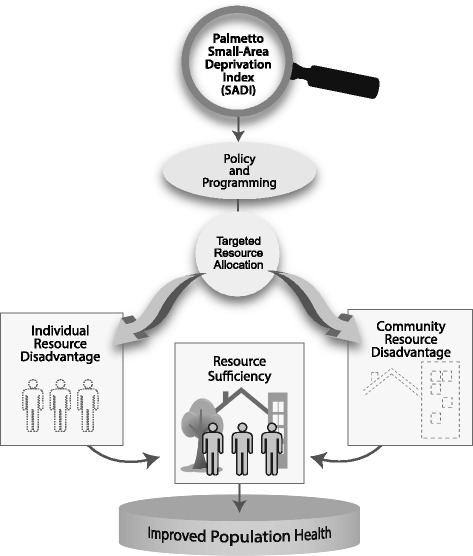
Measures of small-area deprivation may be valuable in geographically targeting limited resources to prevent, diagnose, and effectively manage chronic conditions in vulnerable populations. We developed a census-based small-area socioeconomic deprivation index specifically to predict chronic disease burden among publically insured Medicaid recipients in South Carolina, a relatively poor state in the southern United States. We compared the predictive ability of the new index with that of four other small-area deprivation indicators.
To derive the ZIP Code Tabulation Area-Level Palmetto Small-Area Deprivation Index (Palmetto SADI), we evaluated ten census variables across five socioeconomic deprivation domains, identifying the combination of census indicators most highly correlated with a set of five chronic disease conditions among South Carolina Medicaid enrollees. In separate validation studies, we used both logistic and spatial regression methods to assess the ability of Palmetto SADI to predict chronic disease burden among state Medicaid recipients relative to four alternative small-area socioeconomic deprivation measures: the Townsend index of material deprivation; a single-variable poverty indicator; and two small-area designations of health care resource deprivation, Primary Care Health Professional Shortage Area and Medically Underserved Area/Medically Underserved Population.
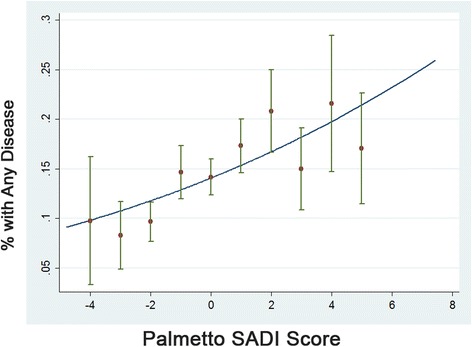
Palmetto SADI was the best predictor of chronic disease burden (presence of at least one condition and presence of two or more conditions) among state Medicaid recipients compared to all alternative deprivation measures tested.
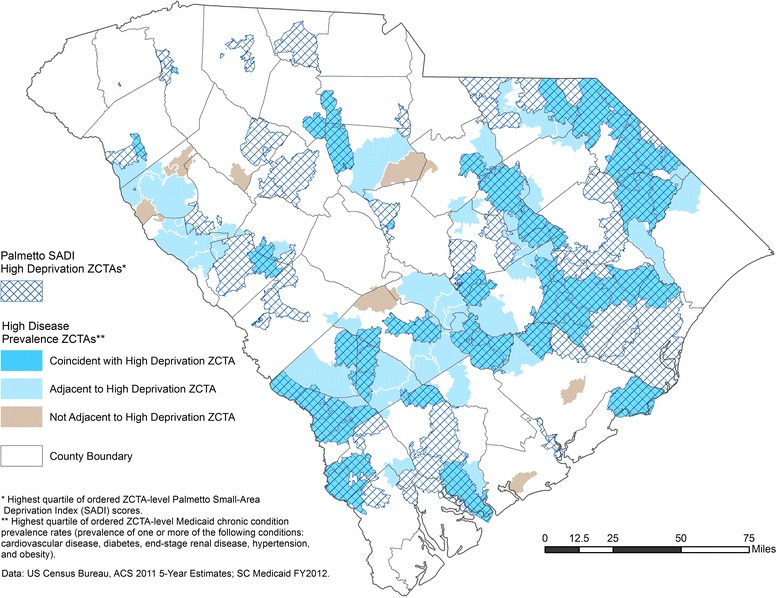
A low-cost, regionally optimized socioeconomic deprivation index, Palmetto SADI can be used to identify areas in South Carolina at high risk for chronic disease burden among Medicaid recipients and other low-income Medicaid-eligible populations for targeted prevention, screening, diagnosis, disease self-management, and care coordination activities.
小区域贫困衡量指标对于在地理上精准分配有限资源以预防、诊断和有效管理弱势群体的慢性病可能具有重要价值。我们专门开发了一种基于人口普查的小区域社会经济贫困指数,以预测南卡罗来纳州公共保险的医疗补助接受者中的慢性病负担,该州是美国南部一个相对贫困的州。我们将新指数的预测能力与其他四个小区域贫困指标的预测能力进行了比较。
为了得出邮政编码分区层面的棕榈州小区域贫困指数(Palmetto SADI),我们评估了五个社会经济贫困领域的十个普查变量,确定了与南卡罗来纳州医疗补助参保者中一组五种慢性病状况相关性最高的普查指标组合。在单独的验证研究中,我们使用逻辑回归和空间回归方法,评估Palmetto SADI相对于四种替代性小区域社会经济贫困衡量指标预测该州医疗补助接受者慢性病负担的能力:汤森物质剥夺指数;单变量贫困指标;以及两种医疗资源剥夺的小区域指定,即初级保健卫生专业人员短缺地区和医疗服务不足地区/医疗服务不足人群。
与所有测试的替代性贫困衡量指标相比,Palmetto SADI是该州医疗补助接受者慢性病负担(至少存在一种疾病状况和存在两种或更多疾病状况)的最佳预测指标。
Palmetto SADI是一种低成本、区域优化的社会经济贫困指数,可用于识别南卡罗来纳州医疗补助接受者和其他符合低收入医疗补助条件人群中慢性病负担高风险的地区,以开展有针对性的预防、筛查、诊断、疾病自我管理和护理协调活动。