Manyike Pius C, Chinawa Josephat M, Chinawa Awoere T, Obu Herbert A, Nwokocha Ada R C, Odetunde Odutola I
College of Medicine, Ebonyi State University/Department of Pediatrics, Federal Teaching Hospital, Abakiliki, Nigeria.
Department of Pediatrics, College of Medicine, University of Nigeria, Enugu Campus/University of Nigeria Teaching Hospital (UNTH), Ituku- Ozalla, Enugu State, 400001, Nigeria.
BMC Pediatr. 2016 Jun 9;16:78. doi: 10.1186/s12887-016-0615-9.
Psycho-active substance use among adolescents is a national and global problem and its attendant effects on adolescents cannot be overemphasized. The objectives of this study are to determine the prevalence and pattern of psychoactive substance use among adolescents; the substances involved and the extent of the problem in this locale.
This is a cross-sectional study that assesses the pattern of psychoactive substance use among secondary school adolescents in Enugu, south East, Nigeria. The study was carried out among adolescents attending six secondary boarding schools in Enugu metropolis of Enugu State of Nigeria. The WHO Student Drug Use Questionnaire was adapted for this study. Data were analyzed using the Statistical Package for Social Sciences program (SPSS), version 17. Chi-square and multivariate regression were used as a test of significance for qualitative variables. A p-value less than 0.05 were accepted as significant for each statistical test.
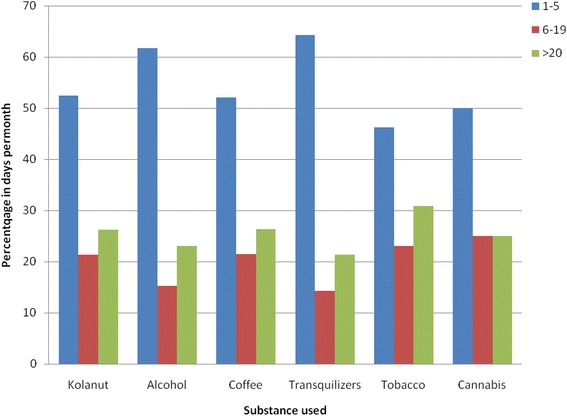
Out of 900, a total of 896 respondents, comprising 400 and 82 boys (482) (53.8 %) and 400 and 14 girls (414) (46.2 %) completed the questionnaires. This gave a response rate of 99.6 %. The study revealed that the prevalence of current use for psychoactive substances ranges from 0.4 to 34.9 % while that for life use ranges from 0.8 to 63.5 %. The least being cannabis and the most being kola nuts. Kola nut is the most widely used psychoactive substance both for current use, past year use and the respondents' life time use. It shows a lifetime prevalence of 63.5 % and a current use prevalence of 34.9 %. More than half of the users of each of the psychoactive substances take it occasionally, using them on 1-5 days in a month. On the other hand, almost one-quarter of the users of each of the substances take it on 20 or more days in a month.
The study revealed that the prevalence of current use for psychoactive substances ranges from 0.4 to 34.9 % while that for life use ranges from 0.8 to 63.5 %. The least being cannabis and the most being kola nuts.
青少年使用精神活性物质是一个国内和全球范围内的问题,其对青少年产生的影响再怎么强调都不为过。本研究的目的是确定青少年中精神活性物质使用的患病率和模式;所涉及的物质以及该地区该问题的严重程度。
这是一项横断面研究,评估尼日利亚东南部埃努古市中学青少年中精神活性物质的使用模式。该研究在尼日利亚埃努古州埃努古市六所中学寄宿学校的青少年中开展。世界卫生组织学生药物使用问卷被改编用于本研究。使用社会科学统计软件包(SPSS)第17版对数据进行分析。卡方检验和多变量回归被用作定性变量的显著性检验。每次统计检验的p值小于0.05被视为具有显著性。
在900名参与者中,共有896名受访者完成了问卷,其中男生482名(400 + 82)(53.8%),女生414名(400 + 14)(46.2%)。这给出了99.6%的回复率。研究显示,精神活性物质当前使用的患病率在0.4%至34.9%之间,而终身使用的患病率在0.8%至63.5%之间。最少的是大麻,最多的是可乐果。可乐果是当前使用、过去一年使用以及受访者终身使用中使用最广泛的精神活性物质。其终身患病率为63.5%,当前使用患病率为34.9%。每种精神活性物质的使用者中,超过一半的人偶尔使用,每月使用1 - 5天。另一方面,每种物质的使用者中几乎四分之一的人每月使用20天或更多天。
研究显示,精神活性物质当前使用的患病率在0.4%至34.9%之间,而终身使用的患病率在0.8%至63.5%之间。最少的是大麻,最多的是可乐果。