Lepping Rebecca J, Atchley Ruth Ann, Chrysikou Evangelia, Martin Laura E, Clair Alicia A, Ingram Rick E, Simmons W Kyle, Savage Cary R
Hoglund Brain Imaging Center, University of Kansas Medical Center, Kansas City, Kansas, United States of America.
Department of Psychology, University of Kansas, Lawrence, Kansas, United States of America.
PLoS One. 2016 Jun 10;11(6):e0156859. doi: 10.1371/journal.pone.0156859. eCollection 2016.
Anterior cingulate cortex (ACC) and striatum are part of the emotional neural circuitry implicated in major depressive disorder (MDD). Music is often used for emotion regulation, and pleasurable music listening activates the dopaminergic system in the brain, including the ACC. The present study uses functional MRI (fMRI) and an emotional nonmusical and musical stimuli paradigm to examine how neural processing of emotionally provocative auditory stimuli is altered within the ACC and striatum in depression.
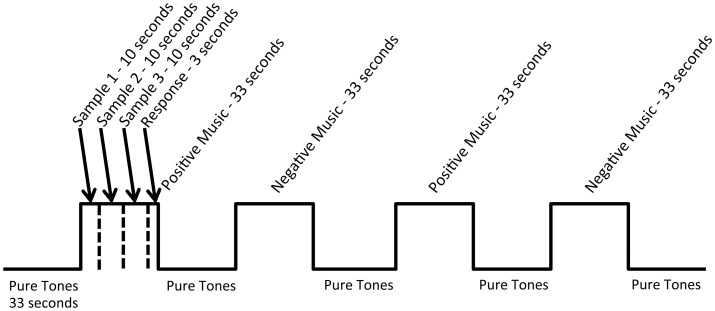
Nineteen MDD and 20 never-depressed (ND) control participants listened to standardized positive and negative emotional musical and nonmusical stimuli during fMRI scanning and gave subjective ratings of valence and arousal following scanning.
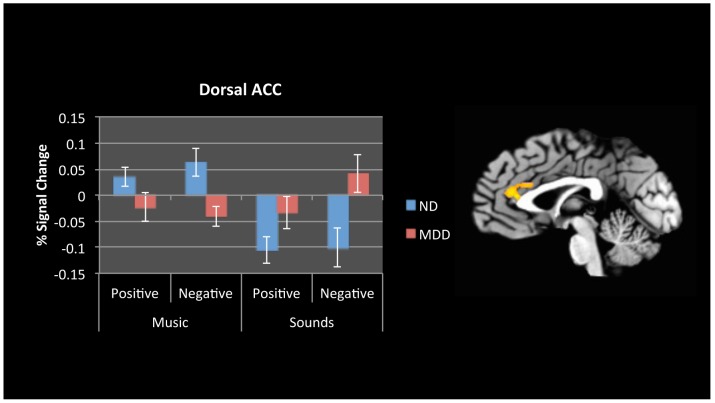
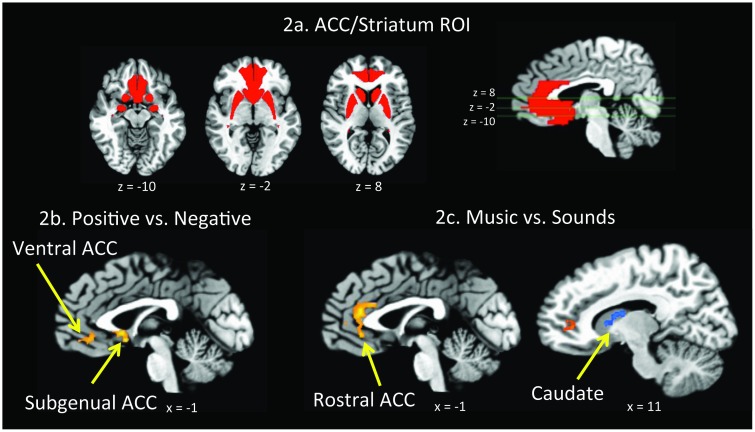
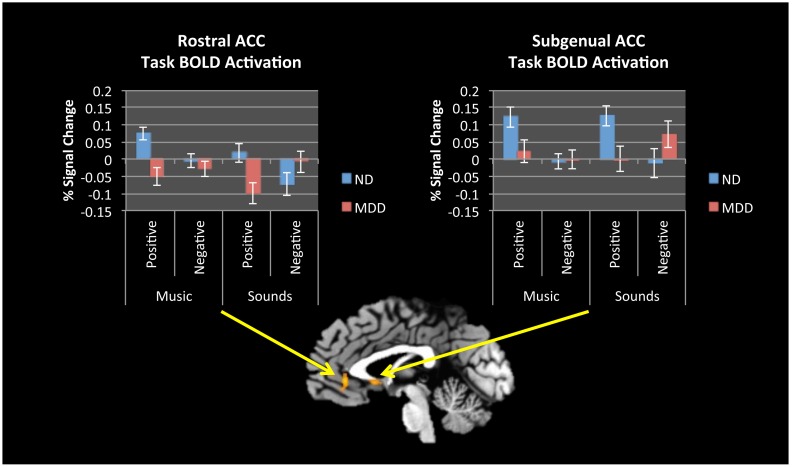
ND participants exhibited greater activation to positive versus negative stimuli in ventral ACC. When compared with ND participants, MDD participants showed a different pattern of activation in ACC. In the rostral part of the ACC, ND participants showed greater activation for positive information, while MDD participants showed greater activation to negative information. In dorsal ACC, the pattern of activation distinguished between the types of stimuli, with ND participants showing greater activation to music compared to nonmusical stimuli, while MDD participants showed greater activation to nonmusical stimuli, with the greatest response to negative nonmusical stimuli. No group differences were found in striatum.
These results suggest that people with depression may process emotional auditory stimuli differently based on both the type of stimulation and the emotional content of that stimulation. This raises the possibility that music may be useful in retraining ACC function, potentially leading to more effective and targeted treatments.
前扣带回皮质(ACC)和纹状体是与重度抑郁症(MDD)相关的情绪神经回路的一部分。音乐常被用于情绪调节,愉悦地聆听音乐能激活大脑中的多巴胺能系统,包括ACC。本研究使用功能磁共振成像(fMRI)以及情绪性非音乐和音乐刺激范式,来探究在抑郁症患者的ACC和纹状体中,情绪激发性听觉刺激的神经处理过程是如何改变的。
19名MDD患者和20名从未患过抑郁症(ND)的对照参与者在fMRI扫描期间聆听标准化的积极和消极情绪的音乐及非音乐刺激,并在扫描后对效价和唤醒度进行主观评分。
ND参与者在腹侧ACC中对积极刺激的激活程度高于消极刺激。与ND参与者相比,MDD参与者在ACC中的激活模式不同。在ACC的喙部,ND参与者对积极信息的激活程度更高,而MDD参与者对消极信息的激活程度更高。在背侧ACC中,激活模式因刺激类型而异,ND参与者对音乐的激活程度高于非音乐刺激,而MDD参与者对非音乐刺激的激活程度更高,对消极非音乐刺激的反应最为强烈。在纹状体中未发现组间差异。
这些结果表明,抑郁症患者可能根据刺激类型和刺激的情绪内容,对情绪性听觉刺激进行不同的处理。这增加了音乐可能有助于重新训练ACC功能的可能性,从而可能带来更有效和有针对性的治疗方法。