Mickey Brian J, Zhou Zhifeng, Heitzeg Mary M, Heinz Elizabeth, Hodgkinson Colin A, Hsu David T, Langenecker Scott A, Love Tiffany M, Peciña Marta, Shafir Tal, Stohler Christian S, Goldman David, Zubieta Jon-Kar
Molecular and Behavioral Neuroscience Institute, University of Michigan, 205 Zina Pitcher Pl, Ann Arbor, MI 48109-5720, USA.
Arch Gen Psychiatry. 2011 Feb;68(2):158-66. doi: 10.1001/archgenpsychiatry.2010.197.
Despite recent progress in describing the common neural circuitry of emotion and stress processing, the bases of individual variation are less well understood. Genetic variants that underlie psychiatric disease have proven particularly difficult to elucidate. Functional genetic variation of neuropeptide Y (NPY) was recently identified as a source of individual differences in emotion. Low NPY levels have been reported in major depressive disorder (MDD).
To determine whether low-expression NPY genotypes are associated with negative emotional processing at 3 levels of analysis.
Cross-sectional, case-control study.
Academic medical center.
Among 44 individuals with MDD and 137 healthy controls, 152 (84%) had an NPY genotype classified as low, intermediate, or high expression according to previously established haplotype-based expression data.
Healthy subjects participated in functional magnetic resonance imaging while viewing negative (vs neutral) words (n = 58) and rated positive and negative affect during a pain-stress challenge (n = 78). Genotype distribution was compared between 113 control subjects and 39 subjects with MDD.
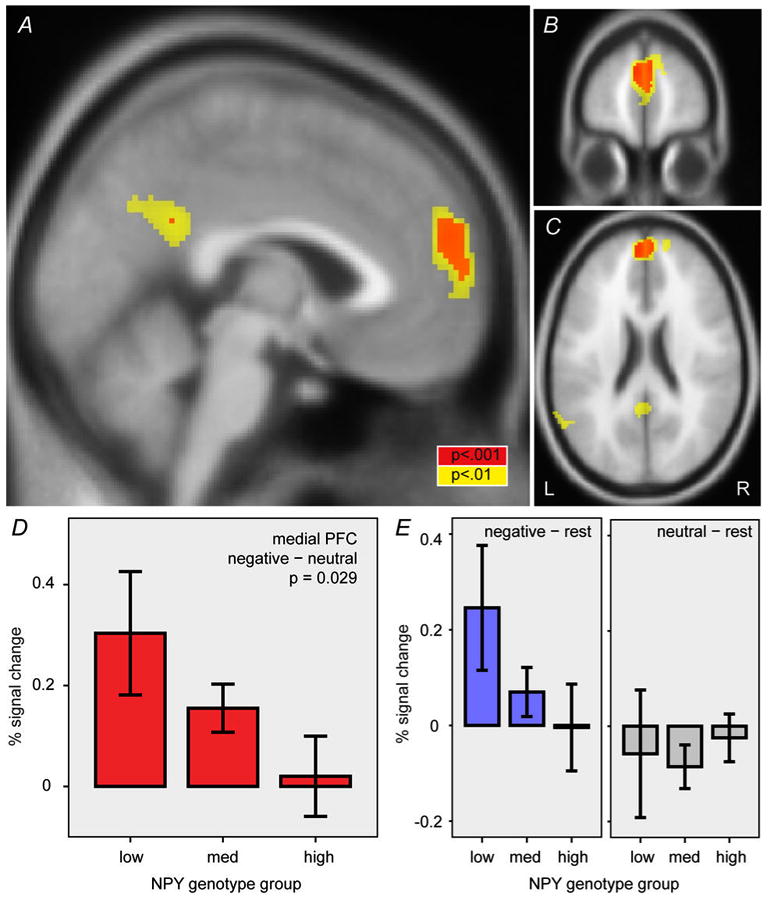
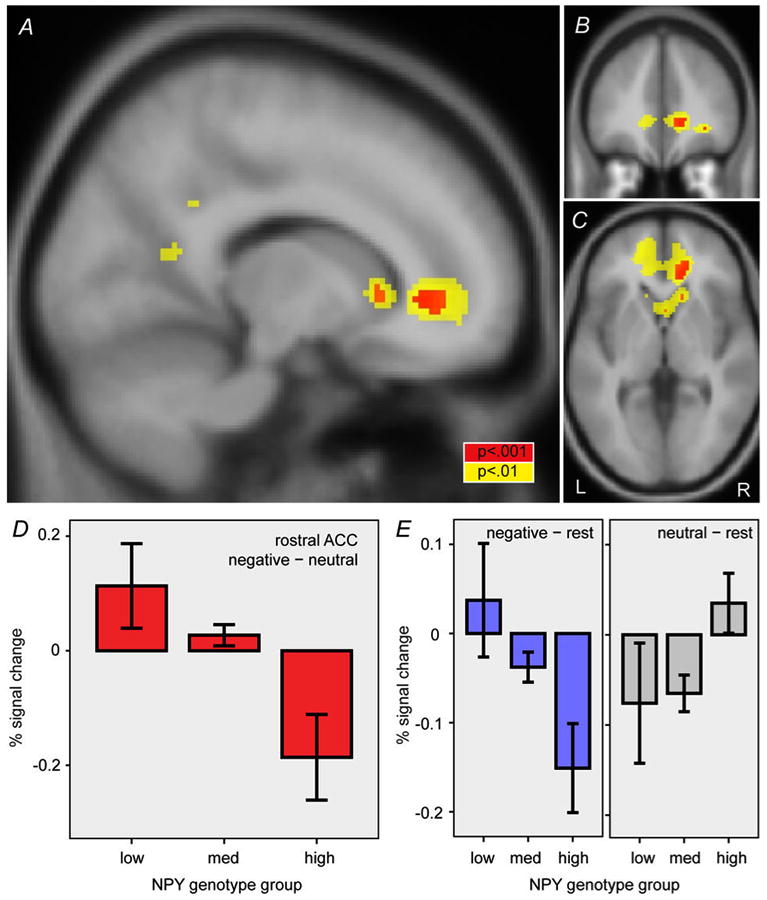
Among healthy individuals, negatively valenced words activated the medial prefrontal cortex. Activation within this region was inversely related to genotype-predicted NPY expression (P = .03). Whole-brain regression of responses to negative words showed that the rostral anterior cingulate cortex activated in the low-expression group and deactivated in the high-expression group (P < .05). During the stress challenge, individuals with low-expression NPY genotypes reported more negative affective experience before and after pain (P = .002). Low-expression NPY genotypes were overrepresented in subjects with MDD after controlling for age and sex (P = .004). Population stratification did not account for the results.
These findings support a model in which NPY genetic variation predisposes certain individuals to low NPY expression, thereby increasing neural responsivity to negative stimuli within key affective circuit elements, including the medial prefrontal and anterior cingulate cortices. These genetically influenced neural response patterns appear to mediate risk for some forms of MDD.
尽管近期在描述情绪与应激处理的常见神经回路方面取得了进展,但个体差异的基础仍未得到充分理解。已证实构成精神疾病基础的基因变异尤其难以阐明。神经肽Y(NPY)的功能性基因变异最近被确定为情绪个体差异的一个来源。据报道,重度抑郁症(MDD)患者的NPY水平较低。
在三个分析层面确定低表达NPY基因型是否与负性情绪处理相关。
横断面病例对照研究。
学术医疗中心。
在44名MDD患者和137名健康对照者中,根据先前建立的基于单倍型的表达数据,152人(84%)的NPY基因型被分类为低表达、中等表达或高表达。
健康受试者在观看负性(与中性相对)词语时(n = 58)参与功能磁共振成像,并在疼痛应激挑战期间(n = 78)对正负性情绪进行评分。比较了113名对照受试者和39名MDD受试者的基因型分布。
在健康个体中,负性词语激活了内侧前额叶皮层。该区域内的激活与基因型预测的NPY表达呈负相关(P = 0.03)。对负性词语反应的全脑回归显示,低表达组的喙部前扣带回皮层激活,高表达组则失活(P < 0.05)。在应激挑战期间,低表达NPY基因型的个体在疼痛前后报告了更多的负性情绪体验(P = 0.002)。在控制年龄和性别后,MDD患者中低表达NPY基因型的比例过高(P = 0.004)。群体分层不能解释这些结果。
这些发现支持一种模型,即NPY基因变异使某些个体易出现低NPY表达,从而增加关键情感回路元件(包括内侧前额叶和前扣带回皮层)对负性刺激的神经反应性。这些受基因影响的神经反应模式似乎介导了某些形式MDD的风险。