Mannan Munim, Mamun Abdullah, Doi Suhail, Clavarino Alexandra
School of Pharmacy, The University of Queensland, 20 Cornwall Street, Woolloongabba, 4102, Queensland, Australia.
School of Population Health, The University of Queensland, Herston Road, Herston, 4006, Queensland, Australia.
PLoS One. 2016 Jun 10;11(6):e0157240. doi: 10.1371/journal.pone.0157240. eCollection 2016.
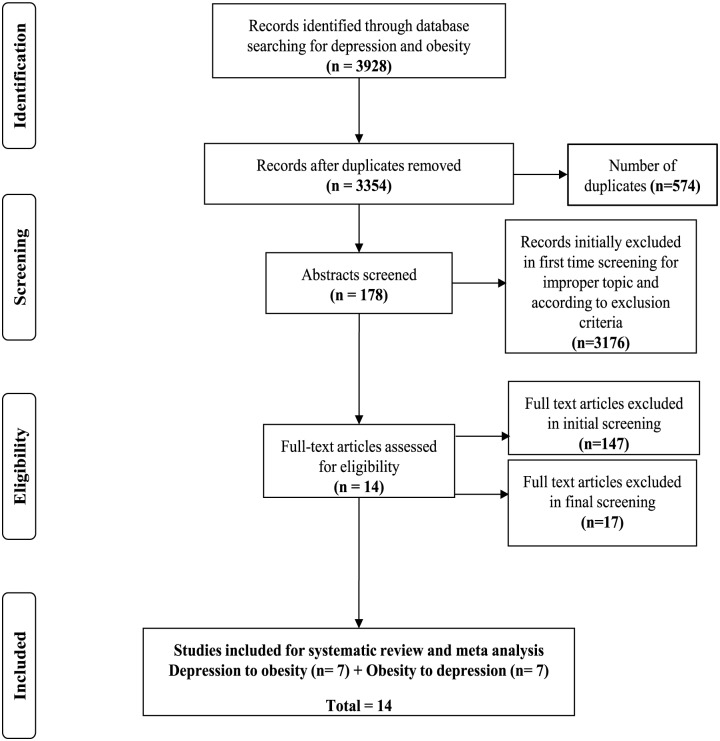
Adolescent obesity and depression are increasingly prevalent and are currently recognised as major public health concerns worldwide. The aim of this study is to evaluate the bi-directional associations between obesity and depression in adolescents using longitudinal studies. A systematic literature search was conducted using Pubmed (including Medline), PsycINFO, Embase, CINAHL, BIOSIS Preview and the Cochrane Library databases. According to the inclusion criteria, 13 studies were found where seven studies evaluated depression leading to obesity and six other studies examined obesity leading to depression. Using a bias-adjusted quality effects model for the meta-analysis, we found that adolescents who were depressed had a 70% (RR 1.70, 95% CI: 1.40, 2.07) increased risk of being obese, conversely obese adolescents had an increased risk of 40% (RR 1.40, 95% CI: 1.16, 1.70) of being depressed. The risk difference (RD) of early adolescent depression leading to obesity is 3% higher risk than it is for obesity leading to depression. In sensitivity analysis, the association between depression leading to obesity was greater than that of obesity leading to depression for females in early adulthood compared with females in late adolescence. Overall, the findings of this study suggest a bi-directional association between depression and obesity that was stronger for female adolescents. However, this finding also underscores the importance of early detection and treatment strategies to inhibit the development of reciprocal disorders.
青少年肥胖和抑郁症日益普遍,目前被公认为全球主要的公共卫生问题。本研究的目的是利用纵向研究评估青少年肥胖与抑郁症之间的双向关联。使用PubMed(包括Medline)、PsycINFO、Embase、CINAHL、BIOSIS Preview和Cochrane图书馆数据库进行了系统的文献检索。根据纳入标准,共找到13项研究,其中7项研究评估了抑郁症导致肥胖的情况,另外6项研究考察了肥胖导致抑郁症的情况。采用偏倚调整后的质量效应模型进行荟萃分析,我们发现,抑郁的青少年肥胖风险增加了70%(RR 1.70,95%CI:1.40,2.07),相反,肥胖青少年患抑郁症的风险增加了40%(RR 1.40,95%CI:1.16,1.70)。青少年早期抑郁症导致肥胖的风险差异(RD)比肥胖导致抑郁症的风险高3%。在敏感性分析中,与青春期后期女性相比,成年早期女性抑郁症导致肥胖的关联大于肥胖导致抑郁症的关联。总体而言,本研究结果表明抑郁症与肥胖之间存在双向关联,且在女性青少年中更强。然而,这一发现也强调了早期检测和治疗策略对于抑制相互性疾病发展的重要性。