Gupta Gaurav, Ahmad Sohail, Khan A H, Sherwani M K A, Khan Abdul Qayyum
Department of Orthopaedic Surgery, J. N. Medical College, AMU, Aligarh, Uttar Pradesh, India.
Department of Plastic Surgery, J. N. Medical College, AMU, Aligarh, Uttar Pradesh, India.
Indian J Orthop. 2016 May-Jun;50(3):290-6. doi: 10.4103/0019-5413.181780.
Gap nonunion of long bones is a challenging problem, due to the limitation of conventional reconstructive techniques more so if associated with infection and soft tissue defect. Treatment options such as autograft with non-vascularized fibula and cancellous bone graft, vascularized bone graft, and bone transportation are highly demanding on the part of surgeons and hospital setups and have many drawbacks. This study aims to analyze the outcome of patients with wide diaphyseal bone gap treated with induced-membrane technique (Masquelet technique).
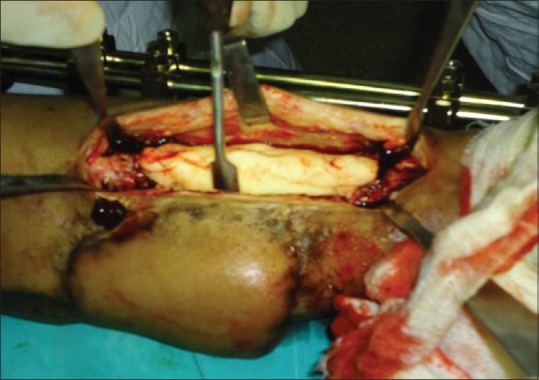
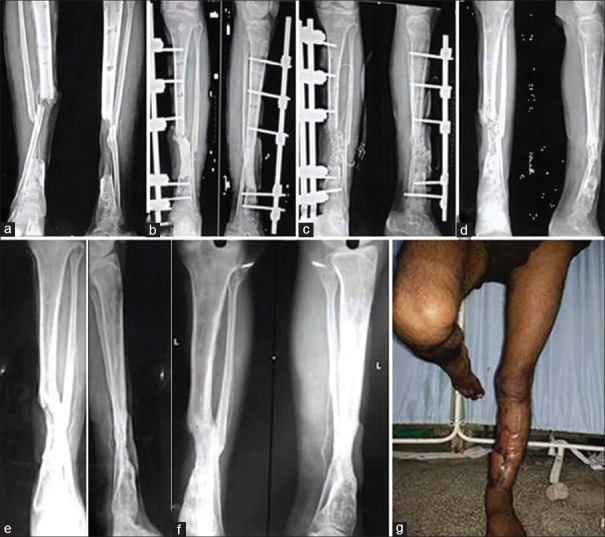
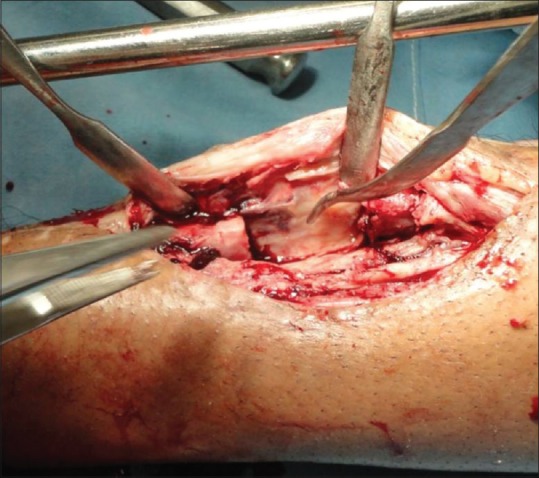
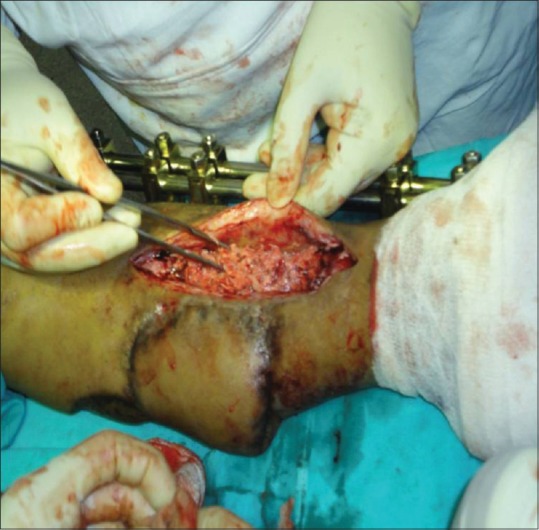
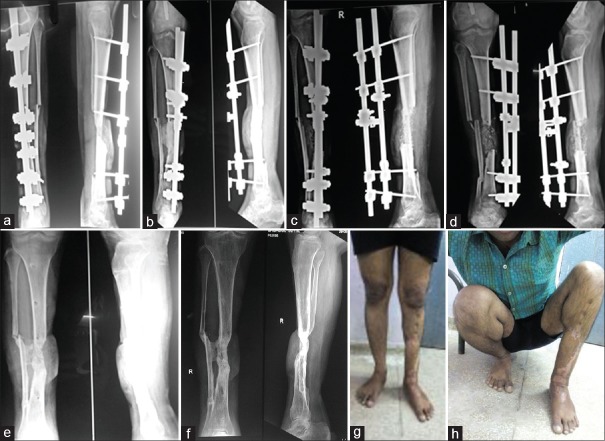
This study included 9 patients (7 males and 2 females), all with tibial bone-gap. Eight of the 9 patients were infected and in 3 patients there was associated large soft tissue defect requiring flap cover. This technique is two-stage procedure. Stage I surgery included debridement, fracture stabilization, application of spacer between bone ends, and soft tissue reconstruction. Stage II surgery included removal of spacer with preservation of induced membrane formed at spacer surface and filling the bone-gap with morselized iliac crest bone-graft within the membrane sleeve. Average bone-gap of 5.2 cm was treated. The spacer was always found to be encapsulated by a thick glistening membrane which did not collapse after its removal. All patients were followed up for an average period of 21.5 months.
Serial Radiographs showed regular uptake of autograft and thus consolidation within themselves in the region of bone gap and also with host bone. Bone-union was documented in all patients and all patients are walking full weight-bearing without support.
The study highlights that the technique provide effective and practical management for difficult gap nonunion. It does not require specialized equipment, investigations, and surgery. Thus, it provides a reasonable alternative to the developing infrastructures and is a reliable and reproducible technique.
长骨间隙性骨不连是一个具有挑战性的问题,由于传统重建技术的局限性,尤其是在伴有感染和软组织缺损的情况下。诸如非血管化腓骨和松质骨移植的自体骨移植、带血管骨移植以及骨搬运等治疗选择,对外科医生和医院设施要求很高,并且有许多缺点。本研究旨在分析采用诱导膜技术(Masquelet技术)治疗骨干大骨间隙患者的疗效。
本研究纳入9例患者(7例男性和2例女性),均为胫骨骨间隙患者。9例患者中有8例感染,3例伴有大面积软组织缺损需要皮瓣覆盖。该技术为两阶段手术。第一阶段手术包括清创、骨折固定、在骨端之间放置间隔物以及软组织重建。第二阶段手术包括取出间隔物,保留在间隔物表面形成的诱导膜,并在膜套内用碎髂骨移植填充骨间隙。平均5.2厘米的骨间隙得到治疗。间隔物总是被一层厚厚的发亮膜包裹,取出后该膜不会塌陷。所有患者平均随访21.5个月。
系列X线片显示自体骨移植有规律的吸收,因此在骨间隙区域以及与宿主骨之间自身实现了骨愈合。所有患者均记录有骨愈合,所有患者均能在无支撑的情况下完全负重行走。
该研究强调该技术为难治性间隙性骨不连提供了有效且实用的治疗方法。它不需要专门的设备、检查和手术。因此,它为发展中的基础设施提供了一种合理的替代方案,是一种可靠且可重复的技术。