Department of Surgery, Section Trauma Surgery, Amsterdam UMC, location VUmc, De Boelelaan 1117, P.O. Box 7057, 1007, Amsterdam, MB, Netherlands.
Department of Surgery, Section Trauma Surgery, Erasmus MC, Rotterdam, Netherlands.
Eur J Trauma Emerg Surg. 2024 Aug;50(4):1537-1545. doi: 10.1007/s00068-024-02478-y. Epub 2024 Mar 6.
Infected nonunion of the tibia with a large segmental bone defect is a complex and challenging condition for the patient and surgeon. This scoping review was conducted to identify existing evidence and knowledge gaps regarding this clinical scenario. Secondly, the objective of this study was to search for a valid recommendation on the optimal treatment.
A comprehensive search was conducted in the bibliographic databases: PubMed, Embase.com, and Web of Science Core Collection. Studies reporting on bone transport techniques, the Masquelet technique, and vascularized fibular grafts in bone defects greater than 5 cm were included. Bone healing results and functional results were compared according to duration of nonunion, infection recurrence, bone consolidation, complication rate, external fixation time, and time until full weight-bearing.
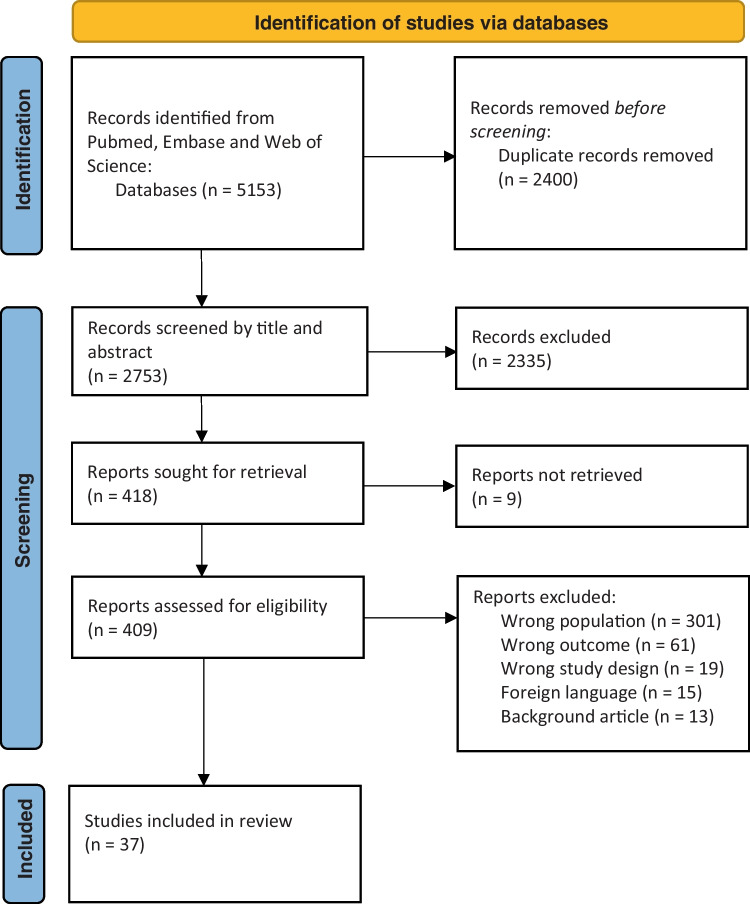
Of the 2753 articles retrieved, 37 studies could be included on bone transport techniques (n = 23), the Masquelet technique (n = 7), and vascularized fibular grafts (n = 7). Respective bone union percentages were 94.3%, 89.5%, and 96.5%. The percentages of infection recurrence respectively were 1.6%, 14.4% and 7.0%, followed by respectively 1.58, 0.78, and 0.73 complications per patient.
Bone transport was found to be the most widely studied technique in the literature. Depending on the surgeon's expertise, vascularized fibular grafts may be held as a favourable alternative. This review indicates that further high-quality research on large bone defects ( 5 cm) in patients with infected tibial nonunions is necessary to gain more insight into the potentially beneficial results of vascularized fibular grafts and the Masquelet technique.
感染性胫骨骨不连伴大节段骨缺损是患者和外科医生面临的复杂且具有挑战性的情况。本范围界定综述旨在确定该临床情况下现有证据和知识空白。其次,本研究的目的是寻找关于最佳治疗方法的有效建议。
在文献数据库:PubMed、Embase.com 和 Web of Science Core Collection 中进行全面检索。纳入报道骨搬运技术、Masquelet 技术和大于 5 cm 骨缺损血管化腓骨移植的研究。根据骨不连时间、感染复发、骨愈合、并发症发生率、外固定时间和完全负重时间,比较骨愈合结果和功能结果。
从 2753 篇文章中检索到 37 篇可纳入骨搬运技术(n=23)、Masquelet 技术(n=7)和血管化腓骨移植(n=7)的研究。分别为 94.3%、89.5%和 96.5%的骨愈合率。分别为 1.6%、14.4%和 7.0%的感染复发率,随后分别为 1.58、0.78 和 0.73 例/患者的并发症。
在文献中,骨搬运技术是研究最广泛的技术。根据外科医生的专业知识,血管化腓骨移植可能是一种有利的选择。本综述表明,需要进一步开展高质量研究,以深入了解感染性胫骨骨不连伴大骨缺损(>5 cm)患者血管化腓骨移植和 Masquelet 技术的潜在有益结果。