• 文献检索
  • 文档翻译
  • 深度研究
  • 学术资讯
  • Suppr Zotero 插件Zotero 插件
  • 邀请有礼
  • 套餐&价格
  • 历史记录
应用&插件
Suppr Zotero 插件Zotero 插件浏览器插件Mac 客户端Windows 客户端微信小程序
定价
高级版会员购买积分包购买API积分包
服务
文献检索文档翻译深度研究API 文档MCP 服务
关于我们
关于 Suppr公司介绍联系我们用户协议隐私条款
关注我们

Suppr 超能文献

核心技术专利:CN118964589B侵权必究
粤ICP备2023148730 号-1Suppr @ 2026

文献检索

告别复杂PubMed语法,用中文像聊天一样搜索,搜遍4000万医学文献。AI智能推荐,让科研检索更轻松。

立即免费搜索

文件翻译

保留排版,准确专业,支持PDF/Word/PPT等文件格式,支持 12+语言互译。

免费翻译文档

深度研究

AI帮你快速写综述,25分钟生成高质量综述,智能提取关键信息,辅助科研写作。

立即免费体验

基于人口统计学的网络健康相关社交媒体内容分析

Demographic-Based Content Analysis of Web-Based Health-Related Social Media.

作者信息

Sadah Shouq A, Shahbazi Moloud, Wiley Matthew T, Hristidis Vagelis

机构信息

University of California, Riverside, Department of Computer Science and Engineering, Riverside, CA, United States.

出版信息

J Med Internet Res. 2016 Jun 13;18(6):e148. doi: 10.2196/jmir.5327.

DOI:10.2196/jmir.5327
PMID:27296242
原文链接:https://pmc.ncbi.nlm.nih.gov/articles/PMC4923586/
Abstract

BACKGROUND

An increasing number of patients from diverse demographic groups share and search for health-related information on Web-based social media. However, little is known about the content of the posted information with respect to the users' demographics.

OBJECTIVE

The aims of this study were to analyze the content of Web-based health-related social media based on users' demographics to identify which health topics are discussed in which social media by which demographic groups and to help guide educational and research activities.

METHODS

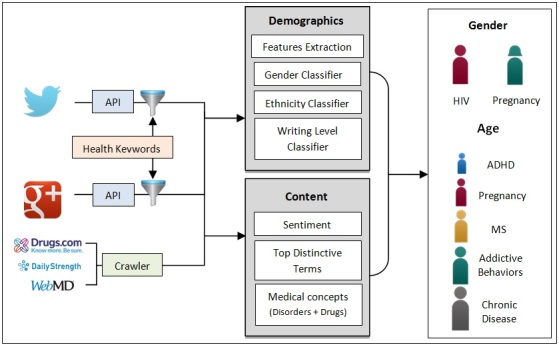
We analyze 3 different types of health-related social media: (1) general Web-based social networks Twitter and Google+; (2) drug review websites; and (3) health Web forums, with a total of about 6 million users and 20 million posts. We analyzed the content of these posts based on the demographic group of their authors, in terms of sentiment and emotion, top distinctive terms, and top medical concepts.

RESULTS

The results of this study are: (1) Pregnancy is the dominant topic for female users in drug review websites and health Web forums, whereas for male users, it is cardiac problems, HIV, and back pain, but this is not the case for Twitter; (2) younger users (0-17 years) mainly talk about attention-deficit hyperactivity disorder (ADHD) and depression-related drugs, users aged 35-44 years discuss about multiple sclerosis (MS) drugs, and middle-aged users (45-64 years) talk about alcohol and smoking; (3) users from the Northeast United States talk about physical disorders, whereas users from the West United States talk about mental disorders and addictive behaviors; (4) Users with higher writing level express less anger in their posts.

CONCLUSION

We studied the popular topics and the sentiment based on users' demographics in Web-based health-related social media. Our results provide valuable information, which can help create targeted and effective educational campaigns and guide experts to reach the right users on Web-based social chatter.

摘要

背景

越来越多来自不同人口统计学群体的患者在基于网络的社交媒体上分享和搜索与健康相关的信息。然而,关于所发布信息的内容与用户人口统计学特征之间的关系,我们却知之甚少。

目的

本研究的目的是根据用户的人口统计学特征分析基于网络的健康相关社交媒体的内容,以确定哪些人口统计学群体在哪些社交媒体上讨论了哪些健康话题,并为教育和研究活动提供指导。

方法

我们分析了3种不同类型的健康相关社交媒体:(1)基于网络的一般社交网络推特和谷歌+;(2)药品评论网站;(3)健康网络论坛,共有约600万用户和2000万条帖子。我们根据帖子作者的人口统计学群体,从情感和情绪、最具特色的词汇以及最主要的医学概念等方面分析了这些帖子的内容。

结果

本研究的结果如下:(1)在药品评论网站和健康网络论坛中,怀孕是女性用户的主要话题,而男性用户的主要话题是心脏问题、艾滋病毒和背痛,但推特上并非如此;(2)年轻用户(0 - 17岁)主要谈论注意力缺陷多动障碍(ADHD)和与抑郁症相关的药物,35 - 44岁的用户讨论多发性硬化症(MS)药物,中年用户(45 - 64岁)谈论酒精和吸烟;(3)美国东北部的用户谈论身体疾病,而美国西部的用户谈论精神疾病和成瘾行为;(4)写作水平较高的用户在帖子中表达的愤怒较少。

结论

我们研究了基于网络的健康相关社交媒体中基于用户人口统计学特征的热门话题和情感倾向。我们的结果提供了有价值的信息,有助于开展有针对性的有效教育活动,并指导专家在基于网络的社交交流中找到合适的用户。
https://cdn.ncbi.nlm.nih.gov/pmc/blobs/b592/4923586/78fd4a5afdfe/jmir_v18i6e148_fig1.jpg

相似文献

1
Demographic-Based Content Analysis of Web-Based Health-Related Social Media.基于人口统计学的网络健康相关社交媒体内容分析
J Med Internet Res. 2016 Jun 13;18(6):e148. doi: 10.2196/jmir.5327.
2
A Study of the Demographics of Web-Based Health-Related Social Media Users.基于网络的健康相关社交媒体用户的人口统计学研究。
J Med Internet Res. 2015 Aug 6;17(8):e194. doi: 10.2196/jmir.4308.
3
Classification of Health-Related Social Media Posts: Evaluation of Post Content-Classifier Models and Analysis of User Demographics.健康相关社交媒体帖子的分类:帖子内容分类模型的评估和用户人口统计学分析。
JMIR Public Health Surveill. 2020 Apr 1;6(2):e14952. doi: 10.2196/14952.
4
Exploring the Behavior of Users With Attention-Deficit/Hyperactivity Disorder on Twitter: Comparative Analysis of Tweet Content and User Interactions.探索 Twitter 上注意力缺陷多动障碍用户的行为:推文内容和用户互动的比较分析。
J Med Internet Res. 2023 May 17;25:e43439. doi: 10.2196/43439.
5
Mapping and Modeling of Discussions Related to Gastrointestinal Discomfort in French-Speaking Online Forums: Results of a 15-Year Retrospective Infodemiology Study.法语在线论坛中与胃肠道不适相关讨论的映射和建模:一项为期 15 年的回顾性信息流行病学研究结果。
J Med Internet Res. 2020 Nov 3;22(11):e17247. doi: 10.2196/17247.
6
Images of Little Cigars and Cigarillos on Instagram Identified by the Hashtag #swisher: Thematic Analysis.Instagram上带有#swisher标签的小雪茄和小雪茄烟图片:主题分析
J Med Internet Res. 2017 Jul 14;19(7):e255. doi: 10.2196/jmir.7634.
7
Tobacco Use Behaviors, Attitudes, and Demographic Characteristics of Tobacco Opinion Leaders and Their Followers: Twitter Analysis.烟草意见领袖及其追随者的烟草使用行为、态度和人口统计学特征:推特分析
J Med Internet Res. 2019 Jun 4;21(6):e12676. doi: 10.2196/12676.
8
The Search for Consumers of Web-Based Raw DNA Interpretation Services: Using Social Media to Target Hard-to-Reach Populations.寻找基于网络的原始DNA解读服务的消费者:利用社交媒体针对难以触及的人群
J Med Internet Res. 2019 Jul 30;21(7):e12980. doi: 10.2196/12980.
9
Pharmaceutical companies and their drugs on social media: a content analysis of drug information on popular social media sites.制药公司及其药品在社交媒体上的情况:对热门社交媒体网站上药品信息的内容分析。
J Med Internet Res. 2015 Jun 1;17(6):e130. doi: 10.2196/jmir.4357.
10
Determination of Patient Sentiment and Emotion in Ophthalmology: Infoveillance Tutorial on Web-Based Health Forum Discussions.眼科患者情绪的测定:基于网络健康论坛讨论的 Infoveillance 教程。
J Med Internet Res. 2021 May 17;23(5):e20803. doi: 10.2196/20803.

引用本文的文献

1
"Know your medicines, know your health"-public perspectives on medicines and health awareness campaigns.“了解你的药物,了解你的健康”——公众对药品及健康宣传活动的看法。
Front Public Health. 2025 Feb 14;13:1541185. doi: 10.3389/fpubh.2025.1541185. eCollection 2025.
2
Social Media Use and Mental Health: A Global Analysis.社交媒体使用与心理健康:一项全球分析。
Epidemiologia (Basel). 2022 Jan 11;3(1):11-25. doi: 10.3390/epidemiologia3010002.
3
Methods to Establish Race or Ethnicity of Twitter Users: Scoping Review.方法建立种族或族裔的 Twitter 用户:范围审查。

本文引用的文献

1
A Study of the Demographics of Web-Based Health-Related Social Media Users.基于网络的健康相关社交媒体用户的人口统计学研究。
J Med Internet Res. 2015 Aug 6;17(8):e194. doi: 10.2196/jmir.4308.
2
Social Media Use in Chronic Disease: A Systematic Review and Novel Taxonomy.社交媒体在慢性病中的应用:系统评价与新型分类法。
Am J Med. 2015 Dec;128(12):1335-50. doi: 10.1016/j.amjmed.2015.06.015. Epub 2015 Jul 6.
3
Mortality Attributable to Low Levels of Education in the United States.美国因低教育水平导致的死亡率
J Med Internet Res. 2022 Apr 29;24(4):e35788. doi: 10.2196/35788.
4
Analysis of Online Peripartum Depression Communities: Application of Multilabel Text Classification Techniques to Inform Digitally-Mediated Prevention and Management.在线围产期抑郁症社区分析:多标签文本分类技术在数字媒介预防与管理中的应用
Front Digit Health. 2021 May 21;3:653769. doi: 10.3389/fdgth.2021.653769. eCollection 2021.
5
Determination of Patient Sentiment and Emotion in Ophthalmology: Infoveillance Tutorial on Web-Based Health Forum Discussions.眼科患者情绪的测定:基于网络健康论坛讨论的 Infoveillance 教程。
J Med Internet Res. 2021 May 17;23(5):e20803. doi: 10.2196/20803.
6
Emotional Attitudes of Chinese Citizens on Social Distancing During the COVID-19 Outbreak: Analysis of Social Media Data.新冠疫情期间中国公民对社交距离的情绪态度:基于社交媒体数据的分析
JMIR Med Inform. 2021 Mar 16;9(3):e27079. doi: 10.2196/27079.
7
COVID-19 prevention and treatment information on the internet: a systematic analysis and quality assessment.互联网上的新型冠状病毒肺炎防治信息:系统分析与质量评估
BMJ Open. 2020 Sep 10;10(9):e040487. doi: 10.1136/bmjopen-2020-040487.
8
Topic Modeling for Analyzing Patients' Perceptions and Concerns of Hearing Loss on Social Q&A Sites: Incorporating Patients' Perspective.主题建模分析社交问答网站中患者对听力损失的看法和担忧:纳入患者视角
Int J Environ Res Public Health. 2020 Aug 27;17(17):6209. doi: 10.3390/ijerph17176209.
9
When Public Health Research Meets Social Media: Knowledge Mapping From 2000 to 2018.当公共卫生研究遇到社交媒体:2000 年至 2018 年的知识图谱
J Med Internet Res. 2020 Aug 13;22(8):e17582. doi: 10.2196/17582.
10
Infodemiology and Infoveillance: Scoping Review.信息流行病学与信息监测:范围综述
J Med Internet Res. 2020 Apr 28;22(4):e16206. doi: 10.2196/16206.
PLoS One. 2015 Jul 8;10(7):e0131809. doi: 10.1371/journal.pone.0131809. eCollection 2015.
4
Extracting patient demographics and personal medical information from online health forums.从在线健康论坛中提取患者人口统计学和个人医疗信息。
AMIA Annu Symp Proc. 2014 Nov 14;2014:1825-34. eCollection 2014.
5
Pharmaceutical drugs chatter on Online Social Networks.药品在在线社交网络上引发热议。
J Biomed Inform. 2014 Jun;49:245-54. doi: 10.1016/j.jbi.2014.03.006. Epub 2014 Mar 15.
6
Are health behavior change interventions that use online social networks effective? A systematic review.使用在线社交网络的健康行为改变干预措施是否有效?一项系统综述。
J Med Internet Res. 2014 Feb 14;16(2):e40. doi: 10.2196/jmir.2952.
7
Social media: a review and tutorial of applications in medicine and health care.社交媒体:医学与医疗保健应用综述及教程
J Med Internet Res. 2014 Feb 11;16(2):e13. doi: 10.2196/jmir.2912.
8
A new dimension of health care: systematic review of the uses, benefits, and limitations of social media for health communication.医疗保健的一个新维度:社交媒体用于健康传播的用途、益处及局限性的系统综述
J Med Internet Res. 2013 Apr 23;15(4):e85. doi: 10.2196/jmir.1933.
9
A randomized trial of a Facebook-based physical activity intervention for young adult cancer survivors.一项基于 Facebook 的针对年轻成年癌症幸存者的身体活动干预的随机试验。
J Cancer Surviv. 2013 Sep;7(3):355-68. doi: 10.1007/s11764-013-0279-5. Epub 2013 Mar 27.
10
Health-related hot topic detection in online communities using text clustering.利用文本聚类技术在在线社区中发现与健康相关的热门话题。
PLoS One. 2013;8(2):e56221. doi: 10.1371/journal.pone.0056221. Epub 2013 Feb 15.