Satija Ambika, Bhupathiraju Shilpa N, Rimm Eric B, Spiegelman Donna, Chiuve Stephanie E, Borgi Lea, Willett Walter C, Manson JoAnn E, Sun Qi, Hu Frank B
Department of Nutrition, Harvard T.H. Chan School of Public Health, Boston, Massachusetts, United States of America.
Department of Epidemiology, Harvard T.H. Chan School of Public Health, Boston, Massachusetts, United States of America.
PLoS Med. 2016 Jun 14;13(6):e1002039. doi: 10.1371/journal.pmed.1002039. eCollection 2016 Jun.
Plant-based diets have been recommended to reduce the risk of type 2 diabetes (T2D). However, not all plant foods are necessarily beneficial. We examined the association of an overall plant-based diet and hypothesized healthful and unhealthful versions of a plant-based diet with T2D incidence in three prospective cohort studies in the US.
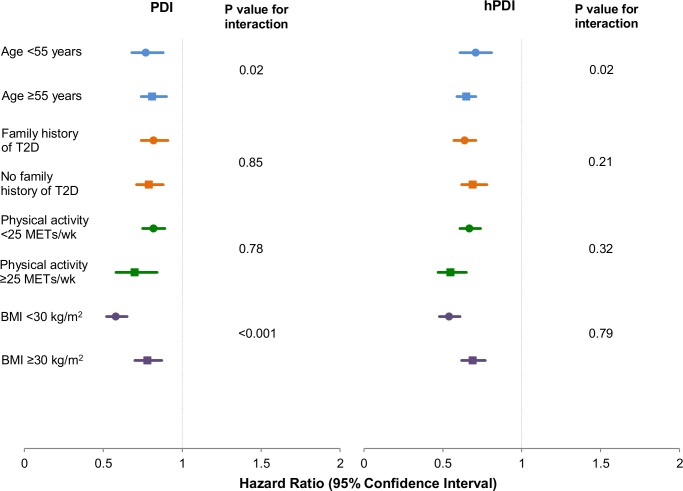
We included 69,949 women from the Nurses' Health Study (1984-2012), 90,239 women from the Nurses' Health Study 2 (1991-2011), and 40,539 men from the Health Professionals Follow-Up Study (1986-2010), free of chronic diseases at baseline. Dietary data were collected every 2-4 y using a semi-quantitative food frequency questionnaire. Using these data, we created an overall plant-based diet index (PDI), where plant foods received positive scores, while animal foods (animal fats, dairy, eggs, fish/seafood, poultry/red meat, miscellaneous animal-based foods) received reverse scores. We also created a healthful plant-based diet index (hPDI), where healthy plant foods (whole grains, fruits, vegetables, nuts, legumes, vegetable oils, tea/coffee) received positive scores, while less healthy plant foods (fruit juices, sweetened beverages, refined grains, potatoes, sweets/desserts) and animal foods received reverse scores. Lastly, we created an unhealthful plant-based diet index (uPDI) by assigning positive scores to less healthy plant foods and reverse scores to healthy plant foods and animal foods. We documented 16,162 incident T2D cases during 4,102,369 person-years of follow-up. In pooled multivariable-adjusted analysis, both PDI and hPDI were inversely associated with T2D (PDI: hazard ratio [HR] for extreme deciles 0.51, 95% CI 0.47-0.55, p trend < 0.001; hPDI: HR for extreme deciles 0.55, 95% CI 0.51-0.59, p trend < 0.001). The association of T2D with PDI was considerably attenuated when we additionally adjusted for body mass index (BMI) categories (HR 0.80, 95% CI 0.74-0.87, p trend < 0.001), while that with hPDI remained largely unchanged (HR 0.66, 95% CI 0.61-0.72, p trend < 0.001). uPDI was positively associated with T2D even after BMI adjustment (HR for extreme deciles 1.16, 95% CI 1.08-1.25, p trend < 0.001). Limitations of the study include self-reported diet assessment, with the possibility of measurement error, and the potential for residual or unmeasured confounding given the observational nature of the study design.
Our study suggests that plant-based diets, especially when rich in high-quality plant foods, are associated with substantially lower risk of developing T2D. This supports current recommendations to shift to diets rich in healthy plant foods, with lower intake of less healthy plant and animal foods.
推荐以植物为基础的饮食来降低2型糖尿病(T2D)风险。然而,并非所有植物性食物都必然有益。我们在美国三项前瞻性队列研究中,研究了总体以植物为基础的饮食以及假定的健康和不健康的植物性饮食版本与T2D发病率之间的关联。
我们纳入了护士健康研究(1984 - 2012年)中的69949名女性、护士健康研究2(1991 - 2011年)中的90239名女性以及健康专业人员随访研究(1986 - 2010年)中的40539名男性,这些人在基线时均无慢性病。每2 - 4年使用半定量食物频率问卷收集饮食数据。利用这些数据,我们创建了一个总体植物性饮食指数(PDI),其中植物性食物得正分,而动物性食物(动物脂肪、乳制品、蛋类、鱼类/海鲜、禽肉/红肉、其他动物性食物)得负分。我们还创建了一个健康植物性饮食指数(hPDI),其中健康的植物性食物(全谷物、水果、蔬菜、坚果、豆类、植物油、茶/咖啡)得正分,而不太健康的植物性食物(果汁、甜味饮料、精制谷物、土豆、糖果/甜点)和动物性食物得负分。最后,我们通过给不太健康的植物性食物赋正分,给健康的植物性食物和动物性食物赋负分,创建了一个不健康植物性饮食指数(uPDI)。在4102369人年的随访期间,我们记录了16162例T2D发病病例。在汇总的多变量调整分析中,PDI和hPDI均与T2D呈负相关(PDI:极端十分位数的风险比[HR]为0.51,95%可信区间[CI]为0.47 - 0.55,p趋势<0.001;hPDI:极端十分位数的HR为0.55,95%CI为0.51 - 0.59,p趋势<0.001)。当我们进一步调整体重指数(BMI)类别时,T2D与PDI的关联显著减弱(HR为0.80,95%CI为0.74 - 0.87,p趋势<0.001),而与hPDI的关联基本保持不变(HR为0.66,95%CI为0.61 - 0.72,p趋势<0.001)。即使在调整BMI后,uPDI仍与T2D呈正相关(极端十分位数的HR为1.16,95%CI为1.08 - 1.25,p趋势<)。研究的局限性包括自我报告的饮食评估,可能存在测量误差,以及鉴于研究设计的观察性本质,可能存在残余或未测量的混杂因素。
我们的研究表明,以植物为基础的饮食,尤其是富含优质植物性食物的饮食,与患T2D的风险显著降低相关。这支持了当前转向富含健康植物性食物、减少摄入不太健康的植物性和动物性食物的饮食建议。