Truskey George A
Department of Biochemical Engineering, Duke University, Durham, NC, USA.
F1000Res. 2016 May 31;5. doi: 10.12688/f1000research.8237.1. eCollection 2016.
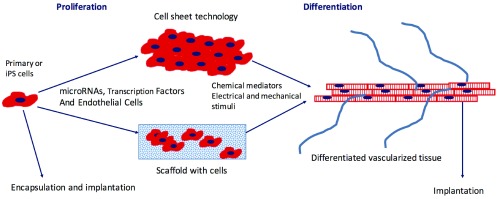
Cardiovascular tissue engineering offers the promise of biologically based repair of injured and damaged blood vessels, valves, and cardiac tissue. Major advances in cardiovascular tissue engineering over the past few years involve improved methods to promote the establishment and differentiation of induced pluripotent stem cells (iPSCs), scaffolds from decellularized tissue that may produce more highly differentiated tissues and advance clinical translation, improved methods to promote vascularization, and novel in vitro microphysiological systems to model normal and diseased tissue function. iPSC technology holds great promise, but robust methods are needed to further promote differentiation. Differentiation can be further enhanced with chemical, electrical, or mechanical stimuli.
心血管组织工程为基于生物学的受损血管、瓣膜和心脏组织修复带来了希望。过去几年心血管组织工程的主要进展包括:改进了促进诱导多能干细胞(iPSC)建立和分化的方法;利用去细胞组织制成的支架,这种支架可能产生分化程度更高的组织并推动临床转化;改进了促进血管化的方法;以及用于模拟正常和患病组织功能的新型体外微生理系统。iPSC技术前景广阔,但需要强有力的方法来进一步促进其分化。化学、电或机械刺激可进一步增强分化。