Choi Jung-Hyun, Jung Min-Ho, Yoo Kyung-Tae
Department of Physical Therapy, Institute for Elderly Health and Welfare, Namseoul University, Republic of Korea.
J Phys Ther Sci. 2016 May;28(5):1660-4. doi: 10.1589/jpts.28.1660. Epub 2016 May 31.
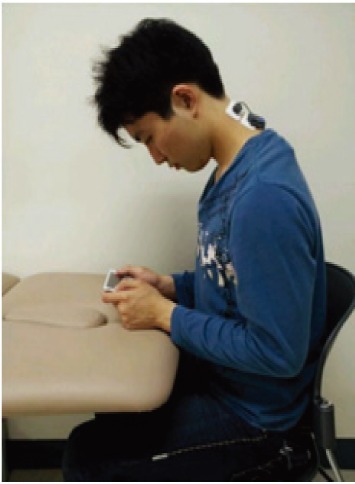
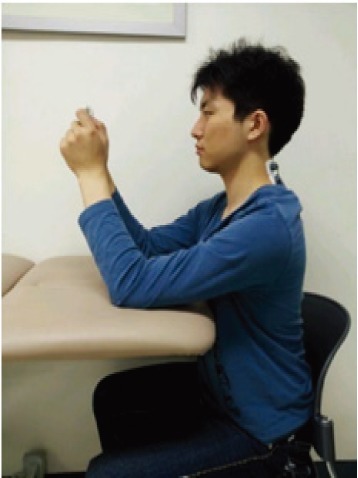
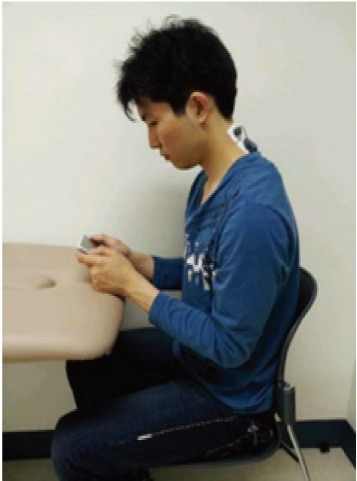
[Purpose] The purpose of this study was to identify changes in the activity and fatigue of the splenius capitis and upper trapezius muscles, which are agonists to the muscles supporting the head, under the three postures most frequently adopted while using a smartphone. [Subjects and Methods] The subjects were 15 college students in their 20s. They formed a single group and had to adopt three different postures (maximum bending, middle bending, and neutral). While the 15 subjects maintained the postures, muscle activity and fatigue were measured using surface electromyography. [Results] Comparison of the muscle fatigue caused by each posture showed statistically significant differences for the right splenius capitis, left splenius capitis, and left upper trapezius muscles. In addition, maintaining the maximum bending posture while using a smartphone resulted in higher levels of fatigue in the right splenius capitis, left splenius capitis, and left upper trapezius muscles compared with those for the middle bending posture. [Conclusion] Therefore, this study suggests that individuals should bend their neck slightly when using a smartphone, rather than bending it too much, or keep their neck straight to reduce fatigue of the cervical erector muscles.
[目的] 本研究旨在确定头夹肌和上斜方肌(头部支撑肌肉的主动肌)在使用智能手机时最常采用的三种姿势下的活动和疲劳变化。[对象与方法] 对象为15名20多岁的大学生。他们组成一个小组,必须采用三种不同姿势(最大弯曲、中度弯曲和中立)。当15名受试者保持姿势时,使用表面肌电图测量肌肉活动和疲劳。[结果] 各姿势引起的肌肉疲劳比较显示,右侧头夹肌、左侧头夹肌和左侧上斜方肌存在统计学显著差异。此外,与中度弯曲姿势相比,使用智能手机时保持最大弯曲姿势会导致右侧头夹肌、左侧头夹肌和左侧上斜方肌的疲劳程度更高。[结论] 因此,本研究表明,人们在使用智能手机时应稍微弯曲颈部,而不是过度弯曲,或者保持颈部挺直,以减少颈伸肌的疲劳。