Toh Siao Hui, Coenen Pieter, Howie Erin K, Straker Leon M
School of Physiotherapy and Exercise Science, Curtin University, Perth, Australia.
Physiotherapy Department, KK Women's and Children's Hospital, Singapore, Singapore.
PLoS One. 2017 Aug 7;12(8):e0181220. doi: 10.1371/journal.pone.0181220. eCollection 2017.
The use of mobile touch screen devices (MTSDs) has increased rapidly over the last decade, and there are concerns that their use may have negative musculoskeletal consequences; yet evidence on the association of MTSD use with musculoskeletal symptoms and exposures is currently dispersed. The aim of this study was to systematically review available literature on musculoskeletal symptoms and exposures associated with MTSD use. The synthesised information may facilitate wise use of MTSDs and may identify areas in need of further research.
EMBASE, Medline, Scopus, PsycINFO and Proquest electronic databases were searched for articles published up to June 2016, using keywords describing MTSD, musculoskeletal symptoms (e.g. pain, discomfort) and musculoskeletal exposures (e.g. posture, muscle activity). Two reviewers independently screened the articles, extracted relevant data and assessed methodological quality of included studies. Due to heterogeneity in the studies, a meta-analysis was not possible and a structured narrative synthesis of the findings was undertaken.
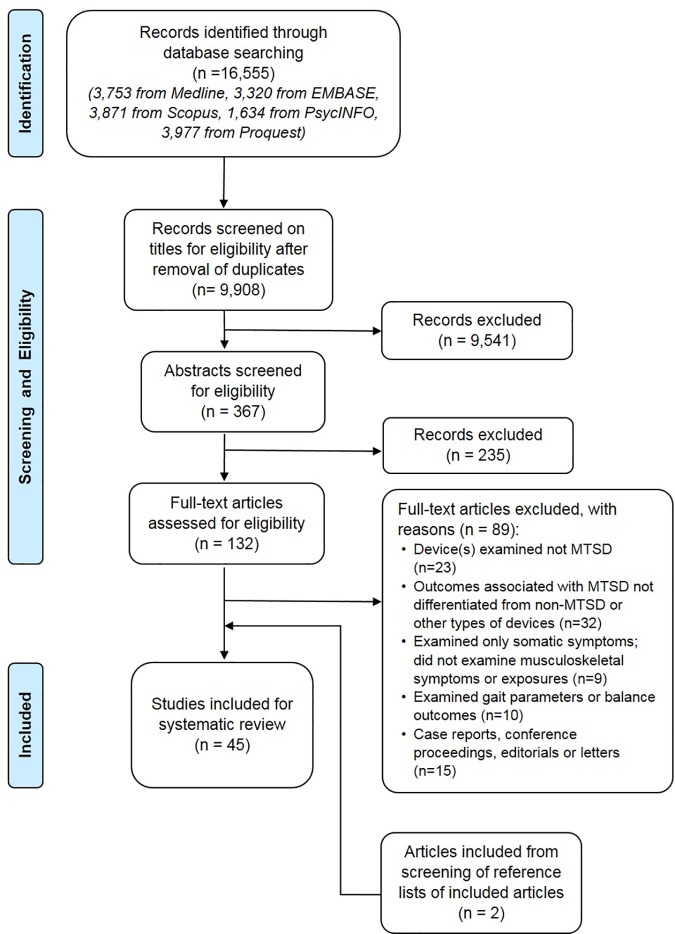
A total of 9,908 articles were screened for eligibility with 45 articles finally included for review. Included articles were of cross-sectional, case-control or experimental laboratory study designs. No longitudinal studies were identified. Findings were presented and discussed in terms of the amount, features, tasks and positions of MTSD use and its association with musculoskeletal symptoms and musculoskeletal exposures.
There is limited evidence that MTSD use, and various aspects of its use (i.e. amount of usage, features, tasks and positions) are associated with musculoskeletal symptoms and exposures. This is due to mainly low quality experimental and case-control laboratory studies, with few cross-sectional and no longitudinal studies. Further research is warranted in order to develop guidelines for wise use of MTSDs.
在过去十年中,移动触摸屏设备(MTSD)的使用迅速增加,人们担心其使用可能会对肌肉骨骼产生不良影响;然而,目前关于MTSD使用与肌肉骨骼症状及暴露之间关联的证据较为分散。本研究的目的是系统回顾与MTSD使用相关的肌肉骨骼症状及暴露的现有文献。综合信息可能有助于明智地使用MTSD,并可能确定需要进一步研究的领域。
检索了EMBASE、Medline、Scopus、PsycINFO和Proquest电子数据库,以查找截至2016年6月发表的文章,使用了描述MTSD、肌肉骨骼症状(如疼痛、不适)和肌肉骨骼暴露(如姿势、肌肉活动)的关键词。两名审稿人独立筛选文章,提取相关数据并评估纳入研究的方法学质量。由于研究存在异质性,无法进行荟萃分析,因此对研究结果进行了结构化的叙述性综合。
共筛选了9908篇文章以确定其是否符合纳入标准,最终纳入45篇文章进行综述。纳入的文章采用横断面、病例对照或实验性实验室研究设计。未发现纵向研究。研究结果根据MTSD使用的数量、特征、任务和姿势及其与肌肉骨骼症状和肌肉骨骼暴露的关联进行了呈现和讨论。
仅有有限的证据表明MTSD的使用及其使用的各个方面(即使用量、特征、任务和姿势)与肌肉骨骼症状和暴露有关。这主要是由于实验性和病例对照实验室研究质量较低,横断面研究较少且没有纵向研究。为了制定明智使用MTSD的指南,有必要进行进一步的研究。