Carrouel Florence, Viennot Stéphane, Santamaria Julie, Veber Philippe, Bourgeois Denis
Institute of Functional Genomics of Lyon, UMR CNRS 5242, Ecole Normale Supérieure de Lyon, University Lyon 1, Lyon France.
Laboratory "Health, Individual, Society" EA4129, University Lyon 1, Lyon France.
Front Microbiol. 2016 Jun 2;7:840. doi: 10.3389/fmicb.2016.00840. eCollection 2016.
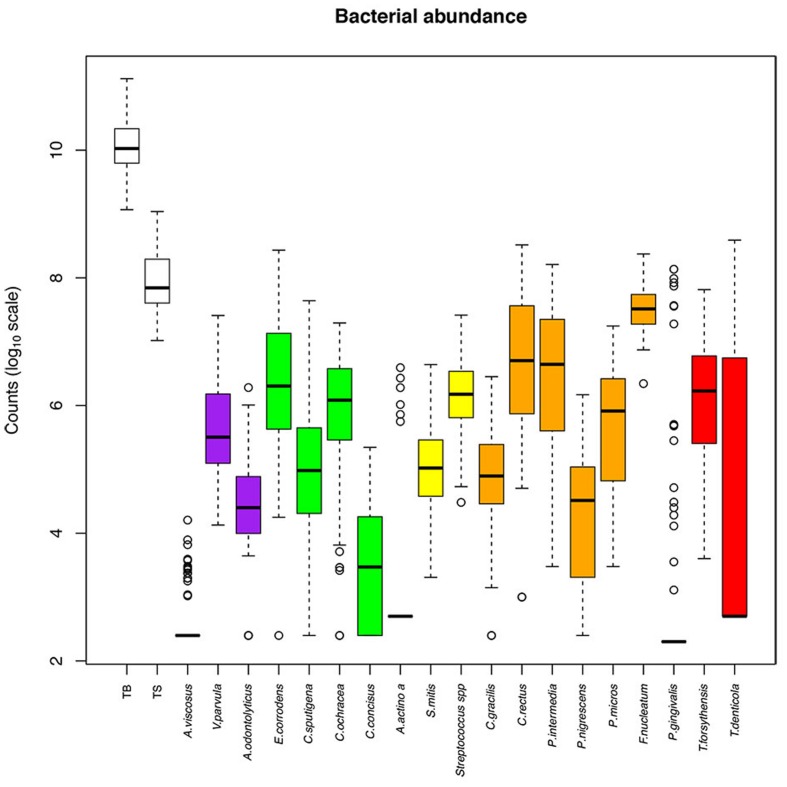
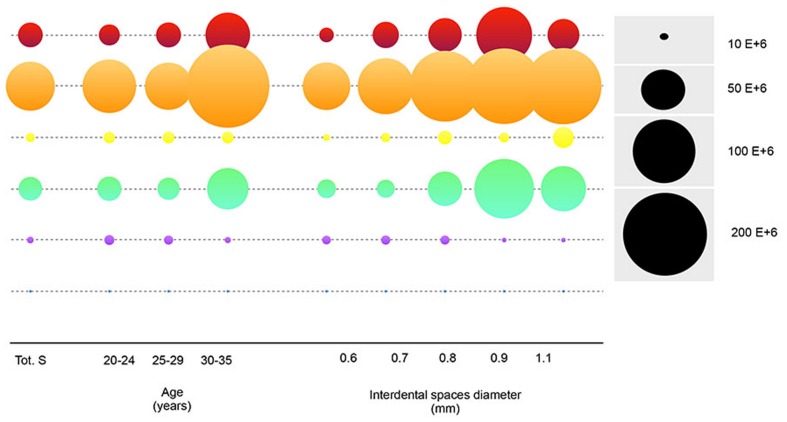
In oral health, the interdental spaces are a real ecological niche for which the body has few or no alternative defenses and where the traditional daily methods for control by disrupting biofilm are not adequate. The interdental spaces are the source of many hypotheses regarding their potential associations with and/or causes of cardiovascular disease, diabetes, chronic kidney disease, degenerative disease, and depression. This PCR study is the first to describe the interdental microbiota in healthy adults aged 18-35 years-old with reference to the Socransky complexes. The complexes tended to reflect microbial succession events in developing dental biofilms. Early colonizers included members of the yellow, green, and purple complexes. The orange complex bacteria generally appear after the early colonizers and include many putative periodontal pathogens, such as Fusobacterium nucleatum. The red complex (Porphyromonas gingivalis, Tannerella forsythia, and Treponema denticola) was considered the climax community and is on the list of putative periodontal pathogens. The 19 major periodontal pathogens tested were expressed at various levels. F. nucleatum was the most abundant species, and the least abundant were Actinomyces viscosus, P. gingivalis, and Aggregatibacter actinomycetemcomitans. The genome counts for Eikenella corrodens, Campylobacter concisus, Campylobacter rectus, T. denticola, and Tannerella forsythensis increased significantly with subject age. The study highlights the observation that bacteria from the yellow complex (Streptococcus spp., S. mitis), the green complex (E. corrodens, Campylobacter gracilis, Capnocytophaga ochracea, Capnocytophaga sputigena, A. actinomycetemcomitans), the purple complex (Veillonella parvula, Actinomyces odontolyticus) and the blue complex (A. viscosus) are correlated. Concerning the orange complex, F. nucleatum is the most abundant species in interdental biofilm. The red complex, which is recognized as the most important pathogen in adult periodontal disease, represents 8.08% of the 19 bacteria analyzed. P. gingivalis was detected in 19% of healthy subjects and represents 0.02% of the interdental biofilm. T. forsythensis and T. denticola (0.02 and 0.04% of the interdental biofilm) were detected in 93 and 49% of healthy subjects, respectively. The effective presence of periodontal pathogens is a strong indicator of the need to develop new methods for disrupting interdental biofilm in daily oral hygiene.
在口腔健康方面,牙间隙是一个真正的生态位,人体对其几乎没有或根本没有替代防御机制,而且传统的日常通过破坏生物膜进行控制的方法并不充分。牙间隙是许多关于其与心血管疾病、糖尿病、慢性肾病、退行性疾病和抑郁症潜在关联及/或病因假说的源头。这项聚合酶链式反应(PCR)研究首次参照索克兰斯基菌群描述了18至35岁健康成年人的牙间隙微生物群。这些菌群往往反映了正在形成的牙菌斑中的微生物演替事件。早期定植菌包括黄色、绿色和紫色菌群的成员。橙色菌群细菌通常在早期定植菌之后出现,包括许多公认的牙周病原体,如具核梭杆菌。红色菌群(牙龈卟啉单胞菌、福赛坦氏菌和齿垢密螺旋体)被认为是顶级群落,且在公认的牙周病原体名单上。所检测的19种主要牙周病原体表达水平各异。具核梭杆菌是最丰富的物种,而黏性放线菌、牙龈卟啉单胞菌和伴放线聚集杆菌是最不丰富的。腐蚀埃肯菌、简明弯曲菌、直肠弯曲菌、齿垢密螺旋体和福赛坦氏菌的基因组数量随受试者年龄显著增加。该研究突出了这样的观察结果:黄色菌群(链球菌属、缓症链球菌)、绿色菌群(腐蚀埃肯菌、纤细弯曲菌、牙龈二氧化碳嗜纤维菌、生痰二氧化碳嗜纤维菌、伴放线聚集杆菌)、紫色菌群(小韦荣球菌、解脲放线菌)和蓝色菌群(黏性放线菌)中的细菌存在相关性。关于橙色菌群,具核梭杆菌是牙间隙生物膜中最丰富的物种。红色菌群被认为是成人牙周病中最重要的病原体,在所分析的19种细菌中占8.08%。19%的健康受试者检测出牙龈卟啉单胞菌,其在牙间隙生物膜中占0.02%。93%和49%的健康受试者分别检测出福赛坦氏菌和齿垢密螺旋体(分别占牙间隙生物膜的0.02%和0.04%)。牙周病原体的有效存在强烈表明需要开发新方法来破坏日常口腔卫生中的牙间隙生物膜。