• 文献检索
  • 文档翻译
  • 深度研究
  • 学术资讯
  • Suppr Zotero 插件Zotero 插件
  • 邀请有礼
  • 套餐&价格
  • 历史记录
应用&插件
Suppr Zotero 插件Zotero 插件浏览器插件Mac 客户端Windows 客户端微信小程序
定价
高级版会员购买积分包购买API积分包
服务
文献检索文档翻译深度研究API 文档MCP 服务
关于我们
关于 Suppr公司介绍联系我们用户协议隐私条款
关注我们

Suppr 超能文献

核心技术专利:CN118964589B侵权必究
粤ICP备2023148730 号-1Suppr @ 2026

文献检索

告别复杂PubMed语法,用中文像聊天一样搜索,搜遍4000万医学文献。AI智能推荐,让科研检索更轻松。

立即免费搜索

文件翻译

保留排版,准确专业,支持PDF/Word/PPT等文件格式,支持 12+语言互译。

免费翻译文档

深度研究

AI帮你快速写综述,25分钟生成高质量综述,智能提取关键信息,辅助科研写作。

立即免费体验

基于叶绿体基因组系统发育学的黍亚科禾本科植物的进化关系(黍亚科;禾本科)。

Evolutionary relationships in Panicoid grasses based on plastome phylogenomics (Panicoideae; Poaceae).

作者信息

Burke Sean V, Wysocki William P, Zuloaga Fernando O, Craine Joseph M, Pires J Chris, Edger Patrick P, Mayfield-Jones Dustin, Clark Lynn G, Kelchner Scot A, Duvall Melvin R

机构信息

Department of Biological Sciences, Northern Illinois University, 1425 W. Lincoln Hwy, DeKalb, IL, 60115-2861, USA.

Instituto de Botánica Darwinion, Labardén 200, Casilla de Correo 22, B1642HYD, San Isidro, Buenos Aires, Argentina.

出版信息

BMC Plant Biol. 2016 Jun 18;16(1):140. doi: 10.1186/s12870-016-0823-3.

DOI:10.1186/s12870-016-0823-3
PMID:27316745
原文链接:https://pmc.ncbi.nlm.nih.gov/articles/PMC4912804/
Abstract

BACKGROUND

Panicoideae are the second largest subfamily in Poaceae (grass family), with 212 genera and approximately 3316 species. Previous studies have begun to reveal relationships within the subfamily, but largely lack resolution and/or robust support for certain tribal and subtribal groups. This study aims to resolve these relationships, as well as characterize a putative mitochondrial insert in one linage.

RESULTS

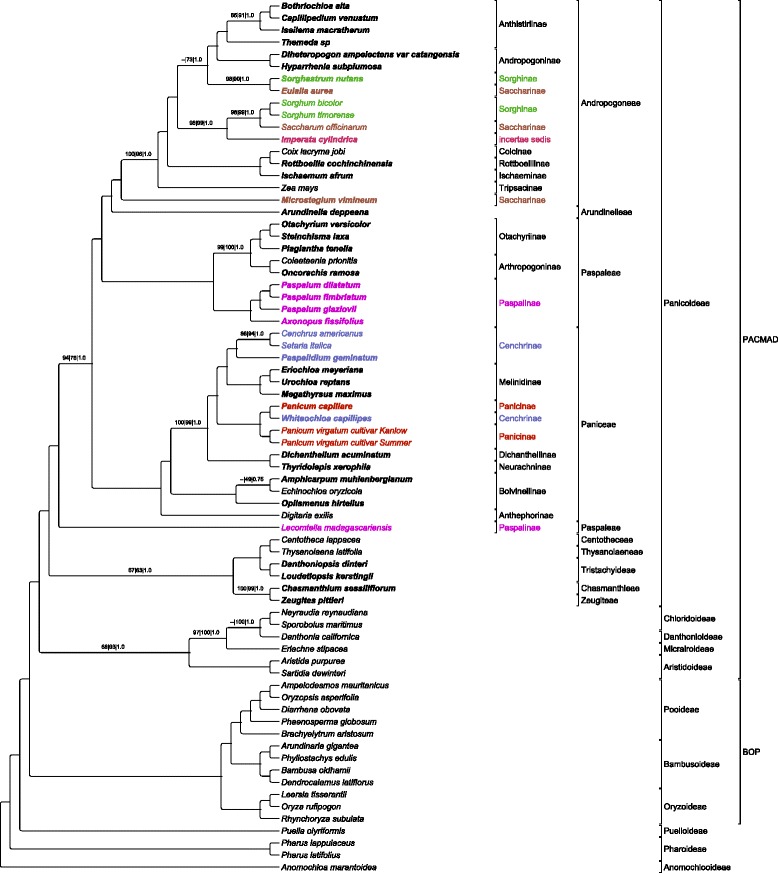
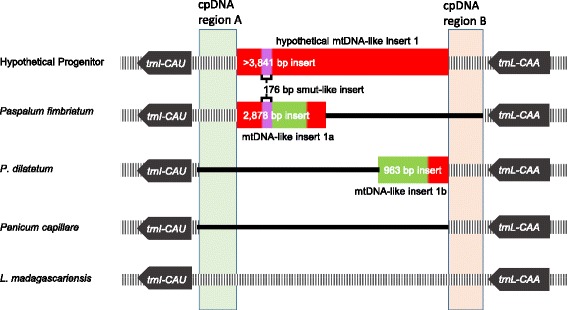
35 newly sequenced Panicoideae plastomes were combined in a phylogenomic study with 37 other species: 15 Panicoideae and 22 from outgroups. A robust Panicoideae topology largely congruent with previous studies was obtained, but with some incongruences with previously reported subtribal relationships. A mitochondrial DNA (mtDNA) to plastid DNA (ptDNA) transfer was discovered in the Paspalum lineage.

CONCLUSIONS

The phylogenomic analysis returned a topology that largely supports previous studies. Five previously recognized subtribes appear on the topology to be non-monophyletic. Additionally, evidence for mtDNA to ptDNA transfer was identified in both Paspalum fimbriatum and P. dilatatum, and suggests a single rare event that took place in a common progenitor. Finally, the framework from this study can guide larger whole plastome sampling to discern the relationships in Cyperochloeae, Steyermarkochloeae, Gynerieae, and other incertae sedis taxa that are weakly supported or unresolved.

摘要

背景

黍亚科是禾本科中第二大亚科,有212个属,约3316个物种。先前的研究已开始揭示该亚科内的关系,但在很大程度上缺乏对某些族和亚族类群的分辨率和/或有力支持。本研究旨在解决这些关系,并对一个谱系中假定的线粒体插入片段进行特征描述。

结果

在一项系统发育基因组学研究中,将35个新测序的黍亚科质体基因组与其他37个物种相结合:15个黍亚科物种和22个外类群物种。获得了一个与先前研究基本一致的稳健的黍亚科拓扑结构,但与先前报道的亚族关系存在一些不一致。在雀稗谱系中发现了线粒体DNA(mtDNA)向质体DNA(ptDNA)的转移。

结论

系统发育基因组学分析得出的拓扑结构在很大程度上支持先前的研究。在拓扑结构上,五个先前认可的亚族似乎不是单系的。此外,在条纹雀稗和宽叶雀稗中均发现了mtDNA向ptDNA转移的证据,这表明在一个共同祖先中发生了一次罕见事件。最后,本研究构建的框架可指导更大规模的全质体基因组采样,以厘清莎稗族、斯氏稗族、吉氏禾族以及其他支持度弱或未解决的地位不确定类群之间的关系。
https://cdn.ncbi.nlm.nih.gov/pmc/blobs/0587/4912804/dc4922effebb/12870_2016_823_Fig2_HTML.jpg
https://cdn.ncbi.nlm.nih.gov/pmc/blobs/0587/4912804/02c1e78b14b3/12870_2016_823_Fig1_HTML.jpg
https://cdn.ncbi.nlm.nih.gov/pmc/blobs/0587/4912804/dc4922effebb/12870_2016_823_Fig2_HTML.jpg
https://cdn.ncbi.nlm.nih.gov/pmc/blobs/0587/4912804/02c1e78b14b3/12870_2016_823_Fig1_HTML.jpg
https://cdn.ncbi.nlm.nih.gov/pmc/blobs/0587/4912804/dc4922effebb/12870_2016_823_Fig2_HTML.jpg

相似文献

1
Evolutionary relationships in Panicoid grasses based on plastome phylogenomics (Panicoideae; Poaceae).基于叶绿体基因组系统发育学的黍亚科禾本科植物的进化关系(黍亚科;禾本科)。
BMC Plant Biol. 2016 Jun 18;16(1):140. doi: 10.1186/s12870-016-0823-3.
2
Investigation of mitochondrial-derived plastome sequences in the Paspalum lineage (Panicoideae; Poaceae).研究帕斯卡利属(禾本科黍族)线粒体衍生质体序列。
BMC Plant Biol. 2018 Aug 3;18(1):152. doi: 10.1186/s12870-018-1379-1.
3
Phylogenomics and taxonomy of Lecomtelleae (Poaceae), an isolated panicoid lineage from Madagascar.莱克姆草族(禾本科)的系统发生基因组学和分类学研究,该族是来自马达加斯加的一个孤立的panicoid 谱系。
Ann Bot. 2013 Oct;112(6):1057-66. doi: 10.1093/aob/mct174. Epub 2013 Aug 28.
4
Polyphyly of Arundinoideae (Poaceae) and evolution of the twisted geniculate lemma awn.芦竹亚科(禾本科)的多系起源与扭曲膝曲状外稃芒的演化
Ann Bot. 2017 Nov 10;120(5):725-738. doi: 10.1093/aob/mcx058.
5
A 250 plastome phylogeny of the grass family (Poaceae): topological support under different data partitions.禾本科250个质体基因组系统发育研究:不同数据分区下的拓扑支持
PeerJ. 2018 Feb 2;6:e4299. doi: 10.7717/peerj.4299. eCollection 2018.
6
Plastid phylogenomics resolves infrafamilial relationships of the Styracaceae and sheds light on the backbone relationships of the Ericales.质体系统发育基因组学解决了杨梅科的亚科内关系,并阐明了桃金娘目植物的骨干关系。
Mol Phylogenet Evol. 2018 Apr;121:198-211. doi: 10.1016/j.ympev.2018.01.004. Epub 2018 Jan 31.
7
Phylogeny and a new tribal classification of the Panicoideae s.l. (Poaceae) based on plastid and nuclear sequence data and structural data.基于质体和核序列数据以及结构数据的广义黍亚科(禾本科)系统发育与新的族分类
Am J Bot. 2010 Oct;97(10):1732-48. doi: 10.3732/ajb.1000024. Epub 2010 Sep 22.
8
Resolving deep relationships of PACMAD grasses: a phylogenomic approach.解析黍超族禾本科植物的深层关系:一种系统基因组学方法。
BMC Plant Biol. 2015 Jul 11;15:178. doi: 10.1186/s12870-015-0563-9.
9
Phylogeny of the Paniceae (Poaceae: Panicoideae): integrating plastid DNA sequences and morphology into a new classification.黍族(禾本科:黍亚科)的系统发育:将质体DNA序列和形态学整合到一个新的分类系统中
Cladistics. 2012 Aug;28(4):333-356. doi: 10.1111/j.1096-0031.2011.00384.x. Epub 2012 Jan 3.
10
Grass plastomes reveal unexpected paraphyly with endemic species of Micrairoideae from India and new haplotype markers in Arundinoideae.禾本科植物叶绿体基因组揭示了与印度Micrairoideae亚科特有物种意外的并系关系以及芦竹亚科新的单倍型标记。
Am J Bot. 2017 Feb;104(2):286-295. doi: 10.3732/ajb.1600285. Epub 2017 Feb 9.

引用本文的文献

1
Genetic linkage mapping in Megathyrsus maximus (Jacq.) with multiple dosage markers.利用多剂量标记对大黍(Megathyrsus maximus (Jacq.))进行遗传连锁图谱构建。
G3 (Bethesda). 2025 Sep 3;15(9). doi: 10.1093/g3journal/jkaf126.
2
Characterization of the complete chloroplast genome of (Michx.) H.O.Yates, 1966 (Poaceae).(米契尔)H.O.耶茨1966年发表的(禾本科)叶绿体全基因组特征分析
Mitochondrial DNA B Resour. 2025 Feb 2;10(3):155-161. doi: 10.1080/23802359.2025.2460781. eCollection 2025.
3
Intracellular gene transfer (IGT) events from the mitochondrial genome to the plastid genome of the subtribe ferulinae drude (Apiaceae) and their implications.

本文引用的文献

1
Phylogeny of the Paniceae (Poaceae: Panicoideae): integrating plastid DNA sequences and morphology into a new classification.黍族(禾本科:黍亚科)的系统发育:将质体DNA序列和形态学整合到一个新的分类系统中
Cladistics. 2012 Aug;28(4):333-356. doi: 10.1111/j.1096-0031.2011.00384.x. Epub 2012 Jan 3.
2
Phylogeny and photosynthesis of the grass tribe Paniceae.黍族的系统发育与光合作用
Am J Bot. 2015 Sep;102(9):1493-505. doi: 10.3732/ajb.1500222. Epub 2015 Sep 15.
3
Resolving deep relationships of PACMAD grasses: a phylogenomic approach.
从阿魏亚族(伞形科)线粒体基因组到质体基因组的细胞内基因转移(IGT)事件及其意义。
BMC Plant Biol. 2024 Dec 6;24(1):1172. doi: 10.1186/s12870-024-05891-y.
4
Comparative plastome analysis of Arundinelleae (Poaceae, Panicoideae), with implications for phylogenetic relationships and plastome evolution.芦竹亚族(禾本科,黍族)比较质体基因组分析,兼论系统发育关系和质体基因组进化。
BMC Genomics. 2024 Oct 30;25(1):1016. doi: 10.1186/s12864-024-10871-5.
5
Complete mitochondrial genome assembly of and comparative genome analysis.[物种名称]的线粒体基因组完整组装及比较基因组分析。 需注意,原文中“of and comparative genome analysis”部分“of”后缺少具体物种等相关信息,这里翻译时做了一定补充以使句子完整通顺,符合语境逻辑。
Front Plant Sci. 2024 Aug 9;15:1381089. doi: 10.3389/fpls.2024.1381089. eCollection 2024.
6
Molecular Characterization and Phylogenetic Analysis of Centipedegrass [ (Munro) Hack.] Based on the Complete Chloroplast Genome Sequence.基于叶绿体全基因组序列的假俭草[(Munro)Hack.]分子特征及系统发育分析
Curr Issues Mol Biol. 2024 Feb 19;46(2):1635-1650. doi: 10.3390/cimb46020106.
7
Phylogenomics and topological conflicts in the tribe Anthospermeae (Rubiaceae).茜草科花锚族的系统发育基因组学与拓扑冲突
Ecol Evol. 2024 Jan 25;14(1):e10868. doi: 10.1002/ece3.10868. eCollection 2024 Jan.
8
Intrageneric structural variation in organelle genomes from the genus (Apiaceae): genome rearrangement and mitochondrion-to-plastid DNA transfer.(伞形科)属细胞器基因组的属内结构变异:基因组重排和线粒体到质体的DNA转移
Front Plant Sci. 2023 Dec 5;14:1283292. doi: 10.3389/fpls.2023.1283292. eCollection 2023.
9
Checklist of the grasses of India.印度禾本科植物名录
PhytoKeys. 2020 Oct 16;163:1-560. doi: 10.3897/phytokeys.163.38393. eCollection 2020.
10
The mitochondrial genome of the diploid oat Avena longiglumis.二倍体燕麦 Avena longiglumis 的线粒体基因组。
BMC Plant Biol. 2023 Apr 26;23(1):218. doi: 10.1186/s12870-023-04217-8.
解析黍超族禾本科植物的深层关系:一种系统基因组学方法。
BMC Plant Biol. 2015 Jul 11;15:178. doi: 10.1186/s12870-015-0563-9.
4
Evidence for horizontal transfer of mitochondrial DNA to the plastid genome in a bamboo genus.竹属植物中线粒体DNA向质体基因组水平转移的证据。
Sci Rep. 2015 Jun 23;5:11608. doi: 10.1038/srep11608.
5
Plastid phylogenomics of the cool-season grass subfamily: clarification of relationships among early-diverging tribes.冷季型禾本科亚科的质体系统发育基因组学:早期分化部落间关系的阐明
AoB Plants. 2015 May 4;7:plv046. doi: 10.1093/aobpla/plv046.
6
Evolution of the bamboos (Bambusoideae; Poaceae): a full plastome phylogenomic analysis.竹类植物(竹亚科;禾本科)的进化:全质体基因组系统发育分析
BMC Evol Biol. 2015 Mar 18;15:50. doi: 10.1186/s12862-015-0321-5.
7
From museums to genomics: old herbarium specimens shed light on a C3 to C4 transition.从博物馆到基因组学:古老的植物标本揭示了C3到C4的转变
J Exp Bot. 2014 Dec;65(22):6711-21. doi: 10.1093/jxb/eru395. Epub 2014 Sep 25.
8
Chloroplast phylogenomic analyses resolve deep-level relationships of an intractable bamboo tribe Arundinarieae (poaceae).叶绿体系统发育基因组学分析解析了难处理的竹族(禾本科)的深层次关系。
Syst Biol. 2014 Nov;63(6):933-50. doi: 10.1093/sysbio/syu054. Epub 2014 Aug 4.
9
Gene loss rather than gene gain is associated with a host jump from monocots to dicots in the Smut Fungus Melanopsichium pennsylvanicum.在黑粉菌宾夕法尼亚黑束黑粉菌(Melanopsichium pennsylvanicum)中,基因丢失而非基因获得与宿主从单子叶植物向双子叶植物的转移有关。
Genome Biol Evol. 2014 Jul 24;6(8):2034-49. doi: 10.1093/gbe/evu148.
10
Biogeography and phylogenomics of New World Bambusoideae (Poaceae), revisited.新世界竹亚科(禾本科)的生物地理学与系统发育基因组学:再探讨
Am J Bot. 2014 May;101(5):886-91. doi: 10.3732/ajb.1400063. Epub 2014 May 7.