Lee Ellen E, Eyler Lisa T, Wolkowitz Owen M, Martin Averria Sirkin, Reuter Chase, Kraemer Helena, Jeste Dilip V
Department of Psychiatry, University of California San Diego, La Jolla, CA, United States.
Department of Psychiatry, University of California San Diego, La Jolla, CA, United States; Desert-Pacific Mental Illness Research Education and Clinical Center, Veterans Affairs San Diego Healthcare System, San Diego, United States.
Schizophr Res. 2016 Oct;176(2-3):320-326. doi: 10.1016/j.schres.2016.06.011. Epub 2016 Jun 16.
Schizophrenia is one of the most disabling psychiatric disorders with increased morbidity and mortality. Both schizophrenia and oxidative stress have been associated with accelerated aging. Previous studies found increased oxidative stress in individuals with schizophrenia, though only one study measured F2-isoprostanes and did so in urine. To our knowledge, the present study is the first to assess plasma F2-isoprostane levels, the putative gold standard measure of systemic oxidative stress in vivo, in schizophrenia.
We compared plasma F2-isoprostane levels in 134 stable outpatients with schizophrenia and 120 age- and gender-matched healthy comparison (HC) subjects. Sociodemographic and clinical data were collected in both groups.
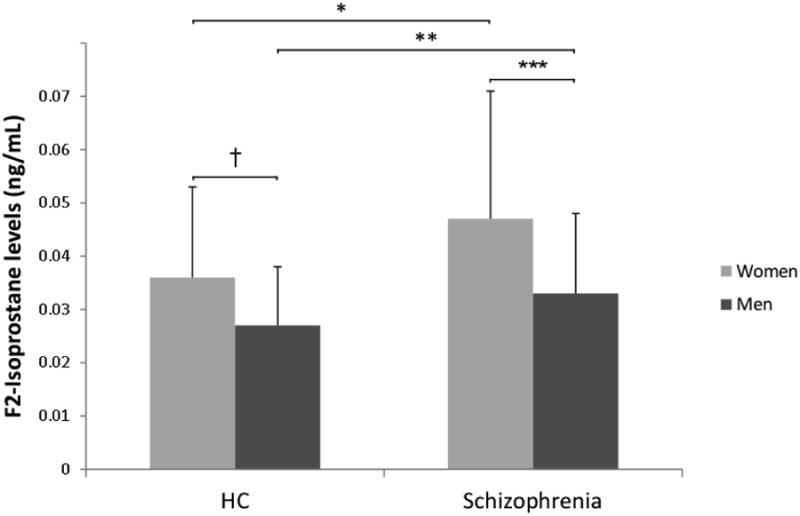
Plasma F2-isoprostane levels were significantly higher in the schizophrenia group than in the HC group. Women had higher F2-isoprostane levels compared to men, and those with higher body mass index (BMI) had higher levels, within each group. F2-isoprostane levels correlated with BMI, physical functioning, and medical comorbidity but not with severity of psychopathology or executive function. Linear models showed significant effects of diagnosis, gender, and BMI on F2-isoprostane levels, but no interactions.
Our finding of increased oxidative stress in schizophrenia is consistent with reports of increased morbidity and mortality as well as accelerated aging in schizophrenia. The significant associations between F2-isoprostane levels and both gender and BMI warrant further study.
精神分裂症是最具致残性的精神障碍之一,其发病率和死亡率都有所增加。精神分裂症和氧化应激都与加速衰老有关。先前的研究发现精神分裂症患者的氧化应激增加,不过只有一项研究测量了F2 -异前列腺素,且是在尿液中进行测量的。据我们所知,本研究是首次评估精神分裂症患者血浆F2 -异前列腺素水平,这是体内系统性氧化应激的公认金标准测量指标。
我们比较了134名病情稳定的精神分裂症门诊患者和120名年龄及性别匹配的健康对照(HC)受试者的血浆F2 -异前列腺素水平。两组均收集了社会人口统计学和临床数据。
精神分裂症组的血浆F2 -异前列腺素水平显著高于HC组。在每组中,女性的F2 -异前列腺素水平高于男性,体重指数(BMI)较高者的水平也更高。F2 -异前列腺素水平与BMI、身体功能和合并症相关,但与精神病理学严重程度或执行功能无关。线性模型显示诊断、性别和BMI对F2 -异前列腺素水平有显著影响,但无交互作用。
我们发现精神分裂症患者氧化应激增加,这与精神分裂症发病率和死亡率增加以及加速衰老的报道一致。F2 -异前列腺素水平与性别和BMI之间的显著关联值得进一步研究。