Xin Hong-Wu, Ambe Chenwi M, Miller Tyler C, Chen Jin-Qiu, Wiegand Gordon W, Anderson Andrew J, Ray Satyajit, Mullinax John E, Hari Danielle M, Koizumi Tomotake, Godbout Jessica D, Goldsmith Paul K, Stojadinovic Alexander, Rudloff Udo, Thorgeirsson Snorri S, Avital Itzhak
1. Surgery Branch, Center for Cancer Research, National Cancer Institute, National Institutes of Health, Bethesda, MD 20892, USA;; 2. Laboratory of Molecular Oncology, Key Laboratory of Carcinogenesis and Translational Research (Ministry of Education), Peking University Cancer Hospital and Institute, Beijing 100142, China;
1. Surgery Branch, Center for Cancer Research, National Cancer Institute, National Institutes of Health, Bethesda, MD 20892, USA;
J Cancer. 2016 Jun 6;7(9):1142-51. doi: 10.7150/jca.10047. eCollection 2016.
BACKGROUND & AIMS: Recently, we reported that liver Label Retaining Cancer Cells (LRCC) can initiate tumors with only 10 cells and are relatively resistant to the targeted drug Sorafenib, a standard of practice in advanced hepatocellular carcinoma (HCC). LRCC are the only cancer stem cells (CSC) isolated alive according to a stem cell fundamental function, asymmetric cell division. Metformin has been reported to preferentially target many other types of CSC of different organs, including liver. It's important to know if LRCC, a novel class of CSC, are relatively resistant to metformin, unlike other types of CSC. As metformin inhibits the Sorafenib-Target-Protein (STP) PI3K, and LRCC are newly described CSC, we undertook this study to test the effects of Metformin on Sorafenib-treated HCC and HCC-derived-LRCC.
We tested various STP levels and phosphorylation status, associated genes' expression, proliferation, viability, toxicity, and apoptosis profiles, before and after treatment with Sorafenib with/without Metformin.
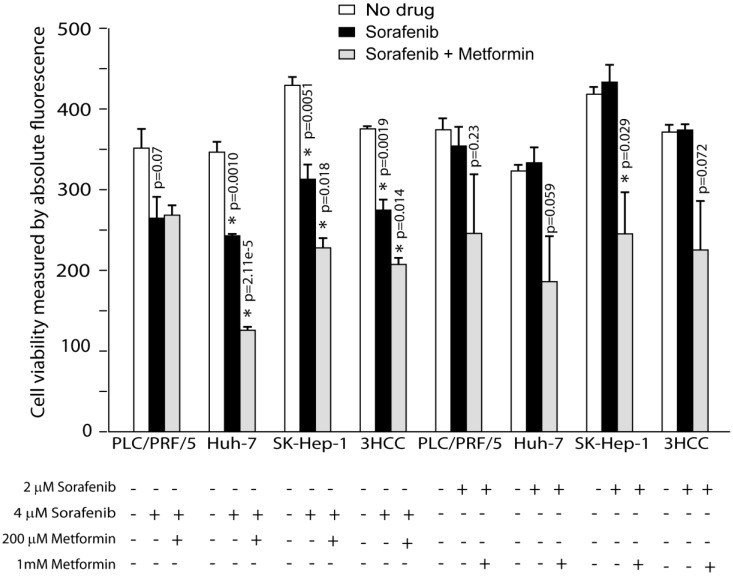
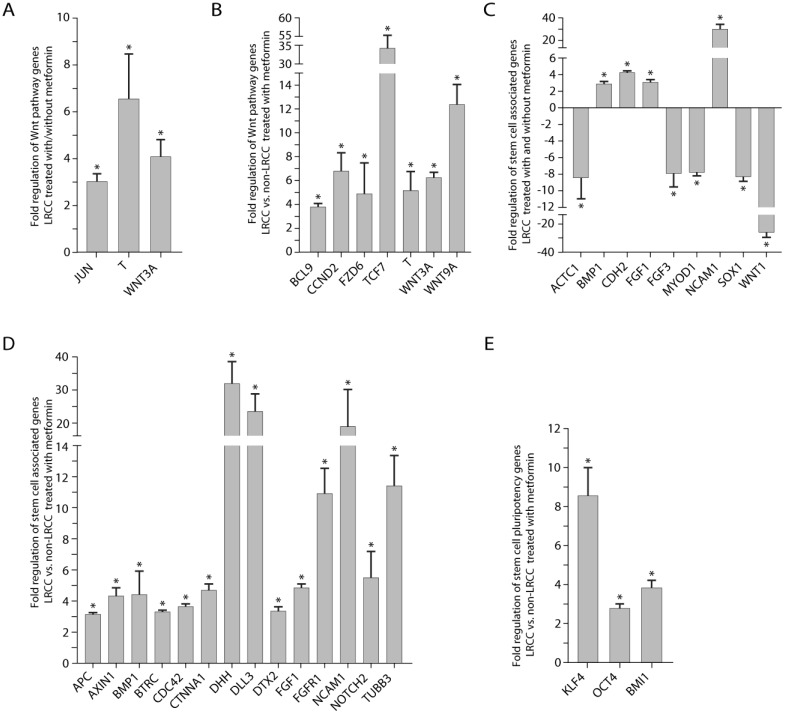
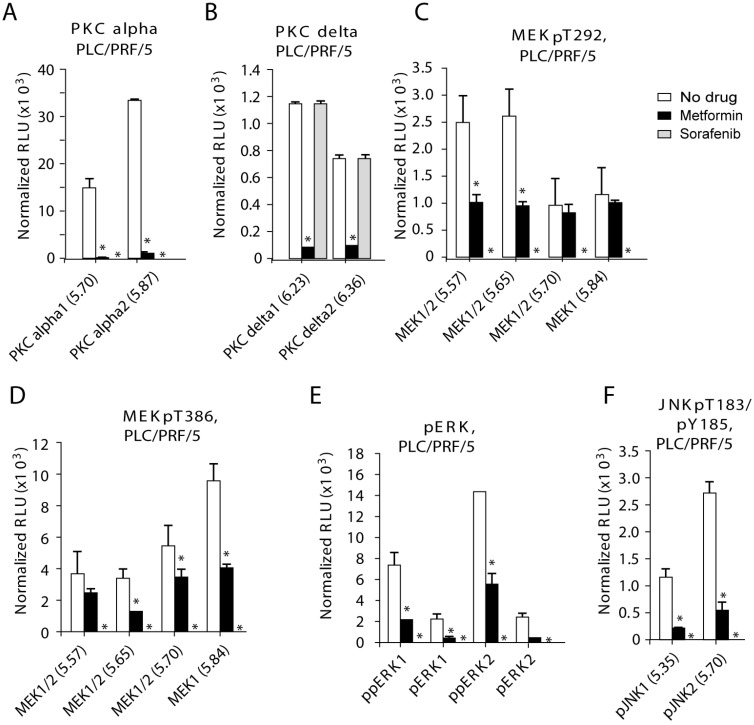
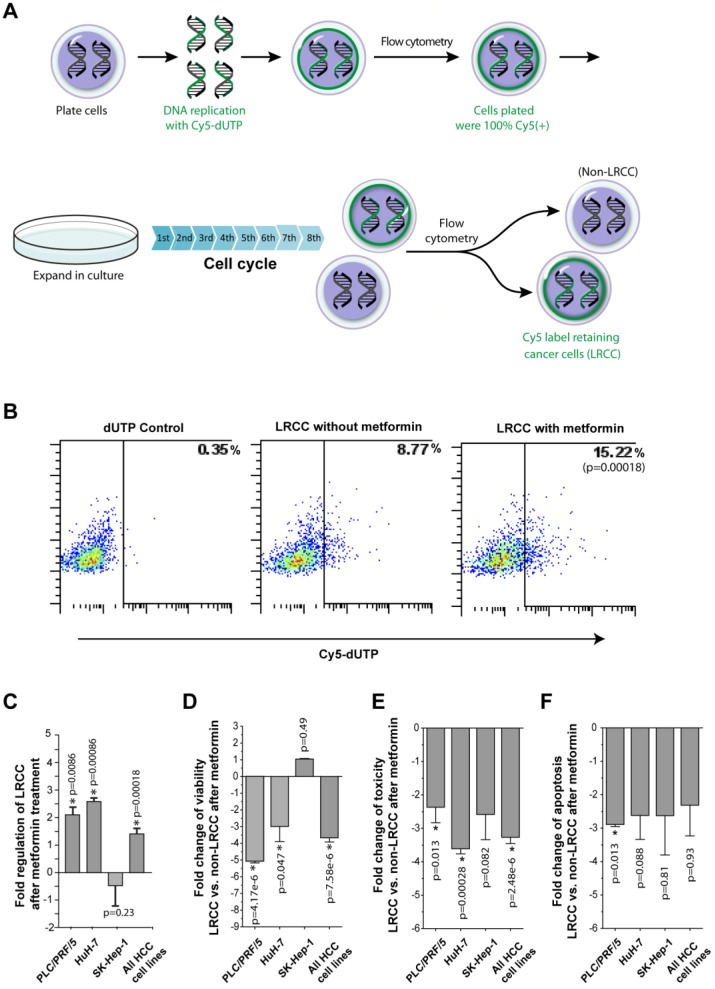
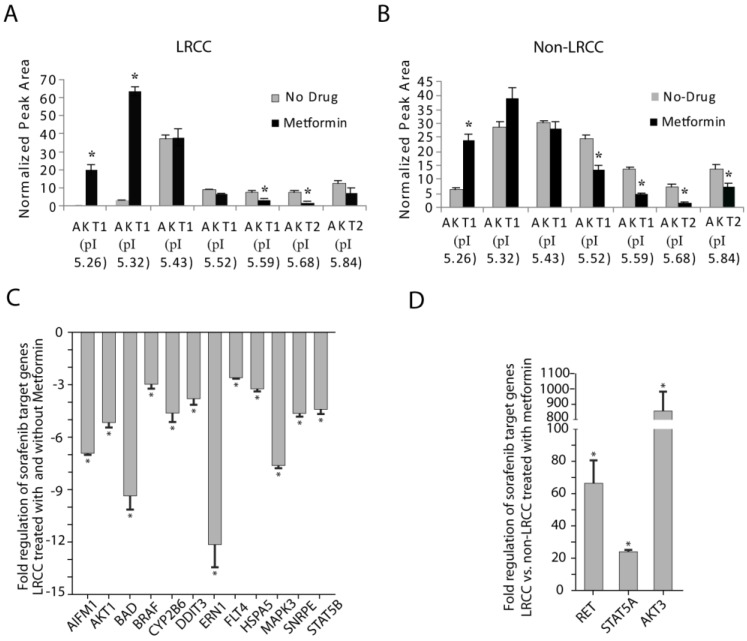
Metformin enhances the effects of Sorafenib on HCC, and significantly decreased viability/proliferation of HCC cells. This insulin-independent effect was associated with inhibition of multiple STPs (PKC, ERK, JNK and AKT). However, Metformin increased the relative proportion of LRCCs. Comparing LRCC vs. non-LRCC, this effect was associated with improved toxicity and apoptosis profiles, down-regulation of cell death genes and up-regulation of cell proliferation and survival genes in LRCC. Concomitantly, Metformin up-regulated pluripotency, Wnt, Notch and SHH pathways genes in LRCC vs. non-LRCC.
Metformin and Sorafenib have enhanced anti-cancer effects. However, in contradistinction to reports on other types of CSC, Metformin is less effective against HCC-derived-CSC LRCC. Our results suggest that combining Metformin with Sorafenib may be able to repress the bulk of tumor cells, but as with other anti-cancer drugs, may leave LRCC behind leading to cancer recurrence. Therefore, liver LRCC, unlike other types of CSC, are relatively resistant to the reported anti-cancer stem cell drug metformin. This is the first report that there is a type of CSC that is not relatively resistant to the CSC-targeting drug. Our findings suggest that a drug targeting LRCC may be critically needed to target CSC and prevent cancer recurrence. These may significantly contribute to the understanding of Metformin's anti-cancer effects and the development of novel drugs targeting the relatively resistant LRCC.
最近,我们报道肝脏标记保留癌细胞(LRCC)仅10个细胞就能启动肿瘤形成,并且对靶向药物索拉非尼具有相对抗性,索拉非尼是晚期肝细胞癌(HCC)的一种标准治疗药物。LRCC是根据干细胞的基本功能——不对称细胞分裂分离出的唯一存活的癌症干细胞(CSC)。据报道,二甲双胍优先靶向包括肝脏在内的不同器官的许多其他类型的CSC。了解LRCC这种新型CSC是否与其他类型的CSC不同,对二甲双胍相对抗性,这一点很重要。由于二甲双胍抑制索拉非尼靶向蛋白(STP)PI3K,且LRCC是新描述的CSC,我们开展了本研究以测试二甲双胍对索拉非尼治疗的HCC和HCC衍生的LRCC的影响。
我们检测了在用或不用二甲双胍的索拉非尼治疗前后各种STP水平和磷酸化状态、相关基因的表达、增殖、活力、毒性和凋亡情况。
二甲双胍增强了索拉非尼对HCC的作用,并显著降低了HCC细胞的活力/增殖。这种不依赖胰岛素的作用与多种STP(PKC、ERK、JNK和AKT)的抑制有关。然而,二甲双胍增加了LRCC的相对比例。比较LRCC与非LRCC,这种作用与LRCC中改善的毒性和凋亡情况、细胞死亡基因的下调以及细胞增殖和存活基因的上调有关。同时,与非LRCC相比,二甲双胍上调了LRCC中的多能性、Wnt、Notch和SHH信号通路基因。
二甲双胍和索拉非尼具有增强的抗癌作用。然而,与关于其他类型CSC的报道相反,二甲双胍对HCC衍生的CSC即LRCC的效果较差。我们的结果表明,二甲双胍与索拉非尼联合使用可能能够抑制大部分肿瘤细胞,但与其他抗癌药物一样,可能会留下LRCC导致癌症复发。因此,肝脏LRCC与其他类型的CSC不同,对已报道的抗癌干细胞药物二甲双胍具有相对抗性。这是首次报道有一种类型的CSC对靶向CSC的药物没有相对抗性。我们的研究结果表明,可能迫切需要一种靶向LRCC的药物来靶向CSC并预防癌症复发。这些可能会显著有助于理解二甲双胍的抗癌作用以及开发靶向相对抗性的LRCC的新型药物。