Zhang Caiguo
Department of Biochemistry and Molecular Genetics, School of Medicine, University of Colorado, Aurora, Colorado, USA.
Genome Integr. 2015 Apr 28;6:2. doi: 10.4103/2041-9414.155953. eCollection 2015.
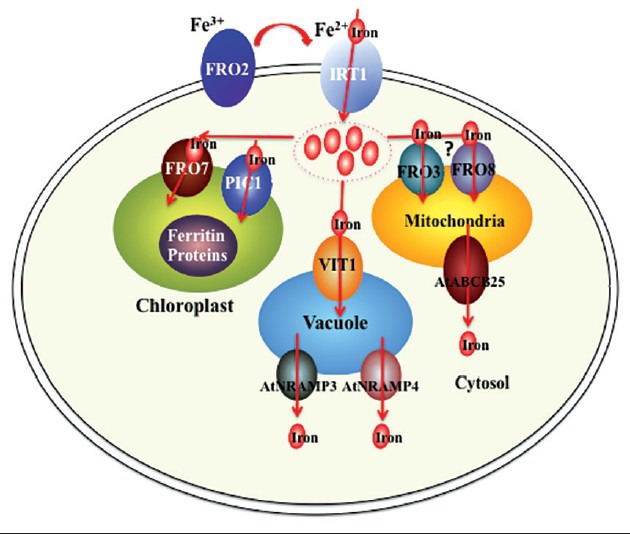
The Arabidopsis genome encodes numerous iron-containing proteins such as iron-sulfur (Fe-S) cluster proteins and hemoproteins. These proteins generally utilize iron as a cofactor, and they perform critical roles in photosynthesis, genome stability, electron transfer, and oxidation-reduction reactions. Plants have evolved sophisticated mechanisms to maintain iron homeostasis for the assembly of functional iron-containing proteins, thereby ensuring genome stability, cell development, and plant growth. Over the past few years, our understanding of iron-containing proteins and their functions involved in genome stability has expanded enormously. In this review, I provide the current perspectives on iron homeostasis in Arabidopsis, followed by a summary of iron-containing protein functions involved in genome stability maintenance and a discussion of their possible molecular mechanisms.
拟南芥基因组编码众多含铁蛋白,如铁硫(Fe-S)簇蛋白和血红素蛋白。这些蛋白通常利用铁作为辅因子,在光合作用、基因组稳定性、电子传递和氧化还原反应中发挥关键作用。植物已经进化出复杂的机制来维持铁稳态,以组装功能性含铁蛋白,从而确保基因组稳定性、细胞发育和植物生长。在过去几年中,我们对含铁蛋白及其在基因组稳定性中的功能的理解有了极大的扩展。在这篇综述中,我阐述了拟南芥中铁稳态的当前观点,接着总结了参与维持基因组稳定性的含铁蛋白功能,并讨论了其可能的分子机制。