Cimini Sara, Gualtieri Carla, Macovei Anca, Balestrazzi Alma, De Gara Laura, Locato Vittoria
Unit of Food Science and Human Nutrition, Campus Bio-Medico University of Rome, Rome, Italy.
Department of Biology and Biotechnology "L. Spallanzani", University of Pavia, Pavia, Italy.
Front Plant Sci. 2019 Aug 2;10:989. doi: 10.3389/fpls.2019.00989. eCollection 2019.
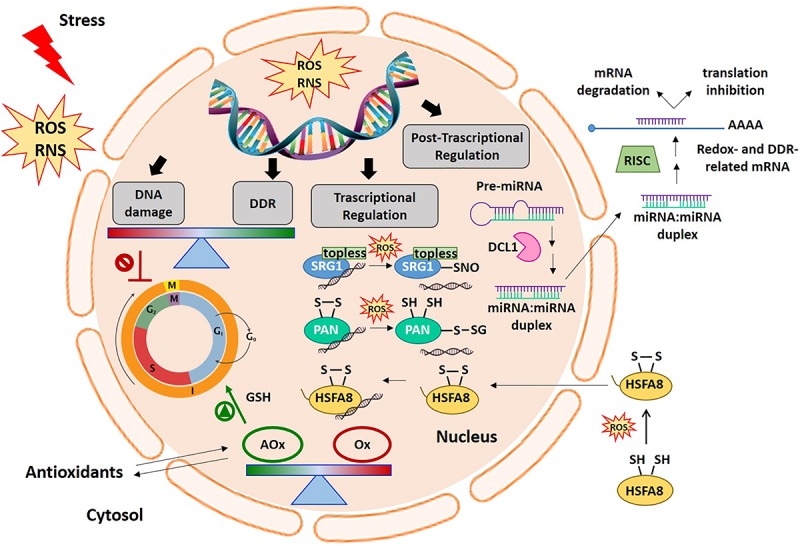
Plants are continuously faced with complex environmental conditions which can affect the oxidative metabolism and photosynthetic efficiency, thus leading to the over-production of reactive oxygen species (ROS). Over a certain threshold, ROS can damage DNA. DNA damage, unless repaired, can affect genome stability, thus interfering with cell survival and severely reducing crop productivity. A complex network of pathways involved in DNA damage response (DDR) needs to be activated in order to maintain genome integrity. The expression of specific genes belonging to these pathways can be used as indicators of oxidative DNA damage and effective DNA repair in plants subjected to stress conditions. Managing ROS levels by modulating their production and scavenging systems shifts the role of these compounds from toxic molecules to key messengers involved in plant tolerance acquisition. Oxidative and anti-oxidative signals normally move among the different cell compartments, including the nucleus, cytosol, and organelles. Nuclei are dynamically equipped with different redox systems, such as glutathione (GSH), thiol reductases, and redox regulated transcription factors (TFs). The nuclear redox network participates in the regulation of the DNA metabolism, in terms of transcriptional events, replication, and repair mechanisms. This mainly occurs through redox-dependent regulatory mechanisms comprising redox buffering and post-translational modifications, such as the thiol-disulphide switch, glutathionylation, and S-nitrosylation. The regulatory role of microRNAs (miRNAs) is also emerging for the maintenance of genome stability and the modulation of antioxidative machinery under adverse environmental conditions. In fact, redox systems and DDR pathways can be controlled at a post-transcriptional level by miRNAs. This review reports on the interconnections between the DDR pathways and redox balancing systems. It presents a new dynamic picture by taking into account the shared regulatory mechanism mediated by miRNAs in plant defense responses to stress.
植物不断面临复杂的环境条件,这些条件会影响氧化代谢和光合效率,从而导致活性氧(ROS)的过量产生。超过一定阈值后,ROS会损伤DNA。DNA损伤若不修复,会影响基因组稳定性,进而干扰细胞存活并严重降低作物产量。为了维持基因组完整性,需要激活一个涉及DNA损伤应答(DDR)的复杂通路网络。属于这些通路的特定基因的表达可作为遭受胁迫条件的植物中氧化DNA损伤和有效DNA修复的指标。通过调节ROS的产生和清除系统来控制ROS水平,可将这些化合物的作用从有毒分子转变为参与植物耐受性获得的关键信使。氧化和抗氧化信号通常在不同的细胞区室之间移动,包括细胞核、细胞质和细胞器。细胞核动态配备有不同的氧化还原系统,如谷胱甘肽(GSH)、硫醇还原酶和氧化还原调节转录因子(TFs)。核氧化还原网络在转录事件、复制和修复机制方面参与DNA代谢的调节。这主要通过包括氧化还原缓冲和翻译后修饰(如硫醇 - 二硫键开关、谷胱甘肽化和S - 亚硝基化)的氧化还原依赖性调节机制发生。在不利环境条件下,微小RNA(miRNA)在维持基因组稳定性和调节抗氧化机制方面的调节作用也正在显现。事实上,氧化还原系统和DDR通路可在转录后水平由miRNA控制。本综述报道了DDR通路与氧化还原平衡系统之间的相互联系。通过考虑miRNA在植物对胁迫的防御反应中介导的共享调节机制,呈现了一幅新的动态图景。