Lu Chung-Yen, Kang Sy-Yuan, Liu Shu-Hui, Mai Cheng-Wei, Tseng Chao-Heng
School of Post-Baccalaureate Chinese Medicine, China Medical University, Taichung 404, Taiwan.
Department of Sport and Health Management, Da-Yeh University, Changhua 515, Taiwan.
Int J Environ Res Public Health. 2016 Jun 20;13(6):612. doi: 10.3390/ijerph13060612.
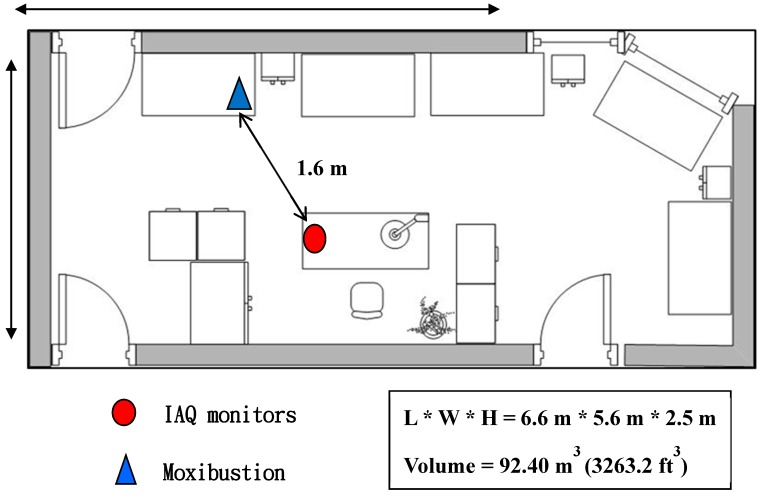
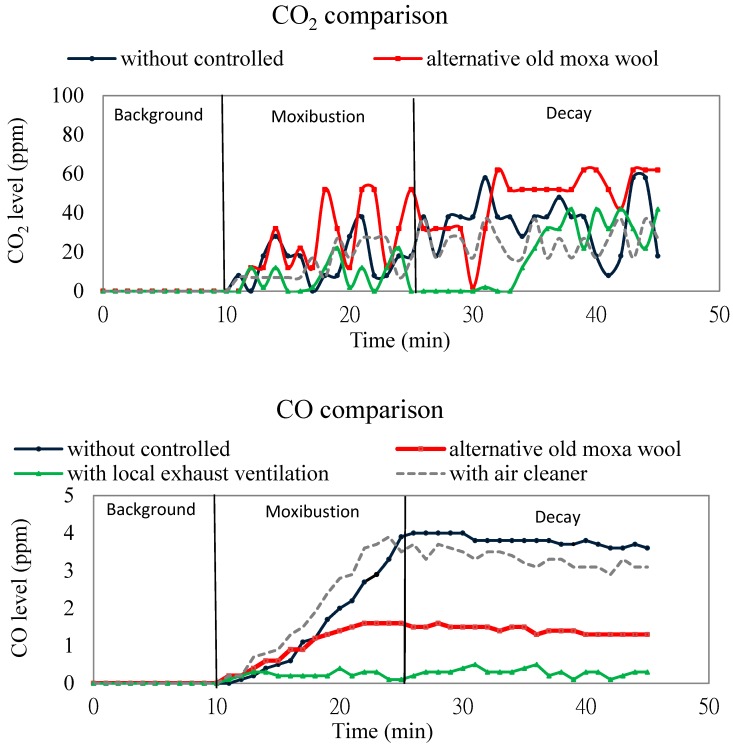
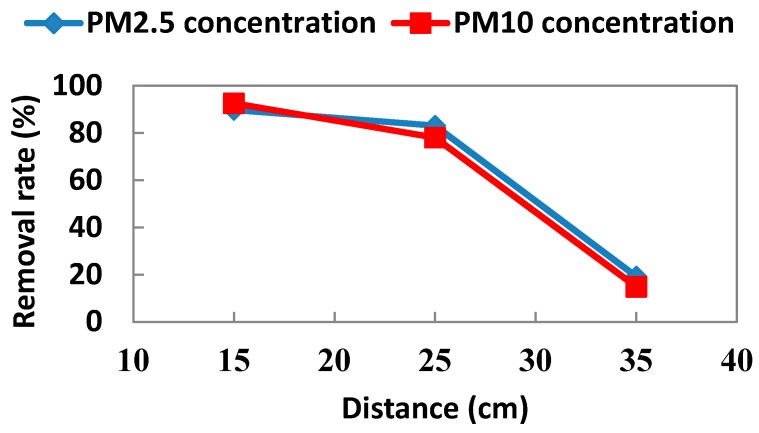
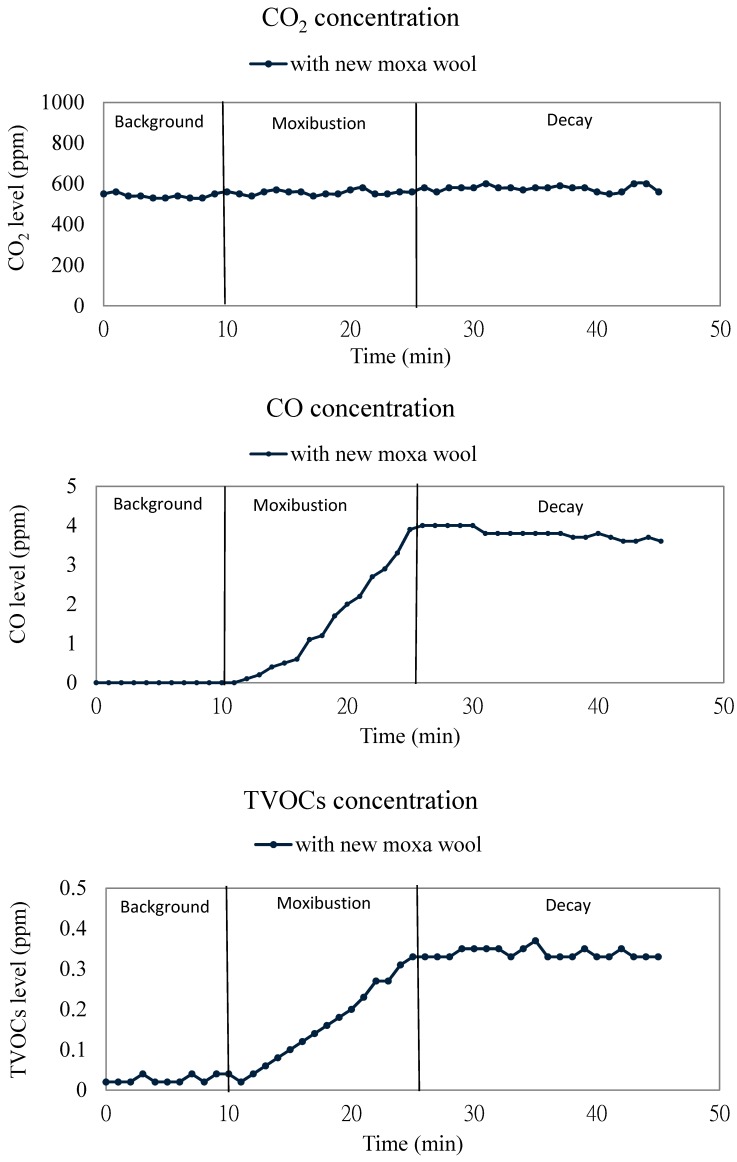
Indoor air quality (IAQ) control of hospitals plays a critical role in protecting both hospital staffs and patients, particularly those who are highly susceptible to the adverse effects of indoor noxious hazards. However, moxibustion in outpatient departments (OPDs) of traditional Chinese medicine (TCM) may be a source of indoor air pollution in hospitals. Some studies have investigated indoor air pollution during moxibustion in Chinese medicine clinics (CMCs) and moxibustion rooms, demonstrating elevated air pollutants that pose a threat to the health of medical staff and patients. Our study investigated the indoor air pollutants of indoor carbon dioxide (CO₂), carbon monoxide (CO), formaldehyde (HCHO), total volatile organic compounds (TVOCs), airborne particulate matter with a diameter of ≤10 µm (PM10) and ≤2.5 µm (PM2.5) during moxibustion in an acupuncture and moxibustion room of the OPD in a hospital in Taipei. To evaluate the different control strategies for indoor air pollution from moxibution, a comparison of air pollutants during moxibution among the methods of using alternative old moxa wools, local exhaust ventilation and an air cleaner was conducted. In this study, burning alternative old moxa wools for moxibustion obviously reduced all gaseous pollutants except for aerosols comparing burning fresh moxa wools. Using local exhaust ventilation reduced most of the aerosols after burning moxa. We also found that using an air cleaner was inefficient for controlling indoor air pollutants, particularly gaseous pollutants. Therefore, combining replacing alternative old moxa wools and local exhaust ventilation could be a suitable design for controlling indoor air pollution during moxibustion therapy.
医院室内空气质量(IAQ)控制对于保护医院工作人员和患者,尤其是那些对室内有害危害的不良影响高度敏感的人起着关键作用。然而,中医门诊部的艾灸可能是医院室内空气污染的一个来源。一些研究调查了中医诊所和艾灸室艾灸过程中的室内空气污染情况,结果表明空气污染物浓度升高,对医护人员和患者的健康构成威胁。我们的研究调查了台北一家医院门诊部针灸艾灸室艾灸过程中室内二氧化碳(CO₂)、一氧化碳(CO)、甲醛(HCHO)、总挥发性有机化合物(TVOCs)、直径≤10微米的空气颗粒物(PM10)和≤2.5微米的空气颗粒物(PM2.5)等污染物情况。为了评估艾灸产生的室内空气污染的不同控制策略,我们对使用替代旧艾绒、局部排风通风和空气净化器等方法在艾灸过程中的空气污染物进行了比较。在本研究中,与燃烧新鲜艾绒相比,燃烧替代旧艾绒进行艾灸明显减少了除气溶胶外的所有气态污染物。使用局部排风通风减少了艾灸燃烧后的大部分气溶胶。我们还发现,使用空气净化器控制室内空气污染物效率低下,尤其是气态污染物。因此,结合使用替代旧艾绒和局部排风通风可能是艾灸治疗过程中控制室内空气污染的合适设计。