Kim Daniel, Griffin Beth Ann, Kabeto Mohammed, Escarce José, Langa Kenneth M, Shih Regina A
Department of Health Sciences, Bouvé College of Health Sciences, Northeastern University, Boston, Massachusetts, United States of America.
Department of Social and Behavioral Sciences, Harvard T.H. Chan School of Public Health, Boston, Massachusetts, United States of America.
PLoS One. 2016 Jun 22;11(6):e0157327. doi: 10.1371/journal.pone.0157327. eCollection 2016.
Much variation in individual-level cognitive function in late life remains unexplained, with little exploration of area-level/contextual factors to date. Income inequality is a contextual factor that may plausibly influence cognitive function.
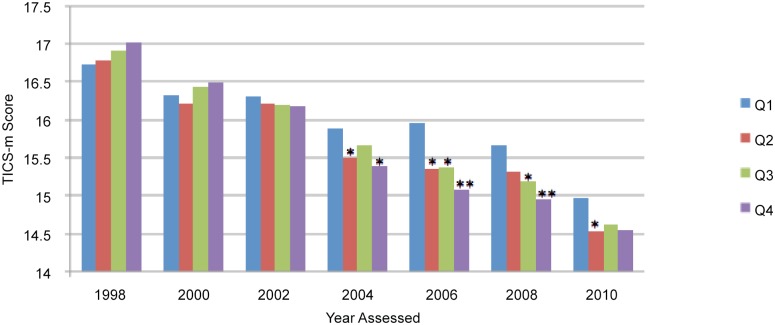
In a nationally-representative cohort of older Americans from the Health and Retirement Study, we examined state- and metropolitan statistical area (MSA)-level income inequality as predictors of individual-level cognitive function measured by the 27-point Telephone Interview for Cognitive Status (TICS-m) scale. We modeled latency periods of 8-20 years, and controlled for state-/metropolitan statistical area (MSA)-level and individual-level factors.
Higher MSA-level income inequality predicted lower cognitive function 16-18 years later. Using a 16-year lag, living in a MSA in the highest income inequality quartile predicted a 0.9-point lower TICS-m score (β = -0.86; 95% CI = -1.41, -0.31), roughly equivalent to the magnitude associated with five years of aging. We observed no associations for state-level income inequality. The findings were robust to sensitivity analyses using propensity score methods.
Among older Americans, MSA-level income inequality appears to influence cognitive function nearly two decades later. Policies reducing income inequality levels within cities may help address the growing burden of declining cognitive function among older populations within the United States.
晚年个体层面认知功能存在很大差异,至今仍未得到充分解释,且对地区层面/背景因素的探索较少。收入不平等是一个可能影响认知功能的背景因素。
在一项来自健康与退休研究的具有全国代表性的美国老年人队列中,我们将州和大都市统计区(MSA)层面的收入不平等作为通过27分认知状态电话访谈(TICS-m)量表测量的个体层面认知功能的预测指标。我们对8至20年的潜伏期进行建模,并控制了州/大都市统计区(MSA)层面和个体层面的因素。
较高的MSA层面收入不平等预示着16至18年后认知功能较低。采用16年的滞后时间,生活在收入不平等最高四分位数的MSA中,预测TICS-m得分低0.9分(β = -0.86;95%置信区间 = -1.41,-0.31),大致相当于与五年衰老相关的幅度。我们未观察到州层面收入不平等的关联。使用倾向得分方法进行敏感性分析时,研究结果具有稳健性。
在美国老年人中,MSA层面的收入不平等似乎在近二十年后影响认知功能。降低城市内部收入不平等水平的政策可能有助于应对美国老年人群体中认知功能下降带来的日益沉重的负担。