Vagelos College of Physicians & Surgeons, Columbia University, New York, NY 10032, USA.
Taub Institute for Research on Alzheimer's Disease and the Aging Brain, Vagelos College of Physicians and Surgeons, Columbia University, New York, NY 10032, USA.
Int J Environ Res Public Health. 2021 Oct 26;18(21):11233. doi: 10.3390/ijerph182111233.
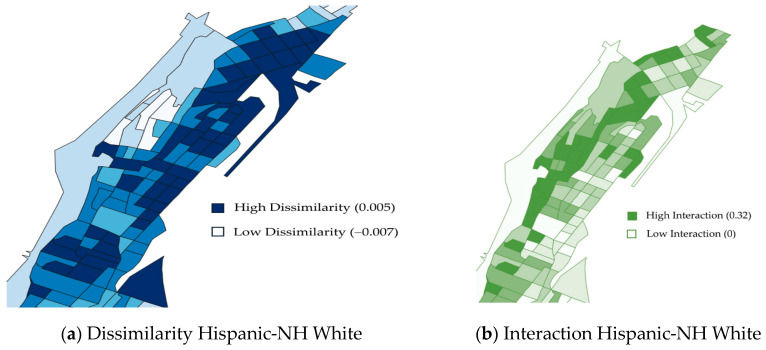
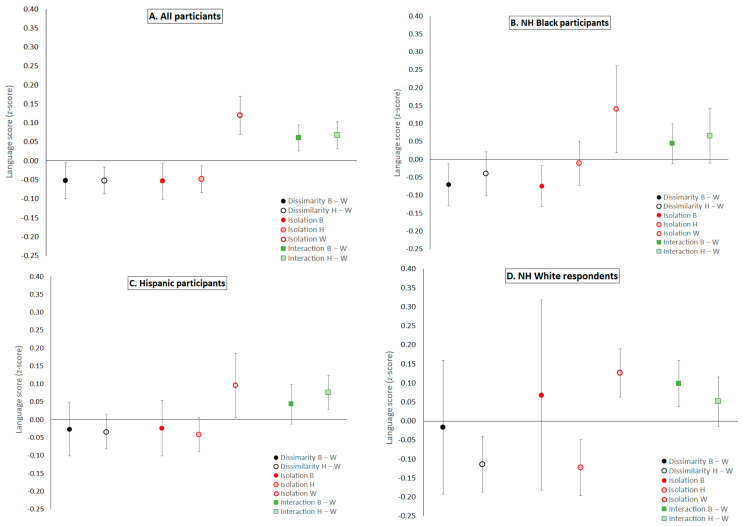
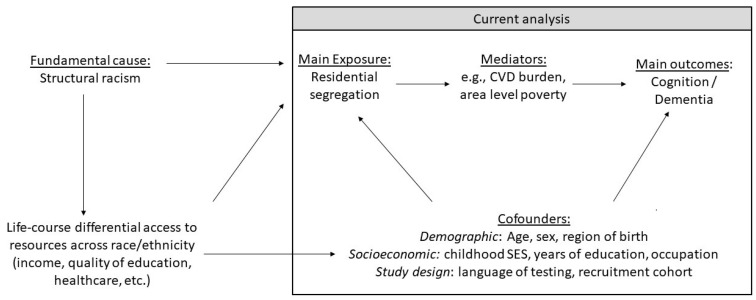
Systemic racism leads to racial/ethnic residential segregation, which can result in health inequities. We examined if the associations between residential segregation and later-life cognition and dementia differed based on segregation measure and by participant race/ethnicity. Tests of memory ( = 4616), language ( = 4333), visuospatial abilities ( = 4557), and incident dementia ( = 4556) were analyzed in older residents of Northern Manhattan, New York (mean age: 75.7 years). Segregation was measured at the block group-level using three indices: dissimilarity, isolation, and interaction. We fit multilevel linear or Cox proportional hazards models and included a race/ethnicity × segregation term to test for differential associations, adjusting for socioeconomic and health factors. Living in block groups with higher proportions of minoritized people was associated with -0.05 SD lower language scores. Living in block groups with higher potential contact between racial/ethnic groups was associated with 0.06-0.1 SD higher language scores. The findings were less pronounced for other cognitive domains and for incident dementia. Non-Hispanic Black adults were most likely to experience negative effects of neighborhood segregation on cognition (language and memory) and dementia. All indices partly capture downstream effects of structural racism (i.e., unequal distributions of wealth/resources) on cognition. Therefore, desegregation and equitable access to resources have the potential to improve later-life cognitive health.
系统性种族主义导致种族/族裔居住隔离,从而导致健康不平等。我们研究了居住隔离与晚年认知和痴呆症之间的关联是否因隔离措施和参与者的种族/族裔而异。在纽约北部曼哈顿的老年居民中,对记忆测试(= 4616)、语言测试(= 4333)、视空间能力测试(= 4557)和新发痴呆症测试(= 4556)进行了分析(平均年龄:75.7 岁)。使用三个指标(不相似性、隔离和相互作用)在街区组层面上测量隔离:少数族裔人群比例较高的街区组与语言得分低 0.05 个标准差有关。与族裔群体之间潜在接触较多的街区组与语言得分高 0.06-0.1 个标准差有关。对于其他认知领域和新发痴呆症,这些发现的程度较低。非西班牙裔黑人成年人最有可能因邻里隔离对认知(语言和记忆)和痴呆症产生负面影响。所有指标都部分反映了结构种族主义(即财富/资源分配不均)对认知的下游影响。因此,去隔离化和公平获得资源有可能改善晚年认知健康。